# Pass the School Entrance Exam
> Generated by All in One SEO Pro v5.0.2, this is an llms-full.txt file, used by LLMs to index the site.
Get Your Child into the School of Your Choice
## Posts
### [Articles on How to Improve Your Child's Learning](https://schoolentranceexam.com/articles/)
**Published:** September 28, 2020
**Author:** Admin
---
### [Breaking Down the CAT4 Assessment](https://schoolentranceexam.com/cat4-assessment/)
**Published:** March 17, 2026
**Author:** Admin
**Content:**
**CAT4 assessments** are a very specific and specialized type of tool which allow schools to independently assess a students abilities. They are generally used in two circumstances but can be used at other points during a child’s schooling – there are various levels available which allow testing at different points in a child’s education.
## When are CAT4 Assessments used?
- To help determine a child’s academic group – generally the results from the CAT4 are used in conjunction with the results from traditional assessments too. Many schools like to use the CAT4 results after KS1 and KS2 to help them with determining a child’s potential.
- As an entry exam which if passed at the appropriate level allows the student to register at the school.
## Purpose of CAT4 Assessments
Normally the purpose of assessments are to determine what a student is learning, has learnt, or as a tool to provide further learning either through the assessment questions themselves or the mistakes they make during the assessment.
The **CAT4** in this aspect is different in the sense it is not about what has or is being learnt but rather about the skills and underlying abilities of the student. These will and do develop over time but generally the results of a **CAT4** provide a good prediction on the future GCSE achievements.
## Developing your Child’s Abilities
**CAT4 assessments** measure the developed abilities of a child in the four areas that are known to make a difference in learning, exam achievement, and ultimately career success – verbal, non-verbal, quantitative and spatial reasoning. The understanding gleaned from these tests indicate success in both national and international examinations but the questions all parents ask is can **CAT4 abilities** of a child be developed and changed.
***Puzzles and games develop cognitive skills***
There is no right or wrong answer to this but I believe nurturing a child in these abilities is key to ensuring all their mentally capacity is developed to its fullest. The age old debate of nature or nurture continues but as parents I believe our job is to ensure our child fulfills their potential and has the opportunity to do so. So actively encouraging a child to arrange shapes and identify patterns may contribute to their performance in **CAT4 assessments** later in life.
These types of thinking games will help prepare our children and ensure they have the fundamental abilities to pick up domain specific knowledge. Spatial ability for instance can be developed somewhat using jigsaw, lego and building blocks – however we are yet to do the research on the effect these games have on a child’s abilities and success later in life. You may want to also check out the page on how to boost these types of skills by clicking [here](https://schoolentranceexam.com/powerful-cat-secrets-to-boost-life-long-success/ "Boost your child's cognitive abilities and performance on the CAT4").
## Four stages of Child Development
There are 4 distinct stages in development of children which we can look to for guidance. These cognitive stages were recognized by a famous scientist Jean Piaget in 1952;
1. **Sensorimotor Stage: Birth to 2 years.** Children are exploring during this stage and learning about the world through their senses and manipulation of objects. It’s not always toys but any object will be fascinating to a child – just make sure its safe and non-toxic.
2. **Preoperational Stage: Ages 2 to 7.** Imagination begins to develop and some children even have imaginary friends or make up stories. Memory develops further and the idea of past and future is understood.
3. **Concrete Operational Stage: Ages 7 to 11.** This is when a child becomes more more aware of external events, their own feelings and the feelings of others. Empathy with other people is developed and an understanding that not everyone agrees with their thoughts and beliefs.
4. **Formal Operational Stage: Ages 11 and above.** Here logic is used to solve problems around them – these are real world problems with real consequences and this age is ever evolving to one of more experiences and maturity.
As you can see above a child simply won’t be able develop certain cognitive skills at an early age. Some intellectual skills simply are not fully understood by a younger child in the same way as a older one. There may be certain areas in which the child excels but overall a younger child is limited in overall cognitive abilities. What can be achieved is simply introducing children to these paradigms and concepts in simple way so when they move to the next stage of development they already have some of the fundamental tools to accurately interpret their new understandings.
## What effects your child’s development?
What effects development?
[Nature or nurture](https://www.simplypsychology.org/naturevsnurture.html#:~:text=Nature%20is%20what%20we%20think,and%20learning%20on%20an%20individual. "Psychology and the debate between nature and nurture") – which is it? Are we born with our abilities or are they nurtured through our environment? (discussed further [here](/improving-cat4-results "Improving your child's CAT4 results")). I’m with the latter and believe that a child will develop their abilities determined on the factors they are exposed to.
There is a tendency to state that children from the same family are all clever but we need to put this into context and determine if their upbringing is actually very similar which is why they turned out the same. To answer the question why one child is bright and his / her siblings are not – the same logic can be applied – this child must have been exposed to a positive influence in his / her environment or had a teacher who took a real interest.
**Categories:** Cognitive Abilities Test
---
### [Time Management to Smash the CAT4 Tests](https://schoolentranceexam.com/time-management-during-the-cat4-tests/)
**Published:** March 17, 2026
**Author:** Admin
**Excerpt:** Time management during any exam is critical to make sure you finish the questions. What you need to know is the actual time for the test. The instructions etc.. instructions and practice items are estimated to take 5-15 minutes and not of any real consequence. It's the actual CAT4 test...
**Content:**
- [How long is the CAT 4 test?](#how-long-is-the-cat-4-test)
- [Breakdown of individual CAT4 test times](#breakdown-of-individual-cat4-test-times)
- [Before the exam](#before-the-exam)
- [During the CAT4 test – stay on track.](#during-the-exam-stay-on-track)
- [Other hints and tips for the CAT4 Test](#other-hints-and-tips-for-exams)
## How long is the CAT 4 test?
Managing your time during the CAT4 test is essential and provide you with some precious seconds for those extra difficult questions. Actual testing time for each of the eight tests lasts between between 8-10 minutes so without a strategy for time management you simply won’t get a chance to focus on those questions that you are most likely to get right. The test battery in total takes approximately 2 hours 15 minutes but actual time in a tests adds up to 72 minutes. Your job is to find the questions you know as quickly as possible, take a best guess to those you don’t know, and use the time saved for those questions you can get right.
## Breakdown of individual CAT4 test times
Instructions and practice items take approximately 5-15 minutes but the **CAT4 test** questions themselves take the following times;
- Figure Classification – 10 mins
- Figure Matrices – 10 mins
- Verbal Classification – 8 mins
- Verbal Analogies – 8 mins
- Number Analogies – 10 mins
- Number Series – 8 mins
- Figure Analysis – 9 mins
- Figure Recognition – 9 mins
## Before the exam
### 1. Know the lay of the land before you start
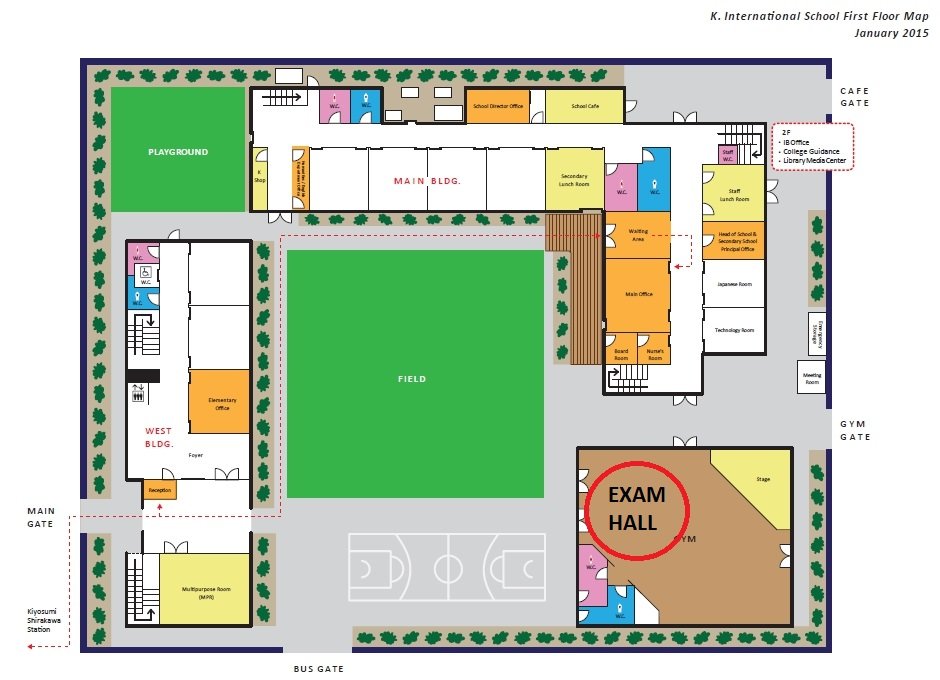*School Map to locate the Exam Hall for CAT4 Test*
You may think this is a given but make sure you and your child know exactly when and where the test is to be held. The worst thing you want is to turn up at the wrong building or worse still the wrong site (if you have a split site school). Everything needs to run as smoothly as possible and that means being fully prepared.
Now there will be 3 parts of the **CAT4** each being broken into two actual tests and each test being between 8-10 minutes. The invigilator (that means a teacher who stops you from teaching) will give instructions – a bit longer during the first test and then allow you to try the example questions.
At this point its worth understanding the exact format of the questions since the practice tests you’ve done although very similar are not exactly the same. These example questions will help you get completely familiar with the environment and may have a few changes due to updates to the interface from the assessment body (GL Assessment).
You are now ready to start the first test. Instructions have been given, you’ve run through example tests, and have a pencil and rough paper. Once you start the clock will start and nothing can stop it !! You have between 8-10 minutes to complete the first **CAT4 test**.
### 2. Writing is no longer an issue but knowing how to use a keyboard and mouse is !!
Rough paper with pencils should also be distributed before the tests.
*Keyboard and mouse skills*
Back when I was a child our hands would tire from the writing of answers during the tests we had. For the CAT4 – and to ease the marking burden for assessors – tests are now online (although paper based tests can be requested). Of course if your child hasn’t ever done online tests it will be shock and leave them severely disadvantaged. If nothing else try the free online test here on this website – [click here](/non-verbal-figure-classification/) – so they at least are aware of what’s coming.
Generation X should generally be comfortable using a computer but again make sure they know how to use a key board and mouse – you’d be surprised how many children only know how to use a smart phone and tablet. Since the tests are all multiple choice knowing how to point a mouse and click is key !!!! I know it sounds silly but make sure your child understands this is how they will be answering the questions.
Using the rough paper is with a pencil for some of the mathematically pattern questions may help your child so again whenever they are running through the practice tests place a paper pad and pencil nearby for them to use.
### 3. Work out how long it takes to understand and answer a question.
We have a good idea of the type of questions that will come up and time is short – between 8-10 minutes. So that’s between 480 and 600 seconds. This really is a race against the clock and you will be lucky to finish. The time constraint is really by design – one of my other posts ([click here](/improving-cat4-results/)) provides a breakdown of what cognitive skills consist of and **brain processing speed** is one of the factors.
One thing I found during my own exam taking – many moons ago – that after confidently answering a question I would spend a moment to celebrate – these few seconds wasted make you feel good but in a **CAT4** test are wasting valuable moments which will come is need when you are presented with another difficult questions.
For each question maximum time taken should be between 24-30 seconds. Easy questions need to be done quickly and accurately without **hesitation and delay** in moving to the next question. If your child has already run through the tests on this site they know that they are working against the clock and need to work fast. Focus, focus, focus – to have to go over the question is valuable time lost but also guessing an answer may not help your final score. Their is a middle ground where you methodically work through each question – mark the answer – and move on. Work like a machine !!!
## During the CAT4 test – stay on track.
### 4. Understand the question – know what’s being asked – read it carefully.
Question by question – step by step to complete
As mentioned in point 3 above you need to be wary of the time and the pace required to complete but on the same hand you need to be as accurate as possible. Each question is a new question – if you get one wrong or are uncertain then make a best guess and move on – don’t dwell on it. The next question is not related to the last and getting the last one wrong doesn’t mean you will get this one wrong.
There is a simple process;
1. Look at the question and understand it taking any rough notes.
2. Systematically – work through the question
3. Any answers which are impossible mentally ignore
4. Keep moving towards the final answer until you have it
5. Click on the answer and move to the next question
6. Start again and keep doing this until all the questions are complete
7. If you have any time review the questions you missed
Now there are times when you don’t know the answer in these circumstances try to reduce the number of answers by ruling out those answers which it simply cannot be. So rather than guessing from 4 questions (25% probability of guessing correct) if you cross off two answers you will be guessing from 2 answers (50% probability of guessing correctly). Improving your chances in this way will help you get the highest mark possible – and avoid over analysis of the questions and answers.
### 5. Have checkpoints during the exam to break it up and keep on track
In any exam you need to have checkpoints to make sure you’re on track to finish ! The CAT4 is no different and with the clock ticking on the screen it’s difficult to ignore. At the half way mark (4 minutes or 5 minutes) make sure you’re at least half, I personally like to be ahead to give me a few extra seconds for those more difficult questions which always seem to turn up towards the end of an exam.
Also if you are ahead it gives you an opportunity to take extra care and spend a little more time on those more difficult questions allowing you to get a higher overall score. Like I said before each question is a mark in its own right so whenever you move on forget about the last question. Cognitive tests in generally will not progressively get more difficult.
Time is of the Essence in CAT4 Exams
Students are all different so how you exactly structure the time is entirely up to you but make sure you aim to finish and make sure you don’t miss any questions out. Take a “guesstimate” if that’s all you can – rule out answers which are impossible to improve your chances but be quick – brain processing speed, focus, memory and problem solving skills all influence your cognitive ability. Improving any of these factors will help you not only in the **CAT4 test** but also in your academic work.
### 6. Don’t miss any questions – always answer the question
CAT4 tests aren’t like traditional tests where you have difficult questions, essay questions etc… each question is a mark in its own right and (as far as I understand) carry a similar weighting. Trying to leave harder questions until later is simply not possible due to time constraints and this type of traditional strategy may leave you with a lot of unanswered questions.
The tests on this site and the sample questions during the test all help you to become acquainted with the format so you don’t need to think to much about the format. It is much better to answer each question as quickly as possible, or take a best guess. It’s highly unlikely you will have time to come back and answer the question.
In normal exams my approach would be very similar but I would mark the questions that I took a guess on and return to them to double check. This would mean that I always completed the questions but also allow me to return to questions which I wasn’t sure of. Since the CAT4 test is so short just stay focused and answer each question as quickly as you can taking best guesses where appropriate.
### 7. Freezing on a question and going blank…
With cognitive abilities test its not about what you have learnt but rather about the skills you have developed. Each question is different but use skills similar to the ones in that particular test. There are times when the question looks so complex or you approach the question use a particular method and fail to get a result.
If it looks complex – choose and approach and systematically work your way through the steps to come to an answer. It’s great when this works out the first time and you have an answer but there are times when you need to repeat the above several times before getting to a conclusion. This wastes valuable time but it’s impossible to know on the outset exactly which approach will work – the best thing is to be methodical and quick and if you feel overwhelmed break it down so you can at the very least cross some of the answers off so you can make a better guess.
## Other hints and tips for the CAT4 Test
### 9. Make sure you use all the time allocated
It’s highly unlikely you’ll have any time to spare but if you do quickly review all the questions especially ones you were unsure of. This is a chance to scrape another couple of marks. USE ALL the time DO NOT finish early.
### 8. Cramming doesn’t work !
Unlike normal exams there is not a lot you can do in terms of cramming – the tests on this site are enough to practice on ([click here](/non-verbal-figure-classification/ "Non-Verbal Figure Classification")). Subject matter is not what’s being tested here – see my post on this by clicking [here](https://schoolentranceexam.com/why-subject-knowledge-doesnt-matter-in-a-cat-test/ "Subject Matter and cognitive testing").
Let us know your thoughts. Any ideas for helping to develop cognitive skills let me know.
**Categories:** Cognitive Abilities Test
---
### [Realistic CAT4 Practice Tests – Level D & E (2026)](https://schoolentranceexam.com/cat4-practice-tests-level-d-level-e-2025/)
**Published:** July 5, 2026
**Author:** Admin
**Content:**
[CAT4 PRACTICE TEST](/practice-cat4-tests/)
*One of the most important things a parent can do is to provide a child with the tools with which to achieve his or her potential.*
## What is the CAT4 Test?
The **Cognitive Abilities Test (CAT4)** is used as an admission test by top private and grammar schools in the UK and beyond. It assesses a student’s reasoning abilities and intelligence across a number of domains: **Verbal, Non-Verbal, Quantitative, and Spatial**. Your child’s performance when sitting a CAT4 will determine their chances of admission to some of the best schools in the UK and internationally.
## What Levels Are Offered?
This site offers Level A all the way to Level F – [click here ](https://schoolentranceexam.com/cat4-levels/ "CAT4 Levels")for a breakdown. Most children are tested at the end of primary school or the first year of secondary school so the most used tests are Level D and Level E.
### **CAT4 Level D Practice Tests**
Ideal for students aged **10 to 11** (Year 6 in the UK).
👉 [Explore Level D Tests](https://schoolentranceexam.com/cat4-level-d-year-7-tests/ "Level D CAT4 Test")
### **CAT4 Level E Practice Tests**
Ideal for students aged **11 to 12** (Year 7 in the UK).
👉 [Explore Level E Tests](https://schoolentranceexam.com/cat4-level-e-year-8-tests/ "CAT4 Level E")
### What’s Inside the CAT4 Practice Packs?
Each pack includes:
- ✏️ Timed test sections (Verbal, Non-Verbal, Quantitative, Spatial)
- 🔍 Full explanations and worked answers (where applicable)
- 📈 Progress tracking
- 🛡️ Unlimited re-attempts for mastery
## What Parents Say:
> ⭐⭐⭐⭐⭐
> “The only site that prepared my son properly for the CAT4. The questions were *exactly like the real test*. Highly recommend!” – **Amira S.**
> ⭐⭐⭐⭐⭐
> “Far more realistic than other websites. Great value and brilliant support team!” – **James T.**
>
> ### Are you ready to help your child Get Started?
>
> Choose your level:
>
> LevelAge GroupActionCAT4 Level D10–11 (End of Year 6)🔗 [Start Now](https://schoolentranceexam.com/cat4-level-d-year-7-tests/ "CAT4 Practice for Year 7")CAT4 Level E11–12 (End of Year 7)🔗 [Start Now](https://schoolentranceexam.com/cat4-level-e-year-8-tests/ "Year 8 CAT4 Practice")
## Why Choose US?
✔️ Realistic questions based on actual CAT4 Level D and E standards
✔️ Affordable pricing – excellent value for money
✔️ Instant feedback, score, and analytical reports
✔️ Trusted by parents, tutors, and top-performing students
✔️ Expert, responsive support team to assist you
### Frequently Asked Questions
**Q: Are your tests like the real CAT4?**
A: Yes. They are built to match CAT4 levels in format, difficulty, and structure.
**Q: Are these tests suitable without supervision?**
A: Absolutely. For older children the tests and online system are quite east to use. The questions are straightforward. For younger children you may need to help initially.
**Q: How many times can my child take the test?**
A: Unlimited attempts – ideal for revision and confidence-building.
**Q: Can I analyse how my child is performing?**
A: There are two reports which are useful the test history reports and an analysis of the tests which uses an average of the results to indicate if there has been improvement or not.
[CAT4 PRACTICE TEST](/practice-cat4-tests/)
**Categories:** Cognitive Abilities Test, Year 7 Apptitude Tests
---
### [How to Prepare for the CAT4 Test](https://schoolentranceexam.com/cat4-test-preparation/)
**Published:** February 4, 2026
**Author:** Admin
**Content:**
## A Comprehensive Guide for Parents and Students
*Master the CAT4 Test with Realistic Practice!*
The Cognitive Abilities Test ([CAT4](https://en.wikipedia.org/wiki/Cognitive_Abilities_Test "CAT4 Wikipedia information page ")) is a widely used assessment designed to measure a student’s reasoning abilities and academic potential. It is commonly administered by schools for admissions, placement, and identifying strengths and weaknesses in students. Preparing for the CAT4 test can seem daunting, but with the right strategies and resources, students can approach the test with confidence and achieve their best possible results.
In this guide, I’ll be walking you through everything you need to know about the CAT4 test – its structure, key focus areas, along with actionable tips for effective preparation. Whether your child is in Year 4 doing the [CAT4 Level A](https://schoolentranceexam.com/cat4-level-a-year-4-tests/) test or [CAT4 Level E](https://schoolentranceexam.com/cat4-level-e-year-8-tests/ "CAT4 Level E Year 8 Practice Test") for high school or even a higher level for college or sixth form, this article will provide the basics you will need to help them do the very best they can.
## What Is the CAT4 Test?
The test is a non-academic test that assesses a student’s cognitive abilities across four key areas:
1. **Verbal Reasoning**: Measures language-based reasoning skills.
2. **Non-Verbal Reasoning**: Evaluates problem-solving using shapes and patterns.
3. **Quantitative Reasoning**: Tests numerical and logical thinking.
4. **Spatial Reasoning**: Assesses the ability to visualize and manipulate objects in space.
These cognitive areas are assessed using eight sub-tests, with each focusing on a specific skill. It is designed to identify a student’s potential rather than their current academic knowledge, making it a valuable tool for schools to understand how a student might perform in the future.
## Why Is Preparation Important for the CAT4 Test?
This admissions test is not curriculum-based, so the approach to preparation is different but still required for several reasons:
- **Familiarity with the Test Format**: Understanding the structure and types of questions can reduce anxiety and improve performance.
- **Time Management**: The CAT4 is a timed test, so practicing under similar conditions helps students learn to work efficiently.
- **Identifying Weaknesses**: Preparation allows students to identify areas where they may need extra support, such as verbal or spatial reasoning.
- **Building Confidence**: Familiarity with the test content and format can boost a student’s confidence, helping them perform to the best of their abilities.
---
## How to Prepare for the CAT4 Test
### 1. Understand the Test Structure
The first step in preparing for the CAT4 test is to understand its structure. The test is divided into four sections, each with two sub-tests:
- **Verbal Reasoning**:
- [Verbal Classification](https://schoolentranceexam.com/verbal-classification/ "CAT4 Verbal Classification Practice Test"): Identify relationships between words.
- [Verbal Analogies](https://schoolentranceexam.com/verbal-analogies/ "CAT4 Verbal Analogies Practice Test"): Recognize patterns and connections in language.
- **Non-Verbal Reasoning**:
- [Figure Classification](https://schoolentranceexam.com/non-verbal-figure-classification/ "CAT4 Non-verbal Figure Classification Practice Test"): Identify similarities and differences between shapes.
- [Figure Matrices](https://schoolentranceexam.com/non-verbal-figure-matrices/ "CAT4 Non-verbal Figure Matrices Practice Test"): Solve visual puzzles using logical reasoning.
- **Quantitative Reasoning**:
- [Number Analogies](https://schoolentranceexam.com/numerical-analogies/ "CAT4 Number Analogies Practice Test"): Recognize numerical patterns and relationships.
- [Number Series](https://schoolentranceexam.com/numerical-series/ "CAT4 Numerical Series Practice Test"): Complete number sequences using logical reasoning.
- **Spatial Reasoning**:
- [Figure Analysis](https://schoolentranceexam.com/non-verbal-figure-analysis/): Visualize and manipulate shapes.
- [Figure Recognition](https://schoolentranceexam.com/non-verbal-figure-recognition/ "CAT4 Non-Verbal Figure Recognition Practice Test"): Identify hidden shapes within complex designs.
Each sub-test is timed, so students must work quickly and accurately.
### 2. Use High-Quality Practice Materials
Investing in high-quality practice materials is one of the most effective ways to prepare for the test. Look for resources that:
- Mirror the actual test format and difficulty level.
- Include detailed explanations for answers.
- Offer timed practice tests to simulate real exam conditions.
Our **CAT4 Ultimate Practice Test** series is specifically designed to provide students with realistic practice questions and comprehensive explanations, making it an invaluable resource for test preparation.
### 3. Focus on Weak Areas
Every student has unique strengths and weaknesses. Use practice tests to identify areas where your child may need extra support. For example:
- If your child struggles with verbal reasoning, focus on building vocabulary and practicing word relationships.
- If spatial reasoning is a challenge, use puzzles and visual exercises to improve their skills.
### 4. Practice Time Management
The CAT4 test is timed, so practicing under similar conditions is essential. Encourage your child to complete practice tests within the allotted time to build their speed and accuracy. This will help them feel more comfortable on test day.
### 5. Create a Study Schedule
Consistency is key when preparing for the test. Create a study schedule that includes regular practice sessions, focusing on different sections of the test. Break down the preparation into manageable chunks to avoid overwhelming your child.
### 6. Encourage a Growth Mindset
Help your child approach the test with a positive attitude. Emphasize that the test is an opportunity to showcase their abilities and that preparation is about improvement, not perfection. A growth mindset can reduce anxiety and boost confidence.
## Tips for the CAT4 Test Day
On the day of the CAT 4 test, ensure your child is well-rested and has a healthy breakfast. Remind them to:
- Read each question carefully.
- Manage their time wisely and not spend too long on any one question.
- Stay calm and focused throughout the test.
---
## Benefits of Using Our CAT4 Ultimate Practice Test
Our **CAT4 Ultimate Practice Test** is one of the most comprehensive resources available for CAT4 preparation. Here’s why it’s the best choice for your child:
- **Realistic Practice Questions**: Designed to match the difficulty and style of the actual CAT4 test.
- **Detailed Explanations**: Clear explanations for every question to help your child understand the reasoning behind the answers.
- **Timed Practice Tests**: Simulate real test conditions to build confidence and improve time management.
- **Progress Tracking**: Monitor your child’s performance and identify areas for improvement.
---
## Frequently Asked Questions About the CAT4 Test
**Q: What age group is the CAT4 test for?**
A: The test is designed for students aged 6 to 17 and is divided into different levels, such as Level A for Year 4 entry.
**Q: How long does the CAT4 test take?**
A: The test typically takes about 2 hours, including breaks between sections.
**Q: Can my child retake the CAT4 test?**
A: Retakes are generally not allowed, so thorough preparation is essential.
**Q: What scores are considered good on the CAT4 test?**
A: Scores are measured using SAS (Standard Age Scores), with 100 being the average. A score above 110 is considered above average.
## Final Word on the CAT4
Preparing for the CAT 4 test doesn’t have to be stressful. With the right resources and strategies, your child can approach the test with confidence and achieve their best possible results. Our **CAT4 Ultimate Practice Tests** provides everything your child needs to succeed, from realistic practice questions to detailed explanations and timed tests.
Start preparing today and give your child the tools they need to excel on the CAT4 test!
[CAT4 PRACTICE TEST](/practice-cat4-tests/)
**Categories:** Cognitive Abilities Test
---
### [How Kevin Improved His CAT4 Score: A Step-by-Step Guide to Success](https://schoolentranceexam.com/cat4-success/)
**Published:** February 28, 2026
**Author:** Admin
**Content:**
- [Kevin’s CAT4 Journey: From Struggles to Success](#aioseo-kevins-cat4-journey-from-struggles-to-success)
- [Key Strategies That Helped Kevin Succeed in the CAT4](#aioseo-key-strategies-that-helped-kevin-succeed-in-the-cat4)
- [The Result: A Dramatic CAT4 Score Improvement](#aioseo-the-result-a-dramatic-cat4-score-improvement)
- [Boost Your Child’s CAT4 Score Today!](#aioseo-boost-your-childs-cat4-score-today)
- [1. Identify Weaknesses and Focus on Them](#aioseo-1-identify-weaknesses-and-focus-on-them)
- [2. Use Realistic Practice Materials](#aioseo-2-use-realistic-practice-materials)
- [3. Develop Problem-Solving Skills](#aioseo-3-develop-problem-solving-skills)
- [4. Practice Under Timed Conditions](#aioseo-4-practice-under-timed-conditions)
- [5. Learn Elimination Strategies](#aioseo-5-learn-elimination-strategies)
- [6. Review Mistakes and Learn from Them](#aioseo-6-review-mistakes-and-learn-from-them)
- [7. Stay Consistent and Motivated](#aioseo-7-stay-consistent-and-motivated)
- [Start Preparing Today!](#aioseo-start-preparing-today)
- [Why Choose SchoolEntranceExam.com?](#aioseo-why-choose-schoolentranceexam-com)
Are you looking for proven strategies to help your child improve their CAT4 score? Meet Kevin, a past user of the schoolentranceexam.com website, and a student who transformed his CAT4 performance in just 20 days! Find out how he did it and how you can achieve similar success for your child.
### **Kevin’s CAT4 Journey: From Struggles to Success**
Kevin’s first attempt at the **CAT4 test** faced significant challenges particularly in unfamiliar areas like **spatial reasoning**. Verbal skills and even mathematics were taught in school and Kevin’s abilities were strong. CAT4 is not just about memorization rather it’s about developing your child’s **critical thinking** and **problem-solving skills**. Kevin and his parents were determined to improve Kevin’s scores. They focused on targeted preparation and consistent practice and fully supported Kevin every step of the way.
### **Key Strategies That Helped Kevin Succeed** in the CAT4
*CAT4 Preparation Works – Kevin After Passing*
1. **Targeted Regular Practice for Weaker Areas**
Kevin identified his weaknesses from the scores of his first attempt—spatial reasoning and number sequences were the lowest—he then focused on improving them. and used a variety of tools ranging from **jigsaw puzzles**, **logic games**, and **math problems** to build up his skills.
2. **Realistic CAT4 Practice Questions**
Kevin’s parents knew he required realistic questions to practice on so they decided to pay for the **[SchoolEntranceExam.com](https://www.schoolentranceexam.com/)**, a trusted resource for **CAT4 practice tests**. These questions mirrored the actual exam and familiarized Kevin with the format and question types.
3. **Timed Mock Tests**
Real exam condition practice is a must, so Kevin practiced with **timed mock tests** to simulate the real thing. This helped get a handle on his **time management** and stay calm under pressure.
4. **Logical Problem-Solving and Elimination Strategies**
Kevin learned to break down complex problems step-by-step and use **elimination strategies** to narrow down the answer. This approach boosted his accuracy and confidence.
5. **Reviewing Mistakes**
After each practice session, Kevin reviewed his mistakes to understand where he went wrong. This turned his weaknesses into strengths over time. This last step is key to improvement and can accelerate your development possible by 10 fold compared to the school system.
### **The Result: A Dramatic CAT4 Score Improvement**
After **20 days of focused preparation** (more like 10 !), Kevin achieved a **significant score improvement** from the previous year. His hard work paid off— and he was accepted into one of the best schools in the country !
### **Boost Your Child’s CAT4 Score Today!**
Follow Kevin’s proven CAT4 improvement strategies and start practicing — we have some of the most accurate and challenging CAT4 resources available. With realistic practice questions, timed mock tests, and expert feedback on each question, your child can achieve their best possible score.
Kevin’s journey to improving his CAT4 score is a great example of how targeted preparation and consistent practice can lead to progress. Here’s a breakdown of the key strategies that helped Kevin succeed, you can also apply these to not just boost your child’s CAT4 performance but performance in any subject:
### **1. Identify Weaknesses and Focus on Them**
Kevin recognized spatial reasoning and number sequences were his worst scoring areas. By focusing on these, he was able to spend more time improving these specific skills.
**Actionable Tip:** Always worth taking a diagnostic test or reviewing past performance to determine which types of questions your child finds challenging. Focus on those areas first.
### **2. Use Realistic Practice Materials**
Kevin used **SchoolEntranceExam.com** to access realistic CAT4 practice questions that mirrored the actual test. This helped a lot and made him become familiar with the format, question types, and difficulty level.
**Actionable Tip:** Invest in high-quality resources that accurately reflect the real CAT4 exam. This will build confidence and reduce surprises on test day.
### **3. Develop Problem-Solving Skills**
Kevin worked on puzzles, jigsaws, and mathematical problems to strengthen his logical thinking and spatial reasoning abilities. These activities support his practice and helped him approach questions more strategically.
**Actionable Tip:** Brain-training activities like Sudoku, pattern recognition games, and logic puzzles are key but need to be focused on your child to enhance the cognitive skills that are weakest – or even further strengthen skills.
### **4. Practice Under Timed Conditions**
Kevin took timed mock tests to simulate real exam conditions. Being as realistic as possible is the only way you can determine how your child will react and how to manage time effectively while staying calm under pressure. Under pressure the first thing to go is logical and critical thinking skills.
**Actionable Tip:** Regularly practice timed sessions to help your child become used to answering questions quickly and accurately under pressure.
### **5. Learn Elimination Strategies**
Kevin improved his score by breaking down problems logically and using elimination techniques to narrow down answer choices. Your child’s job is to work out the most likely answer not just work out the answer – sometimes a process of elimination works.
**Actionable Tip:** Teach your child to obviously wrong answers first – this will increase their odds of selecting the correct option.
### **6. Review Mistakes and Learn from Them**
After each practice session, Kevin reviewed his mistakes on the CAT4 subtest to better understand where he went wrong and how to avoid similar errors in the future when presented with a similar question.
**Actionable Tip:** Creating a “mistake journal” is a great way to to track and analyze errors. This helps turn weaknesses into strengths over time.
### **7. Stay Consistent and Motivated**
Kevin dedicated just 20 days to focused preparation, but even though he remained consistent and motivated throughout he admitted it was probably more like 10 days! His hard work paid off with a significant score improvement – it doesn’t take much to get a boost but discipline is key.
**Actionable Tip:** Set small, achievable goals to keep your child motivated.
### **Start Preparing Today!**
Like Kevin, your child can achieve a higher CAT4 score with the right approach and resources. Use the **[SchoolEntranceExam.com](https://www.schoolentranceexam.com/)** platform to access realistic CAT4 practice questions, timed mock tests, and expert feedback to help your child succeed.
---
### **Why Choose SchoolEntranceExam.com?**
- **Accurate CAT4 Practice Questions** that mirror the real test
- **Timed Mock Tests** to build exam confidence
- **Targeted Strategies** to improve weak areas
- **Proven Results**—just like Kevin’s success story!
**Categories:** Cognitive Abilities Test
---
### [What Type of Questions are in a CAT4 Test?](https://schoolentranceexam.com/what-type-of-questions-are-in-a-cat4-test/)
**Published:** December 21, 2024
**Author:** Admin
**Content:**
## What are Cognitive Abilities?
Cognitive abilities are the fundamental building blocks of all other skills. There are various paradigms out there but the ones the CAT4 focuses on are essential to predict future performance, particularly during GCSEs and A-Levels.
The CAT4 assesses four different cognitive areas:
- Verbal Reasoning (VR)
- Non Verbal Reasoning (NVR)
- Quantitative Reasoning (QR)
- Spatial Awareness (SA)
And uses **8 individual tests.** The tests are between 8-10 minutes and consist of the following;
- [Non-Verbal Figure Classification](https://schoolentranceexam.com/non-verbal-figure-classification/ "Learn about Non-Verbal Figure Classification for school entrance exams")
- [Non-Verbal Figure Analysis](https://schoolentranceexam.com/non-verbal-figure-analysis "Explore Non-Verbal Figure Analysis techniques for school entrance exams")
- [Non-Verbal Figure Matrices](https://schoolentranceexam.com/non-verbal-figure-matrices "Understand Non-Verbal Figure Matrices with detailed examples")
- [Non-Verbal Figure Recognition](https://schoolentranceexam.com/non-verbal-figure-recognition "Master Non-Verbal Figure Recognition skills for assessments")
- [Numerical Analogies](https://schoolentranceexam.com/numerical-analogies/ "Practice Numerical Analogies for cognitive and school entrance tests")
- [Numerical Series](https://schoolentranceexam.com/numerical-series/ "Enhance your skills in Numerical Series for entrance exams")
- [Verbal Analogies](https://schoolentranceexam.com/verbal-analogies/ "Improve your Verbal Analogies proficiency for tests")
- [Verbal Classification](https://schoolentranceexam.com/verbal-classification/ "Develop Verbal Classification techniques for reasoning exams")
Try a CAT4 practice test now by clicking [here](/non-verbal-figure-classification "Try out a Non Verbal Figure Classification CAT4 Test").
## **Verbal Reasoning** (VR)
Verbal reasoning is the ability to understand, classify, and identify patterns in words. The CAT4 measures a child’s ability in this area using a **verbal classification** test and a **verbal analogies** test. This skills translates directly to a child’s academic performance since if they can’t read well and understand they are unlikely to perform well in any tests or exams. A basic level of vocabulary is essential and I would argue this is the one sub test which measures – more than indirectly – a child’s exposure to reading material and verbal skills. If a child does have the basic verbal knowledge then the test starts to meets its objective which to test how well a child can think using words.
The **verbal classification test** presents the student with a number of words which are related in some way. The student then needs to select another word from five other words which is associated in a similar way with the group presented.
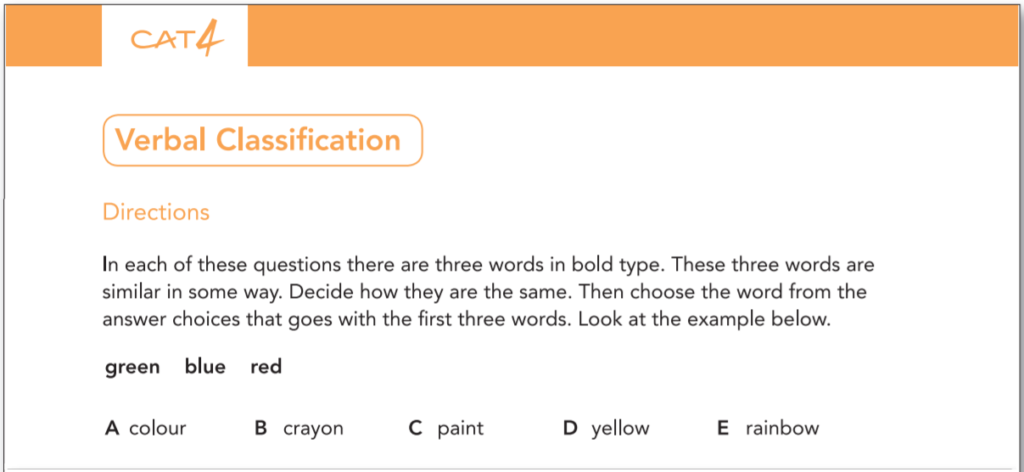*Verbal Classification Example from [GL Assessment](https://www.gl-assessment.co.uk/ "GL Assessment and Education are the creators and publishers of the official CAT4 test")*The **verbal analogies test** requires the student to determine the relationship between a pair of words. A third word will then be presented and the student needs to use the relationship from the first pair to select a fourth word. This helps to assess the ability to determine verbal connections, relationships, and patterns.
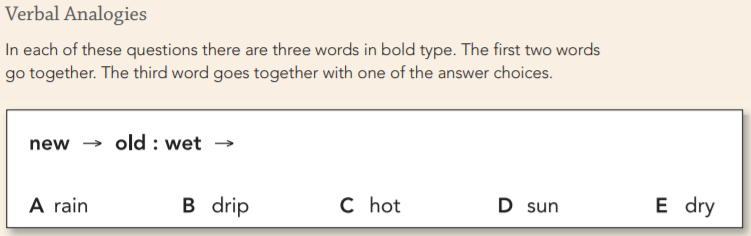*Verbal Analogy Example from [GL Assessment](https://www.gl-assessment.co.uk "Official CAT4 Publisher")*## Quantitative **Reasoning** (QR)
**Quantitative Reasoning** is the ability to apply mathematical skills to real world problems. It requires the identification of similarities and patterns in numbers to help analyse and determine conclusions which are based on logical relationships. The CAT4 measures a child’s ability in this area using a **number analogies** test and a **number series** test. This CAT4 subtest is not actually testing a child’s previous mathematics knowledge but rather the child’s ability to think using numbers – thinking about number patterns, similarities, and differences are key to this particular subtest. It’s not at all about how to use numbers in the real world it’s more about the raw foundational skills you would use when faced with a real world problem involving numbers.
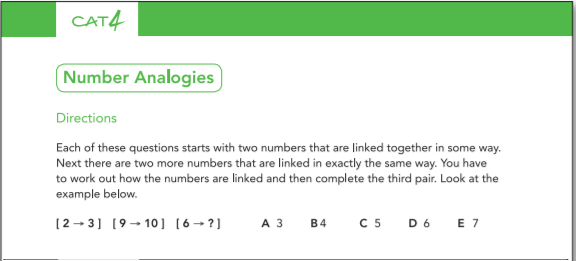
The **number analogies test** provides pairs of numbers which are linked together in some way using a logical rule. The third pair needs to be completed by selecting from five options presented. The relationship determined by analyzing the first two pairs needs to be applied to the third third number to select the correct answer.
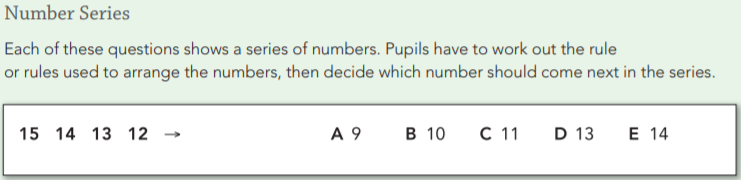
*Number Analogy Example from [GL Assessment](https://www.gl-assessment.co.uk/ "The official published for the CAT4")*The **number series test** presents a series of numbers which are related using a rule or function. The student needs to analyze the numbers and determine the function / rule and calculate the next number in the sequence. This number needs to be selected from the five options presented.
*Number Series Example from [GL Assessment](https://www.gl-assessment.co.uk/)*
## Non **Verbal Reasoning** (NVR)
**Non-verbal reasoning** is the ability to visually understand shapes, their relationships and patterns, differences, and similarities. The CAT4 measures a child’s ability in this area using a **figure classification test** and a **figure matrices test**. Possibly one of the first skills we learn as children is to recognise shapes and faces. Visual non-verbal reasoning is a skill which develops as we grow and start to categorise our surroundings. Furthermore, we bunch things together it larger groups and then smaller groups – four legged animals is split further into cats, dogs, horses etc.. The brain is truly amazing !
The **figure classification test** presents a group of shapes which are similar in some way. The student then needs to select one of the other five shapes presented that also belong to the group due to the shared characteristic.
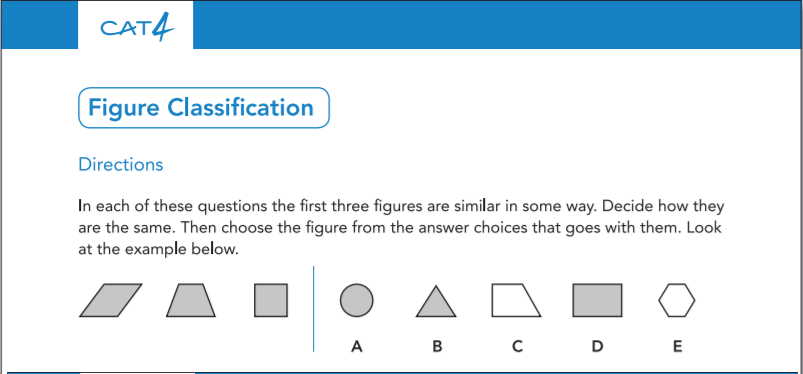*Figure Classification Example from [GL Assessment](https://www.gl-assessment.co.uk/ "Official testers of the CAT4 cognitive abilities test")*The **figure matrices test** is about recognizing the way shapes change and how to apply this change to other shapes. The student will be presented with three shapes in a square with a fourth shape missing. The change between the first two shapes will need to be applied similarly to the third shape to decide which shapes from the five options is the missing fourth shape.
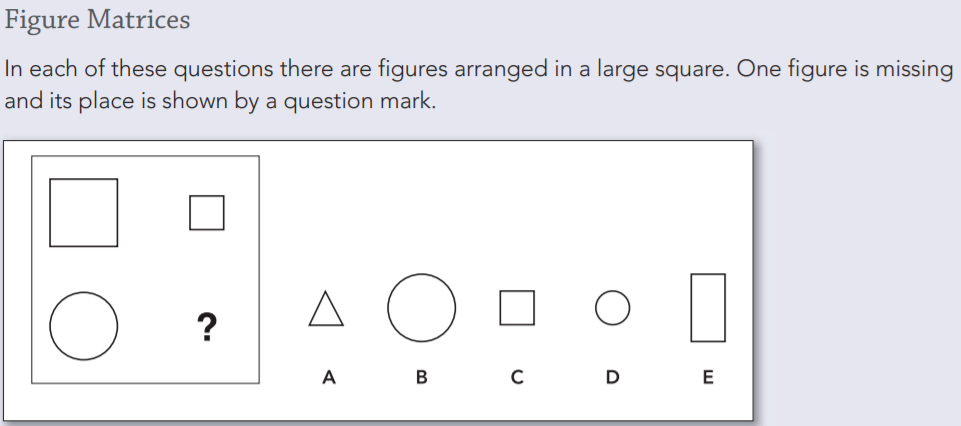*Figure Matrices Example from [GL Assessment](https://www.gl-assessment.co.uk/)*## **Spatial Awareness** (SA)
**Spatial Reasoning** is the ability to solve complex three dimensional problems by mentally visualizing, manipulating, rotating, and transforming images. The CAT4 measures a child’s ability in this area using a **figure analysis test** and a **figure recognition test**. I have a brother-in-law who can’t put together an Ikea flat pack even if his life depended on it. Being able to visualise in both 2d and 3d spaces helps us understand the consequences of actions. As young babies we believe an object simply does not exist if we can’t see it, or if its been rotated – our spatial awareness of objects and what happens to an object when moved or transformed is yet to develop.
The **figure analysis test** presents the user with a square that has been folded and hole punched a number of times. The student needs to visualize how the square would look unfolded and select the correct option from the five presented.
*Figure Analysis Example from [GL Assessment](https://www.gl-assessment.co.uk/)*The **figure recognition test** evaluates the students ability to recognize shapes within other shapes. The user is asked to simply identify the presence of a shape in one of five complex pictures.
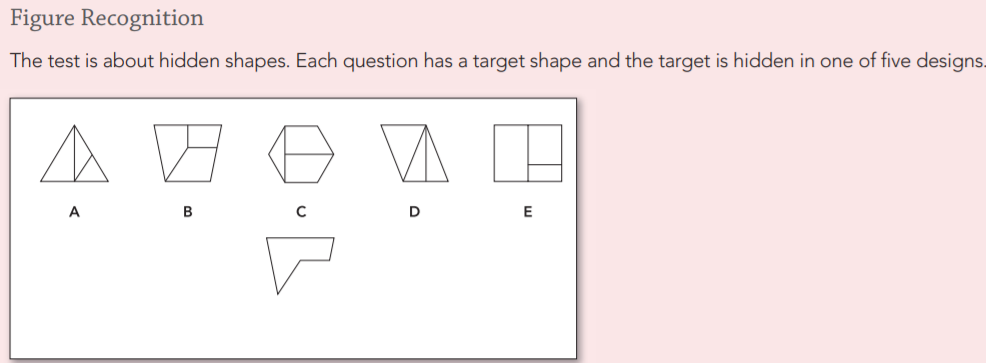*Figure Recognition Example from [GL Assessment](https://www.gl-assessment.co.uk/)*
**Categories:** Cognitive Abilities Test
---
### [How to Understand Cognitive Skills in Children](https://schoolentranceexam.com/improving-cognitive-skills/)
**Published:** July 7, 2023
**Author:** Admin
**Content:**
- [CAT4 Skills Development](#aioseo-cat4-skills-development)
- [Brain Function and Cognitive Growth](#aioseo-brain-function-and-cognitive-growth)
- [Cognitive Skills](#aioseo-cognitive-skills)
- [Nature or nurture – Why are some children smarter?](#aioseo-nature-or-nurture-why-are-some-children-smarter)
## CAT4 Skills Development
Practice makes perfect
A cognitive skill or a physical skill like riding a bike is only difficult until you know how to do it. Children are experts at learning and the way they do this is one step at a time. They start with the foundations and then keep going until they finish building a house.
On the way of course they fall down, but there are key stages which once they have completed they won’t need to go back to except to refine. The persistence and determination of children is something which is truly amazing – as adults we are quick to give up but a child doesn’t until they take their first steps.
Foundational skills on which other talents continuously develop as a child grows – see [CAT4 Assessment](/cat4-assessment "/cat4-assessment") post for details. These skills are the skills that the CAT4 test attempt to measure. In the past assessments would only focus on knowledge but in the modern age problem solving and the ability to learn quickly are more important than being able to recall information which can just as easily be found by browsing the web.
## Brain Function and Cognitive Growth
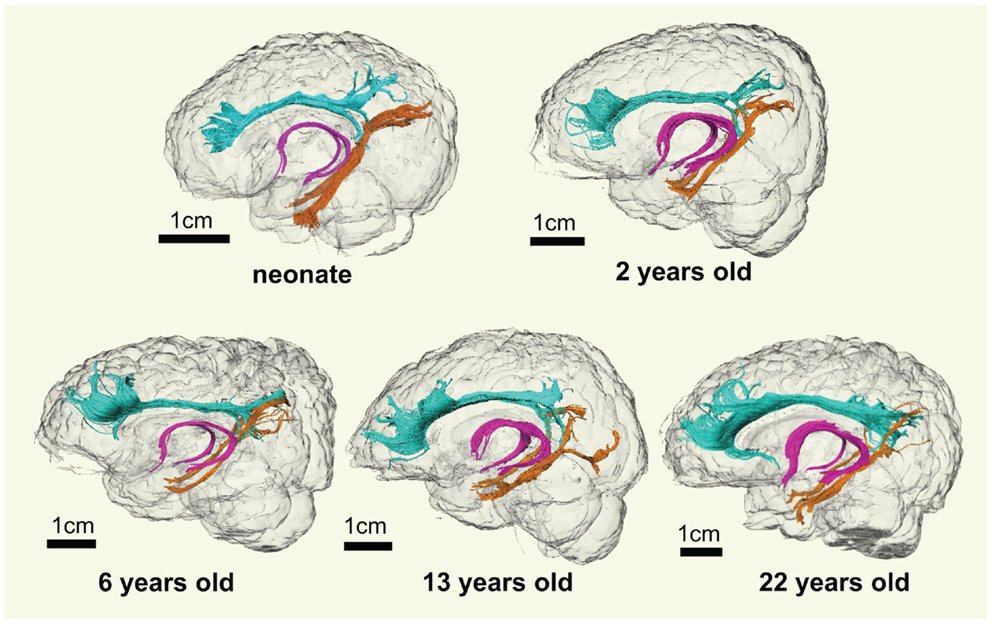*Brain Development*
The thinking skills that are developed come from the brain and the way in which it is being wired together – and this wiring is dependent on the stimulus and challenges the child faces and overcomes. Brain cells or neurons fire off in all directions and create millions of connections as they branch out and reach other neurons. These multitudes of connections – or neural pathways are basically communication paths synonymous to the internet where computers are able to communicate with any other computer connected to the network.
These neurons don’t touch rather they pass information through electrical impulses (or synapses) – so a system of electrical chemical processes allows are thoughts to form and our abilities to develop. The more we are exposed to a particular problem the more synapses and connections are made and reinforced and thus a child becomes gifted in a particular skill.
So to develop the Cognitive Abilities that are useful as we age and part of the CAT4 assessment – children need to be exposed to simpler but **similar** challenges and puzzles to help these pathways to develop. The brain is truly an amazing organ but as with any part of the body if it’s not used it falls into disarray. In the same children need to be exposed to different experiences to expand their awareness and understanding of the world around them.
## Cognitive Skills
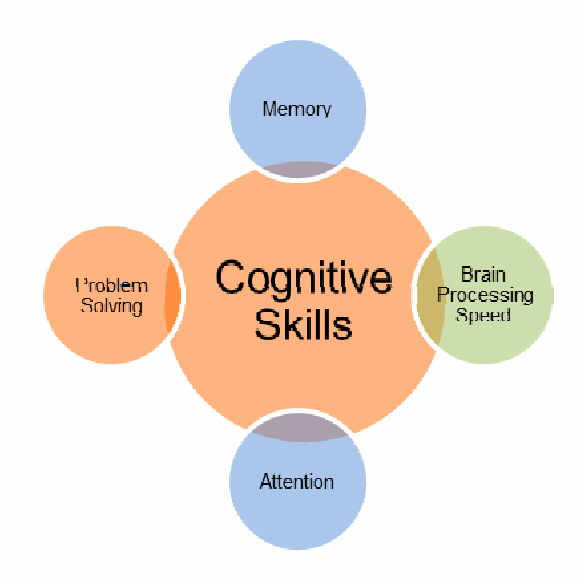Improving Cognitive Skills
Cognitive skills are enhanced by memory, speed, problem solving and attention. [CAT4 tests](/cat4/) evaluate specific skills, verbal, non-verbal, quantitative, spatial; but these are time constrained so if a student is unable to think quickly or solve problems or focus or remember similar scenarios they are highly unlikely to score highly. So the development of these attributes along with focusing on the different types of CAT4 tests is key to higher cognitive abilities. Simply having practiced similar tests is not enough but it does provide context which removes a degree of complexity which would otherwise potentially overwhelm a student when faced with an unfamiliar setting.
## Nature or nurture – Why are some children smarter?
There is an age old debate over nature and nurture – now without going into too much detail not all brains process information the same way – some children have more “flexibility” in their structures and easily take in knew knowledge and setup new networks. Other children take a little longer to develop these abilities. One child may retain these abilities for longer even without using them while another may simply “drop” the unused skill (or network) after a short period. We are all different but we all have the ability to develop our skills at any age so even if a child is not scoring so well on tests – or on the **CAT4** – there is nothing to say that without practice and patience abilities can’t be developed.
There are so many skills as an adult you think you know instinctively about how the world works but its very likely that you have been exposed to similar knowledge problems and patterns as you developed as a child. All the information we accumulate is useful knowledge and helps us process new situations based on past lessons. People accumulate all this useful knowledge through experience, so during childhood parents need to provide challenging scenarios to help their children develop the necessary foundational skills.
What do you think? Is it nature or is it nurture that determines abilities?
**Categories:** Cognitive Abilities Test
---
### [How to CAT4 in China? The good, the bad, and the ugly !](https://schoolentranceexam.com/cat4-in-china/)
**Published:** March 15, 2024
**Author:** Admin
**Content:**
*CAT4 in China*
The **[CAT4 is a diagnostic assessment](https://schoolentranceexam.com/cat4/ "What is the CAT4?")** designed to measure a student’s developed abilities in four key areas: verbal reasoning, non-verbal reasoning, quantitative reasoning, and spatial reasoning. Unlike traditional exams that focus on curriculum-based knowledge, the CAT4 assesses how students think and solve problems, providing insights into their learning potential. This makes it an ideal tool for schools aiming to identify students who can excel in an **international curriculum**, such as the International Baccalaureate (IB), British ([IGCSE/A-Level](https://schoolentranceexam.com/igcse-secret-techniques/ "Techniques to smash the GCSE or A-Level")), or American (AP) systems.
In China, the CAT4 has become a key component of the admissions process for many top-tier international schools. These schools use the CAT4 to identify students with strong academic potential, critical thinking skills, and the ability to thrive in a challenging educational environment. Below is a list of some of the leading Chinese schools that utilize the CAT4 as part of their entrance exams.
## Schools in China Using CAT4 Entrance Test
School NameLocationCurriculum[Dulwich College International (Multiple Campuses)](https://www.dulwich.org/ "Dulwich College")Shanghai, Beijing, Suzhou, and moreBritish[Nord Anglia International Schools (Multiple Campuses)](https://www.nordangliaeducation.com/our-schools/asia "Nord Anglia International Schools in China")Shanghai, Beijing, Guangzhou, and moreBritish/IB[Harrow International Schools (Multiple Campuses)](https://www.harrowschool.org.cn/ "Harrow International School In China")Beijing, Shanghai, Shenzhen, and moreBritish[Wellington College International (Multiple Campuses)](https://www.wellingtoncollege.cn/ "Wellington College International In China")Shanghai, Tianjin, HangzhouBritish[British International School Shanghai (BISS)](https://www.nordangliaeducation.com/biss-puxi "British International School in Shanghai")ShanghaiBritish[Yew Chung International School of Shanghai (YCIS)](https://www.ycis-sh.com/ "Yew Chung International School of Shanghai")ShanghaiIB (International Baccalaureate)[Shanghai Community International School (SCIS)](https://www.scis-china.org/ "Shanghai Community International School")ShanghaiIB (International Baccalaureate)[Shanghai American School (SAS)](https://www.saschina.org/ "Shanghai American School")ShanghaiAmerican[International School of Beijing (ISB)](https://www.isb.bj.edu.cn/ "International School of Beijing")BeijingAmerican[Western Academy of Beijing (WAB)](https://www.wab.edu/ "Western Academy of Beijing")BeijingIB (International Baccalaureate)### **Dulwich College International Schools (Shanghai, Beijing, Suzhou, Zhuhai)**
Part of the renowned Dulwich College family, this school offers a British-based international curriculum. The CAT4 is used to assess students’ cognitive abilities and ensure they are well-suited to the rigorous academic environment.
### **Harrow International Schools (Beijing, Shanghai, Shenzhen, Haikou)**
Harrow Schools in China are known for their excellence in British education. The CAT4 helps identify students who can thrive in their A-Level and IGCSE programs.
### **Nord Anglia Chinese International Schools (Shanghai, Beijing, Guangzhou, Chengdu)**
Nord Anglia schools offer a blend of international and Chinese curricula. The CAT4 is used to evaluate students’ potential and readiness for their globally focused programs.
### **Wellington College International Schools (Shanghai, Tianjin, Hangzhou)**
Wellington Colleges in China provide a British-style education with a strong emphasis on holistic development. The CAT4 is a key component of their admissions process.
### **Yew Chung International Schools (Shanghai, Beijing, Guangzhou, Chongqing)**
Yew Chung schools offer a unique bilingual education model. The CAT4 helps assess students’ cognitive abilities and their ability to adapt to a bilingual learning environment.
### **Shanghai American School (SAS)**
As one of the most prestigious American international schools in China, SAS uses the CAT4 to identify students who can excel in their Advanced Placement (AP) and International Baccalaureate (IB) programs.
### **Western Academy of Beijing (WAB)**
WAB is a leading IB World School that uses the CAT4 to assess students’ readiness for its challenging and inquiry-based curriculum.
### **International School of Beijing (ISB)**
ISB offers an American-style education with a strong focus on innovation and creativity. The CAT4 is used to evaluate students’ problem-solving and critical thinking skills.
### **Shenzhen College of International Education (SCIE)**
SCIE is one of the top schools in southern China offering A-Level and IGCSE programs. The CAT4 is used to select students who demonstrate strong academic potential.
### **Beijing City International School (BCIS)**
BCIS offers an IB curriculum and uses the CAT4 to assess students’ cognitive abilities and their suitability for the IB program.
### **Conclusion**
For students aiming to gain admission to these prestigious schools, preparation for the CAT4 is essential in China. Competition is fierce and while the test does not require specific subject knowledge, familiarizing oneself with the test format and practicing reasoning skills can improve performance. Parents in China enroll their children in specialized tutoring programs or use online resources to help them prepare for the CAT4 type exams.
Many top international schools in China are using the CAT4 or a similar test to help assess students’ cognitive abilities. The CAT4 helps schools identify those best suited to the challenging environment of their school. Generally used by British and international school many American or IB curriculum schools are starting to adopt a similar cognitive testing process. Academic success in China’s competitive international environment is critical for your child’s future.
```
使用認知能力測驗(CAT4)來評估學生的基礎能力和未來的學術潛力。孩子在CAT4中的表現可以用來判斷學生的進步,並根據他們的能力決定是否要錄取學生。 CAT4也幫助學校了解學生的優勢和劣勢,制定個人化的學習計畫和教學模式。此數據可用於確定優勢、劣勢和學習偏好。這為改變特定群體的方法提供了強有力的驅動力和證據。
```
**Categories:** Cognitive Abilities Test
---
### [How To Beat the UK and Ireland CAT4 School Admission Test](https://schoolentranceexam.com/uk-and-ireland-cat4/)
**Published:** September 13, 2024
**Author:** Admin
**Content:**
- [Development of School Admission Tests in the UK and Ireland](#aioseo-development-of-school-entrance)
- [CAT4 Development](#aioseo-cat4-developmet)
- [CAT4 in the UK](#aioseo-development-and-implementation-in-the-uk)
- [Example of Schools in England that Use the CAT4](#aioseo-schools-in-england-that-use-the-cat4)
- [Example of Schools in Wales that Use the CAT4](#aioseo-schools-in-wales-that-use-the-cat4)
- [Example of Schools in Scotland that Use the CAT4](#aioseo-schools-in-scotland-that-use-the-cat4)
- [Example of Schools in Northern Ireland that Use the CAT4](#aioseo-school-in-northern-ireland-that-use-the-cat4)
- [CAT4 in Ireland](#aioseo-cat4-in-ireland)
- [Benefits and Challenges of the CAT4](#aioseo-benefits-and-challenges)
- [Conclusions](#aioseo-conclusion)
## Development of School Admission Tests in the UK and Ireland
CAT4 school entrance tests in the UK and Ireland have gradually evolved over the years in alignment with the development changes of the education system. A key driver has been to provide the best students with the best educational opportunities whatever their background. Entrance exams historically assessed academic subjects such as English, mathematics, and science to determine a student’s eligibility to attend a grammar or independent school. In recent times school have shifted to more holistic assessments to determine a student’s cognitive ability, critical thinking skills, and ultimately future potential. Educators have used these types of cognitive assessments to determine the dormant potential within a child which can be fulfilled with the right opportunity and nurturing environment.
Tests like the Cognitive Abilities Test (CAT4), assess the ability to think, and measure a child’s verbal, non-verbal, spatial, and quantitative reasoning. These areas are much more predictive of their future success at GCSE and A-Levels. Educational institutes have recognized that traditional exams are bias towards those who have a more nurturing school and home environment rather than a student’s actual aptitude.
Ireland has also taken a similar view towards more diagnostic cognitive assessments, helping to ensure students from all educational backgrounds have an equal opportunity. Entrance exams aim to assess both academic achievement with a broader understanding of students’ capabilities, supporting more informed and equitable admissions decisions which allow those who have ability to rise to the top.
## CAT4 Development
[Cognitive Ability testing](https://schoolentranceexam.com/improving-cognitive-skills/ "Improving cognitive abilities") was initially introduced in the UK, with the first versions of a CAT4 type test being used in the 1980s. Cognitive testing evolved over the years and various revisions and improvements introduced which have most recently culminated in one of the most popular cognitive tests used for school admissions – [the CAT4](https://www.gl-education.com/assessments/products/cat4/ "GL Assessment CAT4").
The CAT4 eventually evolved to measure four keys areas which following significant research over the years are accurate at predicting future achievement particularly in GCSEs. The four skills areas measured by the CAT4 are: verbal reasoning, non-verbal reasoning, quantitative reasoning, and spatial ability. Understanding a child’s thinking and problem-solving skills may not always be a predictor to future success but it is a very good predictor of potential a child has.
Typical traditional testing primarily assesses subject-specific knowledge, such as mathematics or reading which is very dependent on the opportunities a child has had in the past – gone a good school and / or had stable supporting parents. Cognitive tests (CAT4) focus on underlying thinking skills that directly underpin a student’s capacity to learn and reason in any context. Understanding these cognitive abilities helps schools to provide focused support, and plan for more individualized instruction where students excel or require extra help.
## CAT4 in the UK
UK Child Practicing Cognitive Skills
The CAT4 is very widely adopted by many primary and secondary schools from the ages of 6 to 17. It helps to support the admissions process in grammar and private schools and also informs academic targets, helping teachers understand the needs of a particular cohort of students. The CAT4 also influences the ways students are grouped since by predicting future academic performance and current cognitive ability students with similar abilities can be grouped into higher sets which push them to achieve even more while less able children can be supported appropriately depending on their identified learning needs. Creating tailored learning plans catering to individual student profiles becomes much simpler using the results of the cognitive tests.
Some students struggle since English may not be their first language – the CAT4’s non-verbal and spatial components are particularly valuable for them since it is able to ascertain a child’s potential ability and for a those with specific learning difficulties, such as dyslexia, aoiding a teacher simply thinking a child doesn’t have the capacity. Taking a broader view on intelligence rather than simply subject specific academic performance has made CAT4 a popular tool for teacher’s to get the most out of their students. The following schools are ones which use the CAT4 test but its a good idea to check with the school you are interested in to make sure nothing has changed.
### Example of Schools in England that Use the CAT4
School NameLocation[Eton College](https://www.etoncollege.com/ "Eton College Official Website")Windsor, Berkshire[Harrow School](https://www.harrowschool.org.uk/ "Harrow School Official Website")Harrow, London[Winchester College](https://www.winchestercollege.org/ "Winchester College Official Website")Winchester, Hampshire[St Paul’s School](https://www.stpaulsschool.org.uk/ "St Paul's School Official Website")London[Westminster School](https://www.westminster.org.uk/ "Westminster School Official Website")London[Rugby School](https://www.rugbyschool.co.uk/ "Rugby School Official Website")Rugby, Warwickshire[Charterhouse School](https://www.charterhouse.org.uk/ "Charterhouse School Official Website")Godalming, Surrey[Oakham School](https://www.oakham.rutland.sch.uk/ "Oakham School Official Website")Oakham, Rutland[Haileybury School](https://www.haileybury.com/ "Haileybury School Official Website")Hertford, Hertfordshire[Bedford School](https://www.bedfordschool.org.uk/ "Bedford School Official Website")Bedford, Bedfordshire### Example of Schools in Wales that Use the CAT4
School NameCurriculum[Haberdashers’ Monmouth Schools](https://www.haberdashers.co.uk/ "Haberdashers' Monmouth Schools Official Website")British[Rydal Penrhos School](https://www.rydalpenrhos.com/ "Rydal Penrhos School Official Website")British[St John’s College](https://www.stjohns.co.uk/ "St John's College Official Website")British[Howell’s School](https://www.howells-cardiff.gdst.net/ "Howell's School Official Website")British[The Cathedral School Llandaff](https://www.llandaffschool.org/ "The Cathedral School Llandaff Official Website")British[Monmouth School for Girls](https://www.queensmonmouth.org.uk/ "Monmouth School for Girls Official Website")British[Rougemont School](https://www.rougemontschool.co.uk/ "Rougemont School Official Website")British[St David’s College](https://www.stdavids-college.co.uk/ "St David's College Official Website")British[Christ College Brecon](https://www.christcollegebrecon.com/ "Christ College Brecon Official Website")British[Llanishen High School](https://www.llanishenhighschool.co.uk/ "Llanishen High School Official Website")British### Example of Schools in Scotland that Use the CAT4
School NameLocation[Hutchesons’ Grammar School](https://www.hutchesons.org/ "Hutchesons' Grammar School Official Website")Glasgow[George Heriot’s School](https://www.george-heriots.com/ "George Heriot's School Official Website")Edinburgh[St Aloysius’ College](https://www.st-aloysius.org/ "St Aloysius' College Official Website")Glasgow[Dollar Academy](https://www.dollaracademy.org.uk/ "Dollar Academy Official Website")Clackmannanshire[Glenalmond College](https://www.glenalmondcollege.co.uk/ "Glenalmond College Official Website")Perthshire[Fettes College](https://www.fettes.com/ "Fettes College Official Website")Edinburgh[Loretto School](https://www.loretto.com/ "Loretto School Official Website")East Lothian[Strathallan School](https://www.strathallan.co.uk/ "Strathallan School Official Website")Perthshire[Merchiston Castle School](https://www.mersinton.bristol.sch.uk/ "Merchiston Castle School Official Website")Edinburgh[St Leonards School](https://www.stleonards-fife.org/ "St Leonards School Official Website")St Andrews### Example of Schools in Northern Ireland that Use the CAT4
School NameCurriculum[Methodist College Belfast](https://www.methody.org/ "Methodist College Belfast Official Website")British[Campbell College Belfast](https://www.campbellcollege.co.uk/ "Campbell College Belfast Official Website")British[Belfast Royal Academy](https://www.belfastroyalacademy.com/ "Belfast Royal Academy Official Website")British[Friends’ School Lisburn](https://www.friendsbelfast.org.uk/ "Friends' School Lisburn Official Website")British[Sullivan Upper School](https://www.sullivanupper.co.uk/ "Sullivan Upper School Official Website")British[Wallace High School](https://www.wallacehigh.org/ "Wallace High School Official Website")British[Banbridge Academy](https://www.banbridgeacademy.org.uk/ "Banbridge Academy Official Website")British[Portora Royal School](https://www.portoradacollege.co.uk/ "Portora Royal School Official Website")British[Lurgan College](https://www.lurgancollege.org/ "Lurgan College Official Website")British[Down High School](https://www.downhigh.co.uk/ "Down High School Official Website")British## CAT4 in Ireland
CAT4 Shows the Way in Ireland
Introduction of the CAT4 in Ireland has followed a similar path to the UK with a large number of schools adopting it not just as part of their admissions process but also as part of their assessment framework. Ireland’s emphasis on individualized learning and inclusive education provides can be driven by cognitive abilities testing and the reporting helps teachers get an objective measure of student abilities – furthermore their may be a common thread in a particular cohort and thus teaching approaches can be modified accordingly – the post-COVID generation for instance may have some strengths and weaknesses which other generations did not. The following is a list of some of the schools in Ireland which use the CAT4 but double check with your school of choice to make sure this is still the case:
School NameCurriculumNotes[St. Columba’s College](https://www.stcolumbas.ie/ "St. Columba's College Official Website")Irish (Transition Year)CAT4 is used for Year 7 admissions.[The King’s Hospital School](https://www.thekingshospital.ie/ "The King's Hospital School Official Website")Irish (Transition Year)CAT4 is used for secondary school admissions.[Wesley College Dublin](https://www.wesleycollege.ie/ "Wesley College Dublin Official Website")Irish (Transition Year)CAT4 is used for Year 7 admissions.[Alexandra College](https://www.alexandracollege.ie/ "Alexandra College Official Website")Irish (Transition Year)CAT4 is used for secondary school admissions.[Blackrock College](https://www.blackrockcollege.com/ "Blackrock College Official Website")Irish (Transition Year)CAT4 is used for Year 7 admissions.[Castleknock College](https://www.castlenockcollege.ie/ "Castleknock College Official Website")Irish (Transition Year)CAT4 is used for secondary school admissions.[Mount Anville Secondary School](https://www.mountansc.ie/ "Mount Anville Secondary School Official Website")Irish (Transition Year)CAT4 is used for Year 7 admissions.[Terenure College](https://www.terenurecollege.ie/ "Terenure College Official Website")Irish (Transition Year)CAT4 is used for secondary school admissions.[Gonzaga College](https://www.gonzaga.ie/ "Gonzaga College Official Website")Irish (Transition Year)CAT4 is used for Year 7 admissions.[St. Andrew’s College](https://www.sac.ie/ "St. Andrew's College Official Website")Irish (Transition Year)CAT4 is used for secondary school admissions.## Benefits and Challenges of the CAT4
The adoption of CAT4 in Ireland and the UK benefited both education systems providing teachers of both nations with a deeper understanding of student learning styles and helping inform schools with the data to determine class placement and program intervention. Parents can also benefit by understanding their child’s areas for development and support their education accordingly.
Challenges do exist with some critics arguing that the insights gained from tests like the CAT4 need to be used along with other tests – the 11 plus for instance uses a combination of subject knowledge and cognitive skills assessment. They argue over-reliance on cognitive tests may overshadow other areas of student development, such as creativity, emotional intelligence, and social skills.
## Conclusions
The use of CAT4 in Ireland and the UK has impacted educational practices, offering an insight into the future potential of students. Understanding the cognitive reasoning level of a student helps teacher understand the capacity of a child to learn rather than simply recall information. Ultimately a holistic approach should be taken which considers other areas of development and growth which are just as important to our children’s future success and healthy contribution towards society.
**Categories:** Cognitive Abilities Test
---
### [School Entrance Exams in the UAE (CAT4, ISEE, MAP, CPAA)](https://schoolentranceexam.com/school-entrance-exams-in-the-uae-cat4-isee-map-cpaa/)
**Published:** August 13, 2023
**Author:** Admin
**Content:**
- [What is the CAT4 Exam in the UAE?](#aioseo-what-is-the-cat4-exam-in-the-uae)
- [What Factors Should You Consider When Choosing a School in the UAE?](#aioseo-what-factors-should-you-consider-when-choosing-a-school-in-the-uae)
- [CAT4 Use in the Emirates](#aioseo-cat4-in-the-different-emirates)
- [What is the CAT4 (Cognitive Abilities Test) and why is it used by UAE schools as part of their admission process?](#aioseo-what-is-the-cat4-cognitive-abilities-test-and-why-is-it-used-by-uae-schools-as-part-of-their-admission-process)
- [What Areas Does CAT4 Assess in the UAE?](#aioseo-what-areas-does-cat4-test-in-dubai-and-abu-dhabi-assess)
- [How is the CAT4 test conducted in the UAE?](#aioseo-how-is-the-cat4-test-conducted-in-the-uae)
- [Entrance Tests other than the CAT4 used by Schools in the UAE](#aioseo-entrance-tests-other-than-the-cat4-used-by-schools-in-the-uae)
- [What curriculum do schools in Dubai and Abu Dhabi Offer?](#aioseo-what-curriculum-do-schools-in-dubai-and-abu-dhabi-offer)
- [Should I send my child to an American or British curriculum?](#aioseo-should-i-send-my-child-to-an-american-or-british-curriculum)
- [What documents are mandatory for admission into a UAE school?](#aioseo-what-documents-are-mandatory-for-admission-into-a-uae-school)
- [Where can I find online ratings of schools in the UAE?](#aioseo-where-can-i-find-online-ratings-of-schools-in-the-uae)
- [Does the School’s fee fit your budget?](#aioseo-does-the-schools-fee-fit-your-budget)
Do you live in the UAE? Are you planning to get your child admitted into a school in UAE and worried about the [CAT4](/cat4/ "What is the CAT4") school entrance exam? Unclear what cognitive skills are? Try a CAT4 practice test by clicking [here](/non-verbal-figure-classification) now.
The U.A.E has the second-highest number of international schools in the world – a staggering count of 624 according to a report by [Khaleej Times](https://www.khaleejtimes.com/news/education/uae-has-highest-number-of-international-schools-in-region). The UAE Vision 2021 National Agenda aims to develop a first-rate education system using up-to-date systems and teaching methods. Using smart technology and devices for teaching, learning and research, not only is the UAE trying to educate its own people but also set the standard globally.
If you are confused about the entrance process in UAE schools, this guide will help by explaining all about UAE school curriculums, fees, admission processes, and CAT4 test requirements. All the Emirates including Dubai, Abu Dhabi, and Sharjah have a similar approach to school entrance and this guide will help you navigate your way through.
*UAE Education is comparable internationally*
## **What is the CAT4 Exam in the UAE?**
The CAT4 exam (Cognitive Abilities Test) is a widely used assessment in the UAE to evaluate students’ academic potential and cognitive abilities. Designed to measure skills like reasoning, logic, focus, and attention to detail, the CAT4 test helps schools identify strengths and areas for improvement. Prepare for the CAT4 exam with practice tests and solutions and boost your child’s confidence and performance with tailored resources for UAE students. Start practicing today!
## What Factors Should You Consider When Choosing a School in the UAE?
Finding the best school for your child is all about finding answers to some simple questions like:
- What kinds of entrance exams does your child need to pass for admission into international schools? (e.g CAT4, MAP, ISEE, etc.
- Which curriculum does the school follow?
- What documentation is required for admission?
- What do the KHDA and ADEK ratings say about the school?
- Does the school’s fee fit your budget?
Across all UAE emirates, the **CAT4 test** plays a vital role in shaping educational strategies and supporting student development. Whether in Abu Dhabi, Dubai, or Fujairah, parents and schools are prioritizing CAT4 preparation to help students unlock their full academic potential.
## CAT4 Use in the Emirates
Here are a list schools in the different Emirates of the UAE that use the CAT4. Schools may update their admissions policies, so always check the latest requirements on their websites or contact their admissions offices directly.
### **1. Abu Dhabi**
In Abu Dhabi, the CAT4 test is widely used in both public and private schools to assess students’ cognitive abilities and academic potential. Schools in Abu Dhabi often rely on CAT4 results to identify gifted students and tailor educational programs to meet individual learning needs. Many parents seek CAT4 practice tests to help their children prepare for this critical assessment.
School NameCurriculumNotes[The British School Al Khubairat](https://www.britishschool.sch.ae/ "The British School Al Khubairat Official Website")BritishCAT4 is used for Year 7 admissions.[Cranleigh Abu Dhabi](https://www.cranleigh.ae/ "Cranleigh Abu Dhabi Official Website")BritishCAT4 is used for secondary school admissions.[Brighton College Abu Dhabi](https://www.brightoncollege.ae/ "Brighton College Abu Dhabi Official Website")BritishCAT4 is used for Year 7 admissions.[Raha International School](https://www.ris.ae/ "Raha International School Official Website")IB (International Baccalaureate)CAT4 is used for secondary school admissions.[American Community School of Abu Dhabi](https://www.aas.ae/ "American Community School of Abu Dhabi Official Website")AmericanCAT4 may be used for placement in certain grades.[GEMS American Academy Abu Dhabi](https://www.gemsaa-abudhabi.com/ "GEMS American Academy Abu Dhabi Official Website")AmericanCAT4 may be used for placement in certain grades.[Al Muna Academy](https://www.almunahazarschool.com/ "Al Muna Academy Official Website")BritishCAT4 is used for Year 7 admissions.[Abu Dhabi International School](https://www.aisa.sch.ae/ "Abu Dhabi International School Official Website")AmericanCAT4 may be used for placement in certain grades.[Rydal Penrhos Abu Dhabi](https://www.rydalpenrhos.com/ "Rydal Penrhos Abu Dhabi Official Website")BritishCAT4 is used for Year 7 admissions.[International Community School Abu Dhabi](https://www.icschool-uae.com/ "International Community School Abu Dhabi Official Website")BritishCAT4 is used for secondary school admissions.### **2. Dubai**
Dubai’s competitive educational landscape makes the CAT4 test a key tool for schools to evaluate students’ reasoning, logic, and problem-solving skills. International schools in Dubai frequently administer the CAT4 exam to benchmark student performance and guide curriculum planning. CAT4 preparation resources are in high demand, with many parents enrolling their children in practice programs.
School NameCurriculumNotes[Dubai College](https://www.dubaicollege.org/)BritishCAT4 is used for Year 7 admissions.[Jumeirah English Speaking School (JESS)](https://www.jess.sch.ae/)BritishCAT4 is used for Year 7 and Year 8 admissions.[Kings’ School Dubai](https://kings-edu.com/dubai/)BritishCAT4 is used for secondary school admissions.[GEMS Wellington International School](https://www.wellingtoninternationalschool.com/)BritishCAT4 is used for Year 7 and above.[Dubai British School](https://www.dubaibritishschool.ae/)BritishCAT4 is used for secondary school admissions.[Nord Anglia International School Dubai](https://www.nordangliaeducation.com/our-schools/dubai)BritishCAT4 is used for Year 7 and above.[Repton School Dubai](https://www.reptondubai.org/)BritishCAT4 is used for Year 7 admissions.[GEMS Dubai American Academy](https://www.gemsaa-dubai.com/)AmericanCAT4 may be used for placement in certain grades.[The English College Dubai](https://www.englishcollege.ac.ae/)BritishCAT4 is used for secondary school admissions.[Raffles World Academy](https://www.rwa.ae/)IB (International Baccalaureate)CAT4 is used for admissions in certain grades.[Swiss International Scientific School Dubai (SISD)](https://www.sisd.ae/)IB (International Baccalaureate)CAT4 is used for secondary school admissions.[GEMS Metropole School](https://www.gemsmetropoleschool-dubai.com/)BritishCAT4 is used for Year 7 and above.[Brighton College Dubai](https://www.brightoncollegedubai.ae/)BritishCAT4 is used for Year 7 admissions.[Dwight School Dubai](https://www.dwight.ae/)IB (International Baccalaureate)CAT4 is used for admissions in certain grades.[GEMS World Academy Dubai](https://www.gemsworldacademy-dubai.com/)IB (International Baccalaureate)CAT4 is used for secondary school admissions.### **3. Sharjah**
In Sharjah, the CAT4 test is commonly used by schools to gain insights into students’ cognitive strengths and weaknesses. Sharjah’s focus on balanced education means the CAT4 results are often used to support personalized learning plans. Parents in Sharjah are increasingly investing in CAT4 practice materials to ensure their children perform well in this assessment.
School NameCurriculumNotes[Sharjah English School](https://www.sabis.net/sharjah "Sharjah English School Official Website")BritishCAT4 is used for Year 7 admissions.[American School of Creative Science](https://www.asc.sch.ae/ "American School of Creative Science Official Website")AmericanCAT4 may be used for placement in certain grades.[GEMS World Academy Sharjah](https://www.gemsworldacademy-sharjah.com/ "GEMS World Academy Sharjah Official Website")IB (International Baccalaureate)CAT4 is used for secondary school admissions.[Sharjah American International School](https://www.sharjahacademy.com/ "Sharjah American International School Official Website")AmericanCAT4 may be used for placement in certain grades.[International School of Creative Science](https://www.iscsharjah.com/ "International School of Creative Science Official Website")BritishCAT4 is used for Year 7 admissions.[Sharjah Indian School](https://www.sharjahindianschool.com/ "Sharjah Indian School Official Website")CBSE (Indian)CAT4 may be used for placement in certain grades.[Al Ameer English School](https://www.ags.sch.ae/ "Al Ameer English School Official Website")BritishCAT4 is used for secondary school admissions.[Sharjah Modern School](https://www.sharjahmodernschool.com/ "Sharjah Modern School Official Website")CBSE (Indian)CAT4 may be used for placement in certain grades.[Sharjah Private School](https://www.sharjahprivateschool.com/ "Sharjah Private School Official Website")AmericanCAT4 may be used for placement in certain grades.[Sharjah International School](https://www.sharjahinternationalschool.com/ "Sharjah International School Official Website")BritishCAT4 is used for Year 7 admissions.### **4. Ajman**
Schools in Ajman use the CAT4 test to assess students’ academic potential and cognitive abilities. The test helps educators identify areas where students may need additional support or enrichment. With a growing emphasis on academic excellence, many parents in Ajman are turning to CAT4 practice tests to help their children excel.
School NameCurriculumNotes[GEMS Ajman Academy](https://www.gemsajmanacademy.com/ "GEMS Ajman Academy Official Website")BritishCAT4 is used for Year 7 admissions.[International Academic School Ajman](https://www.iaa.sch.ae/ "International Academic School Ajman Official Website")BritishCAT4 is used for secondary school admissions.[Ajman Academy](https://www.ajmanacademy.com/ "Ajman Academy Official Website")IB (International Baccalaureate)CAT4 is used for secondary school admissions.[Ajman Indian School](https://www.aisajman.com/ "Ajman Indian School Official Website")CBSE (Indian)CAT4 may be used for placement in certain grades.[Al Mawakeb School Ajman](https://www.almawakeb.sch.ae/ "Al Mawakeb School Ajman Official Website")AmericanCAT4 may be used for placement in certain grades.[City School Ajman](https://www.cityschoolajman.com/ "City School Ajman Official Website")BritishCAT4 is used for Year 7 admissions.[Ajman School](https://www.ajmanschool.com/ "Ajman School Official Website")BritishCAT4 is used for secondary school admissions.[Al Mizhar American Academy](https://www.almizhar.sch.ae/ "Al Mizhar American Academy Official Website")AmericanCAT4 may be used for placement in certain grades.[Ajman Modern School](https://www.ajmanmodernschool.com/ "Ajman Modern School Official Website")CBSE (Indian)CAT4 may be used for placement in certain grades.[Ajman International School](https://www.ajmaninternationalschool.com/ "Ajman International School Official Website")BritishCAT4 is used for Year 7 admissions.### **5. Umm Al Quwain**
In Umm Al Quwain, the CAT4 test is gaining popularity as a tool for evaluating students’ reasoning and problem-solving skills. Schools use the results to create targeted learning strategies. Parents in Umm Al Quwain are increasingly aware of the importance of CAT4 preparation and are seeking resources to help their children succeed.
School NameCurriculumNotes[Umm Al Quwain Indian School](https://www.uaqschools.com/ "Umm Al Quwain Indian School Official Website")CBSE (Indian)CAT4 may be used for placement in certain grades.[Umm Al Quwain Academy](https://www.uaqacademy.com/ "Umm Al Quwain Academy Official Website")BritishCAT4 is used for Year 7 admissions.[Umm Al Quwain International School](https://www.uaqis.com/ "Umm Al Quwain International School Official Website")BritishCAT4 is used for secondary school admissions.[Umm Al Quwain Modern School](https://www.uaqmodernschool.com/ "Umm Al Quwain Modern School Official Website")CBSE (Indian)CAT4 may be used for placement in certain grades.[Umm Al Quwain American School](https://www.uaqamericanschool.com/ "Umm Al Quwain American School Official Website")AmericanCAT4 may be used for placement in certain grades.[Umm Al Quwain British School](https://www.uaqbritishschool.com/ "Umm Al Quwain British School Official Website")BritishCAT4 is used for Year 7 admissions.[Umm Al Quwain Islamic School](https://www.uaqislamicschool.com/ "Umm Al Quwain Islamic School Official Website")Ministry of Education (UAE)CAT4 may be used for placement in certain grades.[Umm Al Quwain Private School](https://www.uaqprivateschool.com/ "Umm Al Quwain Private School Official Website")BritishCAT4 is used for secondary school admissions.[Umm Al Quwain International Academy](https://www.uaqinternationalacademy.com/ "Umm Al Quwain International Academy Official Website")IB (International Baccalaureate)CAT4 is used for secondary school admissions.[Umm Al Quwain School of Excellence](https://www.uaqschoolofexcellence.com/ "Umm Al Quwain School of Excellence Official Website")CBSE (Indian)CAT4 may be used for placement in certain grades.### **6. Ras Al Khaimah**
Ras Al Khaimah’s schools use the CAT4 test to measure students’ cognitive abilities and academic potential. The test is particularly valued for its ability to provide a comprehensive understanding of a student’s strengths and areas for improvement. CAT4 practice tests are becoming a key resource for families in Ras Al Khaimah aiming for academic success.
School NameCurriculumNotes[Ras Al Khaimah Academy](https://www.rakacademy.org/ "Ras Al Khaimah Academy Official Website")BritishCAT4 is used for Year 7 admissions.[GEMS Modern Academy Ras Al Khaimah](https://www.gemsmodernacademy-rak.com/ "GEMS Modern Academy Ras Al Khaimah Official Website")CBSE (Indian)CAT4 may be used for placement in certain grades.[Al Mawakeb School Ras Al Khaimah](https://www.almawakeb.sch.ae/ "Al Mawakeb School Ras Al Khaimah Official Website")AmericanCAT4 may be used for placement in certain grades.[Ras Al Khaimah International School](https://www.risrak.com/ "Ras Al Khaimah International School Official Website")BritishCAT4 is used for secondary school admissions.[Ras Al Khaimah American Academy](https://www.rakamericanacademy.com/ "Ras Al Khaimah American Academy Official Website")AmericanCAT4 may be used for placement in certain grades.[Ras Al Khaimah Schools](https://www.rasalkhaimahschools.com/ "Ras Al Khaimah Schools Official Website")BritishCAT4 is used for Year 7 admissions.[Al Mizhar American Academy Ras Al Khaimah](https://www.almizhar.sch.ae/ "Al Mizhar American Academy Ras Al Khaimah Official Website")AmericanCAT4 may be used for placement in certain grades.[Ras Al Khaimah Indian School](https://www.rakindianschool.com/ "Ras Al Khaimah Indian School Official Website")CBSE (Indian)CAT4 may be used for placement in certain grades.[Ras Al Khaimah Modern School](https://www.rakmodernschool.com/ "Ras Al Khaimah Modern School Official Website")CBSE (Indian)CAT4 may be used for placement in certain grades.[Ras Al Khaimah International School](https://www.rakinternationalschool.com/ "Ras Al Khaimah International School Official Website")BritishCAT4 is used for secondary school admissions.### **7. Fujairah**
In Fujairah, the CAT4 test is used by schools to assess students’ reasoning, logic, and problem-solving skills. The results help educators design personalized learning plans to support student growth. Parents in Fujairah are increasingly focusing on CAT4 preparation to ensure their children are well-prepared for this important assessment.
School NameCurriculumNotes[Dibba English School](https://www.dibbaenglishschool.com/ "Dibba English School Official Website")BritishCAT4 is used for Year 7 admissions.[Fujairah Academy](https://www.fujairahacademy.com/ "Fujairah Academy Official Website")BritishCAT4 is used for secondary school admissions.[International Community School Fujairah](https://www.icschool-uae.com/ "International Community School Fujairah Official Website")BritishCAT4 is used for Year 7 admissions.[Fujairah Modern School](https://www.fujairahmodernschool.com/ "Fujairah Modern School Official Website")CBSE (Indian)CAT4 may be used for placement in certain grades.[Al Mawakeb School Fujairah](https://www.almawakeb.sch.ae/ "Al Mawakeb School Fujairah Official Website")AmericanCAT4 may be used for placement in certain grades.[Fujairah Private School](https://www.fujairahprivateschool.com/ "Fujairah Private School Official Website")BritishCAT4 is used for Year 7 admissions.[Fujairah Islamic School](https://www.fujairahislamicschool.com/ "Fujairah Islamic School Official Website")Ministry of Education (UAE)CAT4 may be used for placement in certain grades.[Fujairah Indian School](https://www.fujairahindianschool.com/ "Fujairah Indian School Official Website")CBSE (Indian)CAT4 may be used for placement in certain grades.[Fujairah City School](https://www.fujairahcityschool.com/ "Fujairah City School Official Website")BritishCAT4 is used for secondary school admissions.[Fujairah International School](https://www.fujairahinternationalschool.com/ "Fujairah International School Official Website")BritishCAT4 is used for Year 7 admissions.## What is the CAT4 (Cognitive Abilities Test) and why is it used by UAE schools as part of their admission process?
Like many schools across the UK and Ireland, a large number of international schools in the UAE also use the Cognitive Abilities Test (CAT4) to select candidates for admission. CAT4 is one of the most popular tests used by schools in the UAE as not just part of the admission process but also as part of predicting a child’s future performance in Year 8.
Developed by [(GL) Assessment](https://www.gl-assessment.co.uk/about-us/), CAT4 provides a comprehensive report on the cognitive and reasoning capabilities of a child and is an excellent predictor of a child’s future academic achievement. The test evaluates and provides scores for the exact strengths and weaknesses of each candidate. CAT4 tests in Dubai and Abu Dhabi work as an excellent tool for schools to filter out students during the admission process and are also used to identify children with extraordinary talents. In the UAE it is also at times used as a basis to award scholarships.
## What Areas Does CAT4 Assess in the UAE?
The CAT4 reports on how well a student performs across four defined dimensions, which include:
1. **Verbal Reasoning**: The assessment involves traditional examining techniques and evaluates the subject’s verbal skills through the expression of ideas and thoughts in words.
2. **Non-Verbal Reasoning**: Used to judge the ability of a candidate to connect different shapes and understand the underlying pattern with the help of images and diagrams.
3. **Spatial Reasoning**: It measures the ability of a student to think and draw conclusions in three-dimensional space by manipulating shapes and objects.
4. **Quantitative Reasoning**: Questions on quantitative reasoning appraise more than just general mathematical skills. It focuses on analyzing the candidate’s ability to think fast through numerical problems and work out relationships in a sequence of numbers.
## How is the CAT4 test conducted in the UAE?
The assessment can be either paper-based or computerized and is carried out in the form of a series of MCQ-styled questions and follows the standard approach as prescribed by GL Assessment.
CAT4 will test your child in several different ways and will consist of questions in various formats such as:
- **Verbal and Numerical Analogies, and Figure Matrices**, all of which involve questions that deal with pattern recognition.
- **Verbal and Numerical Classification** where students have to work out a relationship between several images in question. Then, they identify which of the given options carries the same relationship.
- **Numerical Series** questions ask to figure out the connection between a given series of numbers. The student then has to select the correct option which shows the same connection.
- **Figure Recognition** shows a specific shape that is hidden in only one of the given multiple choices. Students have to identify which option is the right.
- **Figure Analysis** helps to determine whether a candidate has strong visualization skills. These questions require children to recognize the correct orientation of a given object or shape in the three-dimensions.
With such a wide testing approach, CAT4 assessments are great at pinpointing the strengths and weaknesses of a potential student in the UAE.
## Entrance Tests other than the CAT4 used by Schools in the UAE
Apart from CAT4, various schools in Dubai or Abi Dhabi also conduct other tests according to their admission requirements. Some of the more popular entrance tests are described below:
### 1. Independent School Entrance Examination (ISEE)
Independent School Entrance Examination is a test used by several private schools in Dubai and Abu Dhabi. Scoring well in this test is a prerequisite for your child to get into the top private school of your choice. The ISEE tests the child across a wide range of abilities, including verbal skills, quantitative reasoning, mathematical, reading, and writing skills.
### 2. The measure of Academic Progress (MAP)
*Overview of different Admission Tests* (CAT4, MAP, CPAA)
MAP is a kind of entrance test that involves testing the reading ability, science, and math skills of a student. These tests are usually available in computerized form. The great thing about MAP tests is that they are customized to the student’s current level of knowledge and education. This way, every candidate gets a fair chance to prove their knowledge and the school can be sure the child has covered the material and meets a minimum academic standard. The drawback is that this is focused primarily on knowledge rather than the cognitive ability of a student to learn.
### 3. Children’s Progress Academic Assessment (CPAA)
Is a standardized test that lets teachers evaluate your child and provides a very thorough analysis of where your child performed well and where there is room for improvement. It is a good idea to thoroughly review the works from previous years since subject knowledge is critical in passing these tests.
## What curriculum do schools in Dubai and Abu Dhabi Offer?
Before you enroll your child in an international school, it’s important to figure out what curriculum you want your child to study. This depends on several factors such as:
1. Whether or not your child will stay in UAE for higher education. Especially relevant if you are an expatriate and plan to move back to your home country after a few years.
2. If another international curriculum will cover the same subjects as the curriculum of your home country.
International Baccalaureate (IB) schools are generally a good choice for those who come from countries which don’t follow a UK type curriculum with GCSE and A-Level assessments. The IB is easy to transfer and offers great flexibility and provides your child with the skills to switch at during later stages.
## Should I send my child to an American or British curriculum?
There’s a huge number of both American and British international curricula offered in UAE schools. The **American schools** predominantly copy a U.S based education pattern accompanied by a credit scoring system, which is conveniently transferable. Their curriculum is much similar to what any IB school would offer. On the other hand, **British schools** are highly valued by expats who are interested in pursuing higher education in world-renowned UK-based educational institutes. However, at the end of the day, the decision boils down to where you plan to send your child to attend university.
## What documents are mandatory for admission into a UAE school?
The specific admission requirements will be different for different schools. However, there are some basic documentation requirements you have to provide to get your child enrolled in any school in Dubai or Abu Dhabi:
- The school’s admission form
- Previous school records (if any)
- Proof of identification for the child and both parents
- Vaccination records
- The birth certificate of your child
- You will also have to submit a non-refundable admission fee when you get your child registered with the school.
Find out how Schools in the UAE use the Official TestWise portal ## Where can I find online ratings of schools in the UAE?
If you live in Dubai, then you must check the KHDA ratings for international schools in your area. The[ Knowledge and Human Development Authority](https://www.khda.gov.ae/) or KHDA is a regulatory body that oversees matters related to the private education sector in Dubai. Their website rates schools against specific criteria and reports on where these schools rank on their list. KHDA’s rankings are made up of **five levels** starting at the top with ‘Outstanding, Very Good, Good, Acceptable’, and ending at the bottom with ‘Weak’. The criteria for KHDA ratings are a mix of many important factors, such as the school’s leadership capabilities, the student’s academic performance, quality of progress tracking systems, and reporting on results.
However, if you reside in Abu Dhabi, you can use the [Abu Dhabi Department of Education and Knowledge](https://www.adek.gov.ae/) (ADEK) as your go-to website for school searching. This department was recently formed, following in the footsteps of KHDA, and provides the same type of services to the public. Hence, the KHDA and ADEK websites are trustworthy sources to provide you with the exact information you need for your child’s school admission.
## Does the School’s fee fit your budget?
Apart from determining ratings, the KHDA and ADEK platforms are also great sources for finding international schools that match your fee criteria. It’s no secret that International Baccalaureate schools are amongst the countries most expensive. These are then followed by American and British schools which have only marginally cheaper fees.
The school fees in Dubai start from as low as 1,800 AED and go up to a whopping 120,000 AED per annum.
However, one thing you should keep in mind is that the higher fees are generally indicative of a higher quality of education and the curriculum these schools follow. Of course there is a point at which the extra money in fees does not translate to better learning. There are good international schools in the UAE that are affordable and may be covered within your education allowances provided by your employer.
You can use the [online international school database](https://www.international-schools-database.com/) to determine which schools in your area you can afford. By entering your the site will find schools in your area within your budget – but as a caveat the list on this site is not comprehensive and its worth asking friends, families, and posting on expatriate websites for advice. Feel free to contact us if you still have any queries about the school system in the UAE, the admission process, and specifically the CAT4 school entrance exam for schools in the UAE. We will be happy to help.
Try a CAT4 practice test by clicking below:
[CAT4 PRACTICE TEST](/non-verbal-figure-classification)
**Categories:** Cognitive Abilities Test
---
### [How do CAT4 results help your child do better](https://schoolentranceexam.com/how-does-the-cat4-test-really-help/)
**Published:** October 1, 2020
**Author:** Admin
**Content:**
- [Individualised Learning](#aioseo-individualised-learning)
- [Identifying Learning Styles](#aioseo-identifying-learning-styles)
- [Helping Students](#aioseo-helping-students)
- [Summary](#aioseo-summary)
CAT4 (Cognitive Abilities Test) is the new edition of the Cognitive Abilities Test and is the UK’s most widely used assessment of ability. It’s available on demand throughout the year. CAT4 is a standardized test designed to assess cognitive abilities in children and young people. It is used in educational settings to identify strengths and weaknesses in cognitive abilities, such as verbal reasoning, non-verbal reasoning, spatial awareness, and numerical ability. The test can be used to identify students who may be at risk of underachieving academically, or who may need additional support in order to reach their full potential. It is often used as part of a comprehensive assessment process, along with other tests and observations, to identify students who may have learning difficulties or disabilities.
It provides teachers with essential data to help personalise learning, engage with parents, and monitor progress. It supports measuring student abilities and the admissions process into selective schools. There are 4 areas of reasoning which are measured; quantitative, verbal, non-verbal and spatial. The last skills is extremely important for science, technology, engineering, and maths. This is an ability not measured by other tests at school such as the 11+ or SATs.
## Individualised Learning
By understanding a child’s strengths, weaknesses, and learning preferences teaching can be adapted accordingly and talented pupils can be pushed ahead while pupils with low ability can be provided learning support or screened for learning difficulties.
## Identifying Learning Styles
From a child’s ability profile it becomes clear if they have a bias towards spatial skills and will learn better through flow charts and diagrams but may struggle with verbal based subjects. Pupils with an extreme verbal bias will learn well through written texts, writing and discussion but may struggle with STEM subjects. Pupils with a balanced profile will respond to all types of teaching styles.
## Helping Students
Underachieving pupils can be provided with targeted measures to remove barriers to learning. Appropriate goals can be set and monitored, with progress indicators. The results are good indicators to GCSE, A-level and IB course success and the individual student report for teachers provides data that helps to understand a pupils learning profile. The implications for teaching and learning arre profound and base deicisions on objective not subjective opinion.
## Summary
CAT4 supports personalized learning and improves parental engagement, provides direction for informed intervention strategies. Specialized reports are available for senior school leaders to help provide strategic direction to areas where the school or class as a whole can improve. The CAT4 is not about knowledge recall and requires no preparation, although I argue that familiarity of the question format and online delivery helps. There are three ability batteries that are not dependent on language so it is highly suitable for second language students too. CAT4 is available throughout the year and results are available immediately. The CAT4 tests attempt to offer all pupils the same opportunity to show their underlying ability – at least that’s the theory!
CAT4 love it or hate it let me know in the comments section below.
**Categories:** Year 7 Apptitude Tests
---
### [Get Your Child in the Best School Possible](https://schoolentranceexam.com/get-your-child-into-the-best-school-possible/)
**Published:** July 27, 2022
**Author:** Admin
**Content:**
- [Best school possible](#aioseo-why-should-every-parent-try-to-get-there-child-into-the-best-school-possible)
- [Success factors for success](#aioseo-what-are-the-success-factors-for-life-success)
- [4 Daily Questions](#aioseo-4-questions-to-ask-your-child-daily)
- [What your child needs?](#aioseo-what-does-your-child-need-and-what-do-you-need)
- [How to choose?](#aioseo-how-to-choose-the-best-school-possible)
## Why get your child into the **best school** possible?
The best school has better teachers, better students, better resources, a better environment, and is more likely to help your child fulfill their potential – this is a fundamental fact. Choosing the best school for your child (one with a selection exam like the CAT4 or 11+) is one of the best things you can do for the future of your children.
One technique which teachers are trained to use is to create mixed ability classes – this is great for the weaker students since they’ll hopefully learn off the brighter students – but the smarter students will end up lowering their level to the other students. Now you may say that the smarter student may not be effected since the act of teaching and supporting increases understanding – true – but what if the other students simply are disruptive and not focused on what’s been taught… who loses? Your child.
In a selective school – one where the CAT4 or 11+ is used as an entrance exam – the children will all be similar in their abilities and attitudes towards work. It can be safely said that the range of abilities will be not as broad thus any working groups will all be at a similar level and rather than drag each other down the group will grow and learn together.
## What are the success factors for life success?
Lessons from the longest study on human development and the factors which contribute towards wellbeing using various dimensions such as education, wealth, health, longevity, quality of life etc… concluded that if your child is in an environment that provides high expectations, with an active interest from the parents then the likelihood of their success in later life increases. Wealth of course is another factor but something many of us are limited with, so the home environment and your conversations with your children are things you can control. The other significant factor to your child’s future success is the school your child goes to – so make sure you select the **best** one possible.
## 4 Questions To Ask Your Child Daily
Learning Through Reflection
Everyday since year 1 I always asked my children the following questions:
1. What did you achieve today?
2. What did you enjoy and why?
3. What didn’t you enjoy and why?
4. What could you have changed to have made it a better day?
Triggering this type of critical thinking in your child helps them reflect and improve – ultimately all you want in for your child to continue improving and pushing to fulfill their potential. By taking the above approach all you’re doing is triggering your child to make changes – improvements – to their own behaviour and approach. The hope is this becomes second nature and even as adults they will continue this practice.
## What does your child need? And what do you need?
Some children are more structured and organized while others more creative. Every child is different and you need to really understand the type of environment your child will flourish in. One of my children are extremely social and outspoken so for her I looked for a school with an emphasis on English, drama, and other creative skills. Another child may be very sporty in which case you need to ensure the school has a focus on sports – holds sports events – and is well resourced. If your child needs extra attention then the best school for this child would be one that has support structures in place for a student requiring individual attention, or has special needs that need to be met.
The **best school** you choose obviously will have to be located close by – preferably walking distance! There is no point in looking at schools half way across the country unless you are will to move in which case location is not a factor. Don’t forget to factor in after school activities – this one throws a lot of parents especially when their are siblings who don’t have activities on the same days. You want to make life easy for yourself but want the best school possible.
[Click here](https://schoolentranceexam.com/list-of-schools-using-the-11-plus-or-cat4/ "Best Schools and their admission tests") to view the list I created of some of the best schools in the country and their admission requirements.
## How to choose the best school possible?
When choosing the best school possible you need to take a structure approach:
1. **Research schools in your area** – find out as much as you can about each use their websites and also if they are private or public and do they use admission exams like the CAT4 or 11 Plus.
2. **Compare what each have to offer** – different opportunities in different catchment areas.
3. **Visit the school** – ask about past achievements, extracurricular activates, teacher experience, school ethos, class sizes, total student count, do they have space
4. **Student success** – ask or try to find out how well children do after leaving the school. How many go to university? Which universities? Which courses? Which careers?
5. **Talk with parents** – this will give you a real insight into everyday school life and what sort of challenges other parents have faced.
You need to have an environment which is conducive to growth, one that encourages and motivates – an environment which provides the opportunity for your child the achieve the very best possible – that’s all we parents really want – **our child fulfill their potential**.
[Click here](https://www.best-schools.co.uk/uk-school-league-tables/list-of-league-tables/top-100-schools-by-gcse "Best School by GCSE in the UK") for a list of some of the best schools by GCSE.
**Categories:** Education
---
### [Breaking Down the CAT4 Levels - X, Y, A to G](https://schoolentranceexam.com/cat4-levels/)
**Published:** September 20, 2024
**Author:** Admin
**Content:**
[CAT4 PRACTICE TEST](/non-verbal-figure-classification)
**CAT4 level** tests are different versions of the test catering for children who are in different grades in primary school and high school. The table below provides you with a brief summary and **CAT4 level breakdown**. CAT4 Level X and Level Y are for year 1 and 2 and have a different structure. CAT4 Level A to Level G is for year 3 to year 12 and above. Use the information below to decide which level your child should practice on.
**Age range*****CAT4* level****England & Wales****Scotland****Northern Ireland****Ireland**6 years – 7 years 11 months**CAT4 Level X**Y2P3Y3 (P3)1st class7 years – 8 years 11 months**CAT4 Level Y**Y3P4Y4 (P4)2nd class6 years 8 months to 8 years 11 months**CAT4 Level Pre-A**Y3P4Y4 (P4)2nd class7 years 6 months – 9 years 11 months[**CAT4 Level A**](https://schoolentranceexam.com/cat4-level-a-year-4-tests/)Y4P5Y5 (P5)3rd class8 years 6 months – 10 years 11 months[**CAT4 Level B**](https://schoolentranceexam.com/cat4-level-b-year-5-tests/)Y5P6Y6 (P6)4th class9 years 6 months – 11 years 11 months[**CAT4 Level C**](https://schoolentranceexam.com/cat4-level-c-year-6-tests/)Y6P7Y7 (P7)5th class10 years 6 months – 12 years 11 months[**CAT4 Level D**](https://schoolentranceexam.com/cat4-level-d-year-7-tests/)Y7S1Y8 (F1)End of 5th class/ 6th class11 years 6 months – 13 years 11 months[**CAT4 Level E**](https://schoolentranceexam.com/cat4-level-e-year-8-tests/)Y8S2Y9 (F2)End of 6th class/ 1st Year12 years 6 months – 15 years 11 months[**CAT4 Level F**](https://schoolentranceexam.com/cat4-level-f-year-9-year-10-tests/)Y9 & Y10S3 & S4Y10 & Y11 (F3 & F4)2nd and 3rd Year14 years 6 months – 17 years +[**CAT4 Level G**](https://schoolentranceexam.com/cat4-level-g-year-11-tests/)Y11+S5 & S6Y12+ (F5+)4th/TY/5th YearAs you can see there is some overlap in the age groups which may be confusing but helps immensely when testing different age groups in the same cohort – it provides more flexibility in the testing and catches more children in a single test allowing for easier comparison and group scores. Schools use the results to decide on how to group children and determine the best way to deliver teaching so it is focused on the strengths and weakness of a particular group of students.
Try a CAT4 practice test by clicking below:
[CAT4 PRACTICE TEST](/non-verbal-figure-classification)
## CAT4 Level A-G Test Structure
CAT4 Level A – G each levels consists of 8 short online tests. The 8 CAT4 tests are split into 3 parts each checking a child’s foundational abilities in verbal, numerical, and spatial skills as shown below:
**Part 1****Part 2****Part 3**Figure Classification
Figure MatricesVerbal Classification
Verbal Analogies
Number AnalogiesNumber Series
Figure Analysis
Figure RecognitionEach test also has a time limit – I recommend repeating each test several times to make sure your child is ready for the real thing and is able to manage their time effectively to finish. The real tests will have time for instructions; but the actual CAT4 test time is shown below:-
***CAT4 Component******Duration******No. of Questions*****Figure Classification**10 minutes24 questions**Figure Matrices**10 minutes24 questions**Verbal Classification**8 minutes24 questions**Verbal Analogies**8 minutes24 questions**Number Analogies**10 minutes18 questions**Number Series**8 minutes18 questions**Figure Analysis**9 minutes18 questions**Figure Recognition**9 minutes18 questions## Early Years – CAT4 Level X and CAT4 Level Y
*Developing Cognitive Thinking Skills*
Measuring cognitive at an early age is difficult since children develop at different rates. The CAT tests make a good attempt at doing this with the Year 1 and Year 2 versions of the test being presented in a very, very simply format. Children of of this age group will require significant support. The tests are made up of of two parts each with two tests;
**Part 1**
Figures 12 minutes
Word 10 minutes
**Part 2**
Numbers 10 minutes
Shapes 11 minutes
Although these are not formal tests prescribed by the National Curriculum schools can still use them to assess and evaluate how well the children are doing, how they potentially likely to do, and what their individual learning styles are. This information can be used to inform teaching strategies providing support or challenge appropriately.
Generally teachers will do formative assessments during the school year to understand each child’s level but these tests only measure knowledge and don’t attempt to evaluate cognitive skills which are foundational to future success. CATs(cognitive abilities tests) provide this information and help to determine future approaches and can focus on both the weakest and strongest children to ensure no child is left behind and gifted children are appropriately challenged.
Even at such an early age **understanding strengths and weaknesses of individual children** and a group of children can improve our focus and provide a better experience customized to a child’s needs. Attainment in core subjects is important but by using the CAT4 tests schools have a broader view of each child’s capabilities and learning approach. Children of such an early age may be more accustomed to using a pen and paper so this option of delivery is also available.
## CAT4 Test Instructions
Once instructions have been given by the teacher and the practice tests and examples been conducted, the real test will begin. During this time a timer will count down the time allocated. The timer cannot be stopped and in fact the time is a critical aspect of measuring a child’s brain processing speed. The test will timeout even if questions haven’t been completed so it is absolutely essential to make sure a [time management strategy](/time-management-during-the-cat4-tests) of some sort is in place.
CAT4 GL Assessment body does allow for a pen and rough paper for students to use and scribble on and make calculations. So tell your child to make sure one is available before the test or else previous seconds will be lost.
## CAT4 Test Selection
It is recommended that the level of CAT4 appropriate for the year group being assessed is used – this is important if comparisons are made with other schools or past year results. It also helps by measuring cognitive development of children over a number of years to know how well your school is doing and if basic cognitive skills are improving between school cohorts. This information can help determine strategy and teaching plans to improve the overall school performance.
## CAT4 Level Differences
The tests have been validated for each age group so the results are accurate but of course there are differences in their complexity. The two tests for CAT4 Level X (Grade 1) and CAT4 Level Y (Grade 2) consist of only 4 papers but they also contain much simpler questions.
*Lower Level – Primary School CAT4 Question*
An example question would be as simple as matching shapes – as seen opposite. Other questions will be a little more complicated with very simple patterns and counting exercises.
For higher levels of the CAT4 test complicated multi-step problems are presented requiring the student to work out intermediate solutions.
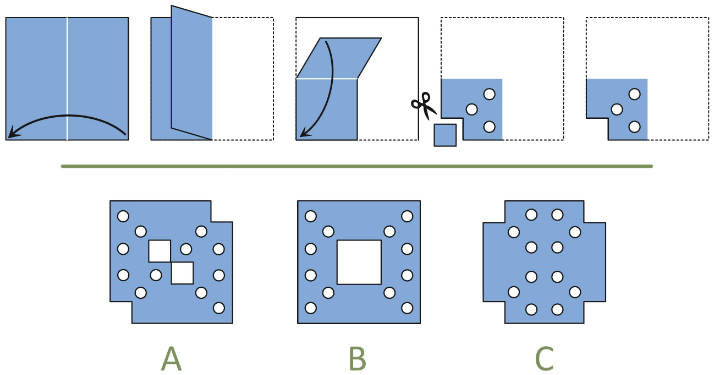*Higher Level CAT4 Questions*A younger child will have difficulty to understand the question above due to its complexity. Walking through the question the student needs to be able to visualize the paper once unfolded and can use a variety of strategies to do this. A simple but effective method is to use one corner of the paper as a marker to determine how the paper unfolds. This provides a simpler way of understanding the question but is a difficult method for a student in primary school to reliably use.
The answers presented in a question are just as important as the question itself – and this question highlights this fact in that the only answer with all four corners cut is C – so if the student has determined that all four corners are cut once the paper is unfolded the answer must be C – the holes and other patterns on the paper are simply a distraction. So the student not only needs to understand the problem but also to focus on the correct area and ignore any superficial information. At times the student may focus on the wrong information which does not lead to a definitive answer – in this case the student will have to back track (or take a best guess!).
The above complexity requires advanced cognitive skills and is required in the higher CAT4 test batteries. Having the ability to focus on the right information and determination to revisit a problem or change approach during the problem solving stage are all skills to score highly in the test. Time is an issue and is deliberately short to determine the student’s ability to process information at speed.
Teachers need to make sure they use the correct test level for their children. Parents shouldn’t worry if a child does not get full marks and be aware the test has been designed to make this extremely difficult if not impossible.
**Categories:** Cognitive Abilities Test
---
### [Ultimate CAT4 Practice Test to Smash the School Entrance Exam](https://schoolentranceexam.com/cat4-practice-test/)
**Published:** May 31, 2024
**Author:** Admin
**Content:**

Preparing for the CAT4 test? Look no further! On this website you’ll find a comprehensive, inexpensive resource providing CAT4 practice test questions and tips to help you ace the real test and pass the school entrance exam. Whether you’re a student or a parent looking to support your child’s preparation, this guide has got you covered.
### Understand the CAT4 Test Format and Content
Before diving into practice test questions, it’s important to understand the format and content of the CAT4 test. The CAT4, or Cognitive Abilities Test, is a widely used assessment tool that measures a student’s cognitive abilities in areas such as verbal reasoning, non-verbal reasoning, quantitative reasoning, and spatial ability. Familiarizing yourself with the test format and content will help you better prepare and perform well on test day.
Below is a quick overview of the types of questions but further information and examples can be found at [this page](https://schoolentranceexam.com/what-type-of-questions-are-in-a-cat4-test/ "CAT4 types of questions").
### Practice Verbal Reasoning Questions
Verbal reasoning is an important component of the CAT4 test, as it assesses a student’s ability to understand and manipulate language. To practice verbal reasoning questions, start by familiarizing yourself with different question types, such as analogies, synonyms, and antonyms. Then, find practice questions that align with the CAT4 format and content. Work through these questions, paying attention to the strategies and techniques used to solve them. With consistent practice, you’ll improve your verbal reasoning skills and feel more confident on test day.
### Master Non-Verbal Reasoning Questions
Non-verbal reasoning questions are a key part of the CAT4 test, and mastering them can greatly improve your overall score. These questions assess your ability to analyze and manipulate visual information, such as patterns, shapes, and sequences. To excel in non-verbal reasoning, it’s important to practice regularly and familiarize yourself with different question types, such as series, matrices, and codes. Look for practice resources that provide clear explanations and strategies for solving these types of questions. By dedicating time to mastering non-verbal reasoning, you’ll be well-prepared for this section of the CAT4 test.
### Ace the Quantitative Reasoning Questions
Before diving into solving a quantitative reasoning question, it’s crucial to take the time to understand the type of question and identify key information. Look for anything which can give you clues about the type of calculation or problem-solving approach you need to use. Once you have a clear understanding of the question and the key information, you’ll be better equipped to tackle it effectively and accurately.
### See Through the Spatial Awareness Questions
Spatial awareness refers to the ability to understand and perceive the space around us, including the relationship between objects, people, and our own body in that space. It involves being aware of our position, orientation, and movement in relation to our surroundings. Spatial awareness is important because it helps us navigate and interact with our environment effectively and safely. It allows us to judge distances, make accurate movements, and avoid obstacles. Developing spatial awareness can also enhance our problem-solving skills and creativity.
Spatial awareness is a skill that can be learned and developed over time. While some individuals may have a natural inclination towards spatial awareness, it is not solely dependent on innate abilities. Through practice and conscious effort, anyone can improve their spatial awareness. Engaging in activities that require spatial thinking, such as puzzles, drawing, and playing certain sports, can help enhance this skill. Additionally, mindfulness and paying attention to our surroundings can also contribute to improving spatial awareness. With consistent practice and effort, individuals can significantly improve their ability to perceive and understand their surroundings.
### Develop Time Management Strategies for the CAT4 Test
Time management is crucial when taking the CAT4 test, as you will have a limited amount of time to complete each section. To develop effective time management strategies, start by familiarizing yourself with the structure and format of the test. Understand how many questions are in each section and allocate your time accordingly. It can be helpful to set specific time goals for each question or section to ensure that you stay on track. Additionally, practice timed mock tests to get a sense of how quickly you can answer questions and identify areas where you may need to improve your speed. By developing strong time management skills, you’ll be able to maximize your performance on the CAT4 test.
For more information on the CAT4 entrance tests check out the [Q&A page](https://schoolentranceexam.com/cat4/ "CAT4 Test Question and Answer Page").
**Categories:** Cognitive Abilities Test
---
### [Unlock Your Child's Hidden Potential Through The CAT4](https://schoolentranceexam.com/the-cat4-reveals-your-childs-hidden-potential/)
**Published:** August 14, 2021
**Author:** Admin
**Content:**
# What is the CAT4 used for?
Hidden cognitive skills lie dormant until triggered !
The CAT4 can be used by schools in a number of different ways and the wealth of data can provide educators with an objective approach to determining teaching methods:
1. **School entrance exam** – as part of the school’s admission process to ensure children accepted into the school have similar abilities to learn.
2. **Measure Learner Styles** – to better understand the learner styles in a particular cohort of students and modify the teaching approach creating more effective learning experiences.
3. **GCSE Predictor** – the CAT4 has been shown to be an excellent predictor of future academic performance, in particular the CAT4 Year 8 seems to correlate directly with future GCSE grades.
Although it may seem harsh and possibly ethically / morally questionable but private and selective schools generally don’t want children who are too far apart in academic abilities. Teaching then becomes difficult and endd up slowing down to teach to the lowest common denominator. There is of course room for peer learning and differentiated learning approaches but many schools are not willing to compromise on the basic cognitive skills they want each and every child to have.
Many schools are using the CAT4 to determine how they should teach a particular cohort and also to predict a child’s future performance – particularly during their GCSE. Each child learns in a different way and each cohort of children may lean more towards a particular learning style which educators need to identify and use to inform their teaching methods and materials.
By developing your child’s cognitive skills in terms of **thinking, reading, learning, remembering, reasoning, and paying attention** your child will outperform many other children over time even with a starting point of low topic knowledge, furthermore these skills will support your child in every way and last a lifetime.
## Can’t children be assessed in the classroom – why do we need the CAT4?
In a classroom the teacher only sees a few aspects of a child’s ability. Sometimes the child simply hasn’t ever felt the need to really use their cognitive abilities. Verbal skills are easy to identify but this hidden potential by determining reasoning ability, spatial reasoning, verbal reasoning, non-verbal reasoning, make a huge difference to future academic performance. Academic ability and topic knowledge is only one part of the puzzle. The teacher / schools needs to be able to assess the full profile of a child and the CAT4 is an excellent tool to break that down into simply, understandable parts.
## Why the CAT4?
The CAT4 is one of the UK (possibly worlds excluding the USA of course) used test of reasoning abilities. It uses at least 25,000 students standardised results to provide an accurate baseline against which your child can be measured. There prove indicators for national tests and examinations during every stage from KS2, SATs, GCSEs and A-Levels. Provide a real insight into the way a child thinks.
**Categories:** Cognitive Abilities Test
---
### [11 Plus - How to Pass and Smash the Exam?](https://schoolentranceexam.com/how-to-pass-and-smash-the-11-plus-exam/)
**Published:** January 5, 2021
**Author:** Admin
**Content:**
[PRACTICE 11 Plus NOW](/11-plus-practice-test-pack-1-try/)
The 11 Plus exam is a standardized test taken by students in the UK during their final year of primary school. The exam is used to determine which students are eligible for selective secondary schools, which are often more academically rigorous than non-selective schools. The exam typically includes sections on English, math, and reasoning skills, and the format can vary depending on the region or school district.
- [What is the Passing Score for the 11 Plus Exam?](#aioseo-what-is-the-passing-score-for-the-11-plus-exam)
- [Find the Best Approach to Passing the 11 Plus Exam](#aioseo-what-is-the-best-approach-to-passing-the-11-plus-exam)
- [What is the pass mark for the 11 plus?](#aioseo-what-is-the-pass-mark-for-the-11-plus)
- [How many children fail the 11 plus?](#aioseo-how-many-children-fail-the-11-plus)
- [How are 11+ test results calculated?](#aioseo-how-are-11-test-results-calculated)
- [Does my child need to prepare for the 11 plus tests?](#aioseo-does-my-child-need-to-prepare-for-the-11-plus-tests)
- [Factors which can effect your child's score](#aioseo-factors-which-can-effect-your-childs-score)
- [Conclusion](#aioseo-conclusion)
## What is the Passing Score for the 11 Plus Exam?
A good 11 plus score is one which gets your child into the school of your choice ! So aim for achieving at least a score of 85% in any of the 11 plus exam practice tests you do. The 11 plus is scored using the SAS (standard age score) which uses the raw score a pupil has received and converts it into an understandable and comparable mark across different types of assessments.
The average score is 100 with 50% of children scoring less than 100 and 50% of children scoring higher. By using this benchmark progress of different pupil across different ages and years can be tracked. By the time your child is ready to sit the 11 plus they should be achieving an SAS of at least 115 – or approximately 84%. Practice papers are the best way to check your child’s progress and their potential performance in the real 11 plus exam.
## Find the Best Approach to Passing the 11 Plus Exam
Passing the 11 plus is just like any other test where a structured approach can increase your child’s chances. Using an 11 plus mock test is an essential strategy parents need to consider when supporting their child. The 11 plus is one of the most difficult tests a year 5/6 child can face and without support and a planned approach it will almost be impossible to pass.
[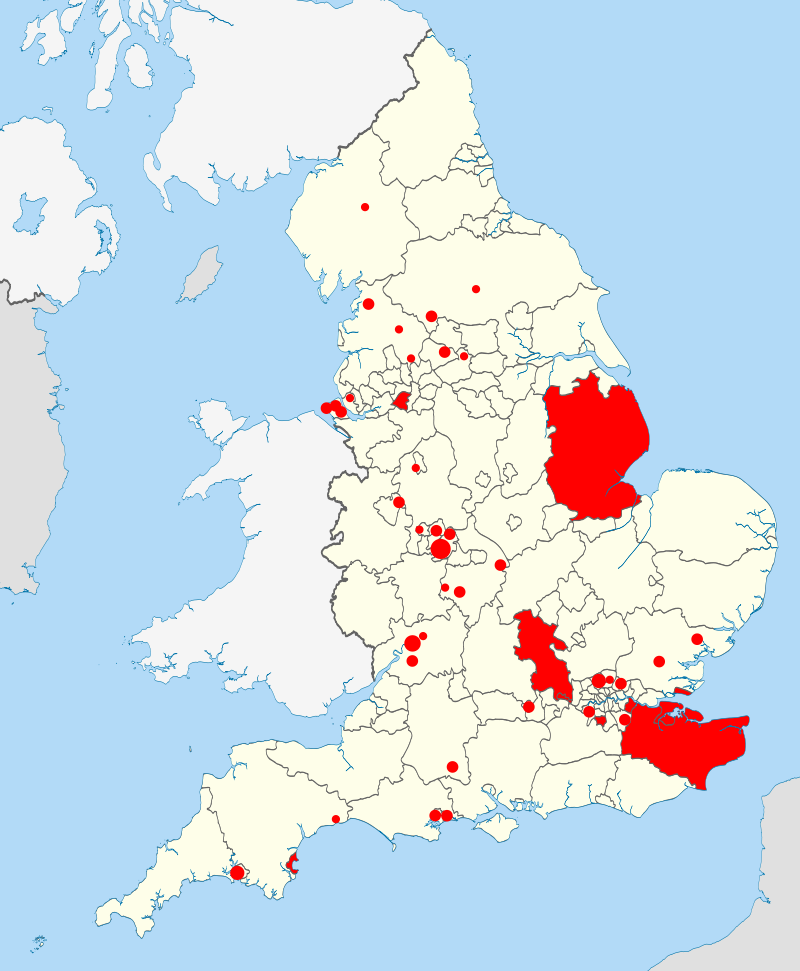](https://en.wikipedia.org/wiki/Eleven-plus)Grammar school areas and groups in England (Ref: [Wikipedia](https://en.wikipedia.org/wiki/Eleven-plus "11 Plus Schools Around England"))
Here is 6-step approach tailored for passing the 11 plus test:
1. Find online or paper based 11plus mock tests
2. Do one 11plus mock test
3. Mark the test or if online submit it for automatic marking
4. Review the feedback / test results and identify improvement areas
5. Find exercises / worksheets to practice these areas
6. Repeat from 2 above until an 80% score is consistently being achieved
Marking these tests is challenging for parents due to the style of questions – some questions measure academic ability and others measure aptitude (intelligence). It’s much easier to either let a tutor do this or use an online 11plus mock test which automatically marks the test and provides a summary identifying areas that require improvement. This saves a lot of time and can be repeated again and again without extra effort.
## What is the pass mark for the 11 plus?
The pass mark for the 11 plus is approximately 80% but fluctuates yearly and can be as high as 90% in some schools. There are a limited number of seats so in reality the children with the highest marks are the ones who get offered a place. The test is very challenging and most simply won’t pass. Using a structured approach and revising intelligently, doing practice questions and complete 11plus mock tests will help increase your child’s chances. Understanding the weaknesses of your child and then addressing them systematically ensures you don’t waste time on areas which your child is already comfortable with.
## How many children fail the 11 plus?
The 11 plus is designed to select the most able pupils and it does this by failing approximately 85% of pupils and selecting approximately the top 15% of pupils. It seems like a failure but rather it’s more a case of not able to do as well as their peers. Unlike other exams which have a predetermined pass or failure mark, the 11+ tests pass mark is relative to the scores of other students. It is all about “making the cut” – coming in within the top 10 or 15% of students.
## How are 11+ test results calculated?
Raw marks go through a standardisation process to allow children to be fairly compared. This standardised score is then used to determine the rank order and what the pass mark is for that particular school and year. 11 plus tests normally consist of a number of tests each with a different number of questions – these marks will then go through a weighting process, and along with the candidate’s age (and possibly postcode, ethnicity and faith), a final standardized score will then be calculated.
The 11 plus test being used by the school may be from an organization, such as GL Assessment or CEM, so the standardisation process will also take into consideration previous years’ 11+ test results and also the different versions of the test and their difficulty. The whole process is quite involved and aiming for more than 85% in any given 11plus mock test will provide you with high level of confidence that your child passes the real thing.
## Does my child need to prepare for the 11 plus tests?
‘Tutor-proof’ 11-plus professor admits grammar school test doesn’t work (Ref: [Guardian](https://www.theguardian.com/education/2016/sep/12/tutor-11plus-test-grammar-schools-disadvantaged-pupils "11 Plus Preparation debate"))
The reasons for children not making “the cut” and coming in the top 15% is many fold and any distraction, domestic problems, or illness should be evidenced and the test postponed. If the pupil is not 100% focused its highly unlikely, he or she will meet the pass rate.
Absolutely, every child sitting the 11 plus will need to prepare, but prepare at the right level and start at the right time. Too much preparation can be just as bad as too little and leave the child overworked and unable to stay motivated leading to underperformance on the day of the exam. Timing is critical and just like an elite athlete a child needs to reach their peak on the day of the exam.
## Factors which can effect your child’s score
Some children who naturally have a higher aptitude and academic ability sometimes lose out to other children who may be less able but have had the support required to prepare and practice. The school curriculum does not cover the material required for the 11plus tests particularly the verbal reasoning and non-verbal reasoning questions are not covered at all in school.
For these questions the right type of preparation is required and its going vary from child to child since reasoning skills may be more or less developed and require nurturing over a period of time. So the fact a child doesn’t pass is not necessarily how difficult he or she found the questions but rather an indication of the lack of preparation and support received.
Right or wrong the 11 plus is not just a test of academic ability but also an indicator of the stability of the environment in which the child lives and how much support a child receives. This could be seen as unfair but it could be justified due to the fact that the same levels of support, or lack of, will continue into later years and leave the child underachieving in a highly competitive environment.
## Conclusion
Passing the 11plus test is very possible and does not require spending 100s of pounds (parents are spending on average 1800 GBP on 11+ tutors) rather it requires a simple, straightforward 6-step approach to determine what your child needs to learn and how much progress he or she has made. Take leave your child disadvantaged. If you need any help or advice on what the best approach simply contact me in the comments below or send me a message on the contact page by clicking here. I’ll get back to you as soon as I can.
## Try a 11 Plus Practice Test
The practice tests on this site are not official tests but use a similar format that can be used to help identify gaps in knowledge and exam taking technique. To try an example of the format and types of questions that may come up click below.
[PRACTICE 11 Plus NOW](/11-plus-practice-test-pack-1-try/)
**Categories:** 11 Plus
---
### [Why Subject Knowledge Doesn't Matter In A CAT Test](https://schoolentranceexam.com/why-subject-knowledge-doesnt-matter-in-a-cat-test/)
**Published:** December 4, 2021
**Author:** Admin
**Excerpt:** What are CAT Tests? CAT Tests or Cognitive Ability Tests are assessments used by many schools and even during job interviews to assess an individuals overall intelligence and future potential. They provide a good indication of future performance and many secondary schools, particularly private, grammar and international schools, use CAT Tests to assess a child’s …
**Content:**
## What are CAT Tests?
Cognitive Abilities Test
CAT Tests or Cognitive Ability Tests are assessments used by many schools and even during job interviews to assess an individuals overall intelligence and future potential. They provide a good indication of future performance and many secondary schools, particularly private, grammar and international schools, use CAT Tests to assess a child’s ability before they start Year 7. These tests are also used by some schools in year 7 and year 8 to help determine which academic set a child should be placed in. The CAT test isn’t used to assess academic and topic knowledge but rather a child’s potential if provided with an appropriate learning environment.
Assessing a child’s ability in any area – or the groups abilities in the different areas – helps the teacher to focus on different learning styles and create material and assessments that provide maximum benefit.
## Types of CAT Tests
### CAT4 / CogAT
There are a variety of CAT tests which are focused on different age groups and created for different purposes. The CAT4 test, or cognitive abilities test, is focused on:
– Verbal Reasoning – Thinking and problem solving with words
– Non-Verbal Reasoning – Thinking and problem solving with shapes and space
– Quantitative Reasoning – Thinking and problem solving with numbers
– Spatial Reasoning – Visualising, picturing and moving shapes around
There are various levels of the CAT4 test ranging from primary school all the way to college / year 12. CogAT is a very similar test and generally used in schools within the United States.
### UCAT Test
The UCAT is a University Clinical Abilities Test which focuses on areas which are more in line with the requirements of a health care professional and consists of:
- 1: Verbal Reasoning.
- 2: Decision Making.
- 3: Quantitative Reasoning.
- 4: Abstract Reasoning.
- 5: Situational Judgement.
Again the first four sections of the UCAT are clearly measuring cognitive abilities which are related to clinical practice – for instance verbal reasoning skills are required to read reports and / or research papers, decision making is needed to determine a care plan for a patient based on the information available, quantitative reasoning is essential when determining dosages, abstract reasoning is needed to be able to see patterns in x-rays, MRIs, and ultrasounds. Section 5 is the one area which is context specific and bringing together all of the other cognitive skills in actual scenarios.
### CAT Test
The Common Admission Test is another form of a cognitive ability assessment which is used by various universities to determine if you have the ability to attend higher education, particularly master level courses. It has in the past consisted of verbal and reading comprehension (VARC), data interpretation and logical reasoning (DILR) and quantitative aptitude. There is a lot of competition to get into university courses so these tests are one part of the admissions process set by the university to help select students who have the potential to do well.
Find out more about the UCAT by clicking [here](https://schoolentranceexam.com/what-is-the-ucat-and-how-to-prepare-for-it/ "Preparing for the UCAT").
## What is a good CAT test score?
A good CAT score is normally one which puts you in the 80th or 90th percentile of the cohort who takes the test. Ultimately if you achieve entry into the school of your choice your score was good enough !
**Categories:** Cognitive Abilities Test
---
### [How to improve your child's vocabulary for the 11+](https://schoolentranceexam.com/how-to-improve-your-childs-vocabulary-for-the-11/)
**Published:** September 29, 2020
**Author:** Admin
**Content:**
Having a better chance of scoring highly in the eleven plus you need to focus on vocabulary, an area that many children find difficult.
## What to expect during your 11 plus tests?

The 11 plus test is designed to assess whether grammar school is a suitable choice for your child. More importantly whether or not if it is the best place for your child to thrive. The 11+ is broken up into four main areas so in the assessment you can expect questions based on English, Maths, Non-Verbal Reasoning and Verbal Reasoning.
## Improving Vocabulary Skills for the 11 Plus
Vocabulary can account for 10% to 15% of the marks in the 11+ exam so your child really needs to make sure they do well in these questions. You’ll need a good quality children’s dictionary – children nowadays use the internet to look up definitions but sometimes the definitions online are confusing. A lot of times they don’t know what they are reading so its better to use a dictionary that uses language they can easily understand.
Probably the most important way of teaching a child new vocabulary is to first introduce the word and then place the word into context and then repeat this a few times so they really get the meaning. This is generally the way we learn when we are very young and continues to work even when we are older. If your child asks you the meaning of a word its a perfect opportunity to provide an explanation but normally just by hearing the word in context the meaning will become obvious. If they do ask you the meaning get them to look it up in the dictionary as a first step.
## Varying the Teaching
To make it more fun sometimes you can ask them to use tools like Siri on your phone. Kids really like using technology and it adds a bit of variety so that learning new words isn’t too boring. Another way of improving vocabulary is by using flashcards and colours to help your child recommend difficult words. Your child should help make them and will definitely remember many of the words because of this. Try to vary the way you make the flash cards to again trigger your child’s memory; you could use felts, crayons and paint. On the reverse of the card put the definition so that when you test your child the answer is readily available.
To further expand your child’s vocabulary you could use a thesaurus and also write the synonyms too. I suggest you write one or two words that your child already knows the meaning of and then write the new words next to it to help expand their knowledge. Flashcards should become part of your daily routine so stick them on your fridge and get your child to look at them at meal time and test them in the morning while having breakfast. You could even test them on the way to school in the car or as you walk along. Don’t do this all the time because you can go overboard but a couple of times a week will help your child’s recall.
It’s also a good idea to put some words away for a few weeks before pulling them out again to see what has been remembered. It is particularly important to point out prefixes and suffixes in words and any other clues that a word has in order to determine its meaning.
## Bond, CGP and other books
There are also a number of Bond and CGP books with verbal reasoning questions that can help your child pickup on patterns, synonyms or antonyms. Spread out all these techniques, there’s no need to do all of this in one week. The 11 plus is all about having understanding as well as recall. One week you might want to focus on new words and cut back on some of their other homework.
If they don’t know how to pronounce the word then they need to practice saying the word out loud by reading story books or following audiobooks which can add a little more context around the word. Reading out a word can help them to grasp the definition as well.
## Some more tips on increasing vocabulary
### 1. Conversation, conversation, conversation
Speak to your chldren all the time and most critically don’t overly dumb down your language. Young children will learn the most difficult of words so itis important to immerse them in new vocabulary from the start. It is truely amazing the amount of words a young child learns and the wider the vocabulary the better a child can score on the 11+.
### 2. Read and listen to your child
You should has regular reading time with your child where you not only read to your child but also listento your child reading. Firstly the interest you show to reading will help your child love reading, secondly you will be modelling the correct reading style with appropriate intonation and pronounciation, thirdly you will provide feedback when your child is reading. It also gives your child an opportunity to immediately ask about vocabulary they do not understand.
The above routine should not stop even after your child can read independently. Children enjoy listening to stories especially from books which they find too difficult. Find books and material which interest them and use non-fiction too. You’ll be surprised at how interested they are when you read an article on the first Space X launch !!
If you do the above religiously you will be amazed at how quickly reading skills, vocabulary, and comprehension develop.
### 3. Play word games
As well as playing the traditional eye spy and scrabble types games you can try something like going through the alphabet and providing a word for each letter in turns. Another variation is the last letter of the word as the first letter of the word you need to think of or simpy as many words as possible for one randomly chosen letter in the alphabet.
All these games will provide your child with useful skills that will be helpful when its time for the 11+.
### 4. Make sentences for new words
Make new sentences of the word – this really helps your child understand how the word can be used. Also if the word has multiple meanings it can help your child understand the subtleties of English. It’s one thing knowing how to say a word another knowing what it really means and using it in your own context. Weekly spelling tests are excellent way of introducing new vocabulary but an added exercise it to create new sentences using the words ! This proves that the child really knows wha the word means – an invaluable skill that is very useful for the 11+.
### 5. Write, write, write and write some more.
Writing is difficult for most adults, only because they didn’t do enough of it when they were children. The first step in writing is to just write ! It doesn’t matter what the topic is, it doesn’t matter about spelling and sentence structure, children just need to start writing. Everything else can be fixed later. Although there is no set 11+ section that requires a written piece of work – if your child can write they can read and understand words better. Have a weekly journal, choose topics for your children or simply ask them to write about their day. Review their work and provide feedback to help them improve, but don’t be overly critical about grammar and punctuation – it takes time to develop a plot and technical details are the last thing on a child’s mind. The bottom line is to just write.
### 6. Create a daily word
This tip is something I did with my kids and it worked wonders. Use letter magnets to make new words every day. Use your fridge as the wall or a magnetic white board which is visible from the place at which you eat your breakfast. The word can then become a topic of conversation and can be used in sentences to help understanding. An easy but very effective way to help your child learn new words. You could even reward your child for using the new word during the day !
### 7. Have a dictionary and thesaurus
It is essential that these two books are accessible to your child at home. You will be amazed at how they’ll just start looking up words for fun. You could also reinforce their use by asking for synonyms of new words you’ve introduced or ask them to expand their writing a little by using richer adjectives and adverbs. Reinforcing the use of new words by simply being a part of your child’s learning journey will help your child to grow their vocabulary and hopefully pass the 11+with flying colours.
If you have some tricks please let me know in the comments below…
**Categories:** 11 Plus
---
### [What Are The Changes To Exams For 2020-2021?](https://schoolentranceexam.com/what-are-the-changes-to-exams-for-2020-2021/)
**Published:** August 9, 2020
**Author:** Admin
**Content:**
*Impact of Covid-19 on Education*
This post was written in August 2020 – just after the government started to ease the lock down.
After consultation the UK government has provided a report on the proposed changes to GCSEs, AS and A-Level assessments in 2020/2021. [Click here](https://assets.publishing.service.gov.uk/government/uploads/system/uploads/attachment_data/file/906173/Consultation_decisions_-_proposed_changes_to_the_assessment_of_GCSEs__AS_and_A_levels_in_2021.pdf) to check out the PDF – keep reading to get a quick summary so you know what to look for. There’s a lot of technical jargon in there so it is quite a difficult read.
## What are the effects of COVID-19 on your education and exams?
The results of a very haphazard approach to delivering online instruction will mean a significant variance in education across the country which ultimately will manifest itself in poor academic performance. The financially challenged and disadvantaged will be impacted the most. Furthermore exams and tests will be delayed and grade boundaries will have to be lowered for national or entrance exams such as; CAT4, 11+, GCSEs, A-Levels. The government has recommended that the 11 plus in particularly be delayed until October / November.
Most schools were closed and conducting online learning for the better part of the third term in the academic year 2019-2020. Teachers needed to come up to speed very quickly in providing online education to all of their children – an almost impossible feat. Most had never taught online so did not understand the pedagogical implications of not being face to face with their students. Handing out a few links and worksheets is simply not good enough and motivation suffered with children not bothering to login and attend. Online pedagogy is in its infancy but most teachers are not aware of how to use the various tools afforded to them.
Secondly children needed to have access to computers, laptops, printers etc.. Many families who struggle financially simply can’t afford to spend 500 pounds for a laptop, printer, along with other consumables such as ink and paper. All this means that learning has suffered with children either not covering the curriculum or not understanding the material.
A lost generation has been created with its effects to last far into the future. This generation has lost out on a third of a year and more than likely will receive below standard instruction for much of 2020 / 2021. Will this be the same for everyone? Of course not, those who are privileged and have the financial ability to do so will have all the equipment required. Others will have online tutors to provide 1-1 tuition. Parents who are capable will have taught and supported their children to ensure they keep up.
## What will happen to A-Levels and GCSEs?
The picture below provides a summary of the subjects that will be effected but it is advised to also contact your exam board.
**GCSEs****AS and A-Levels****AS and A-Levels**Business
Classical Civilization
Classical Greek
Economics
Latin
Maths
Psychology
Religious Studies
Sociology
Accounting
Ancient History
Business
Classical Civilisation
Classical Greek
Computer Science
Economics
English Language / Literature
Futher MathsHistory
Latin
Law
Maths
Pschology
Religious Studies
SociologySummary of Subjects Effected – ( See Appendix of Report [click here](https://assets.publishing.service.gov.uk/government/uploads/system/uploads/attachment_data/file/906173/Consultation_decisions_-_proposed_changes_to_the_assessment_of_GCSEs__AS_and_A_levels_in_2021.pdf) )We are not going to return to the way things were before the pandemic so expect a reduced level of face to face teaching. The implications of this is that practical lessons are going to be difficult to conduct and assess – but what you learn will remain the same. The government has decided that although conducting practicals will be difficult this does not mean a reduced curriculum and all students will be expected to have covered the same material as previous years.
Practicals will be conducted through video demonstrations and many teachers this year will have to create these for physics, biology, and chemistry. It’s a good idea to read through the document to be sure of exactly how your course will be effected. There are details of each of different subjects and the changes that will happen – summary below.
The video below from the OCR Exam board – an excellent summary with a good overview of what we know at the moment.
Exam papers are not going to be effected and will be similar in difficulty in both breadth and depth as previous years. The length and timings of the exams also will not be changing. This approach will actually avoid the difficulty of training teachers on a new approach but will put some pressure on students.
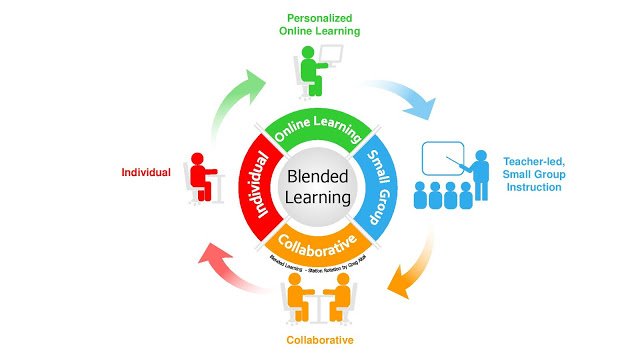*Blended Approach*
The positives are teachers are already accustomed to the material although they will need to work on how best to deliver the material – the coming year looks unlikely to be 100% online or face to face so a blended approach is needed.
## How are practicals going to be conducted for GCSE, AS and A-Levels?
Observation of demonstrations and or simulations to cover the required apparatus and techniques will now be permitted. Students will not need to do the required practicals themselves. Not quite sure how this will be implemented but the skills you learn are just as important so some form of practical would still be a good idea.
Subjects such as Maths which do not have any practicals, are not effected but sciences have practicals as an integral part of the course. Observing these practicals will be required for the A level course where the Common Practical Assessment criteria needs to be fulfilled. This practical endorsement is given at the end of the course and implies you still need to do some sort of practical but it will be a minimal level to demonstrate the skills required. What form this will take is unclear.
Students in Lab from Previous YearsMost students, as of writing, in Year 12 going on to Year 13 will have already done practical work which will cover most of the requirement. Students starting A Levels will have the most disruption to practicals but there is two years to get some hands-on practical experience so it shouldn’t be too much of a worry. In the end you need to know the same amount of content be it A-Level or GCSE which is important when you move on to further and higher education.
## How can students revise for the 2020/2021 Exams?
For some subjects like History, English Literature, and Drama there are a lot more changes but for the Sciences its basically just the practicals. The important thing is they are not going to change the length, number or format of the exam papers, so you can still revise using past papers from 2019 and 2018. Your teachers are already familiar with how to prepare for these style exams and the past papers which are all over the internet are still going to be very useful. For English Literature there will be more choice of questions and for field work in subjects like Geography there’s no requirement to do the field work for Geography. Again check the document for the exact details for your subjects.
## Will the Exam Timetable Change for 2020/2021?
This is not confirmed yet and anything can happen in the next 9 months but if the timetable was pushed back this would effect the results and the university application process so it is unlikely if exam dates will be moved. Pushing exams back will also mean less time for teachers to mark the papers – more room for error – grade boundaries will also need to be determined so if results day is even pushed back from mid August to late August since people need to know their GCSE results for college and Sixth Form.
At every level results are required to help students decided on what options they have next. In terms of University those dates are critical and with later exams there is less time to get results organized and exams marked. At the moment there are no dates for the 2021 exams but its likely there won’t be much of change with exams maybe starting at the end of May and continuing into June. The expectation is there more time will be spent teaching in schools to prepare for exams rather than having exam leave for an extended period of time.
If you are in an independent school or grammar school its more likely you are more organized and have resources at home; with higher motivation levels you’re more likely to have been doing online learning and probably better prepared. Unfortunately the comprehensive school children will suffer with the gap increasing – the document hasn’t addressed this reality but effectively these are national exams and it’s very hard to adjust grades and take into account a student’s background and effectiveness based on this.
Tell me what you think. Should exams be leveled based on the learning environment ? (eg. type of school)
**Categories:** Education
---
### [What Skills Do You Need To Pass The 11+?](https://schoolentranceexam.com/what-skills-do-you-need-to-pass-the-11/)
**Published:** September 15, 2020
**Author:** Admin
**Content:**
The 11 plus is an entrance exam used by grammar schools and private schools all around the country. As a parent who can’t afford to pay for a private school we have to hope that our child can pass and get into one of the grammar schools. As a parent we want the best for our children and want them get a good start to life and not to be disadvantaged. We all know the school your child goes to will have a direct impact on their future.
## Areas Tested in the 11 Plus
Not all tests are built equally and different counties will use different versions – there are two exam boards which design tests (CEM and GL) and its worth asking the school which one your child will be sitting. Generally the areas (or disciplines) being tested are Maths, English, Verbal Reasonining and Non-verbal Reasoning.
11 Plus Exam
Maths and English in the 11+ test check a child’s understanding of these subjects up to the end of year 5 but its worth covering a lot of year 6 too. The questions stretch the material and assume your child has gone to the best school which has pushed up to the edge of the curriculum – its definitely worth covering this material and practicing at a year 6 level.
Non-verbal and verbal reasoning are a little different and don’t directly cover the material your child has covered at school. What they do test is your child’s vocabulary and ability to see patterns, sequences and connections in words and symbols. It’s unlikely your child will ever have done these types of questions at school so its definitely worth practicing 11+ questions in these areas.
## English 11+ Practice Questions
The English skills being tested during the 11 plus test is essentially the same as the work done during KS1 and KS2. The problem is the type of questions being presented are different to what the student is accustomed to. Practice, practice, and more practice is key.
Some of the topics which will come up in he 11+ English section are shown below. A complete set of exercises area available on this site;
Adjectives, Adverbs, Alliteration, Ordering Alphabetically, Antonyms, Apostrophes, Questions, Capital Letters, Commas, Compound Words,Comprehension, Connectives / Conjunctions, Direct Speech, Fact and Opinion, Vocabulary, Indirect Speech, Metaphors, Negatives, Nouns, Onomatopoeia, Paragraphing, Prefixes, Prepositions, Pronouns, Punctuation, Rhyme, Sentence Openers, Similes, Spelling, Suffixes, Synonyms, Their, They’re and There, Verbs, Your and You’re
## Maths 11+ Practice Questions
The Maths skills, just like English, tested during the 11 plus is essentially the same as the work done during KS1 and KS2. The problem is the type of questions being presented are different to what the student is accustomed to. Practice, practice, and more practice is key just like before !
Some of the topics which will come up in he 11+ Maths section are shown below. A complete set of exercises area available on this site;
Addition and Subtraction, Compare and Order Numbers, Decimal Numbers, Fractions, Handling Data, Measures, Multiples, Multiplication and Division, Negative Numbers, Number Sequences, Percentages, Perimeter and Area, Place Value, Position, Properties of Numbers, Ratio, Rounding Numbers, Shapes, Solving Problems, Time
## Verbal Reasoning 11+ Practice Questions
This section of the 11 plus is something new to students. Its tests the students ability to see patterns between words and a wide vocabulary is essential. Synonyms, antonyms, and other such word matching skills are critical. Below are some of the areas which generally will appear in the 11 plus test;
Anagrams, Similes, Complete Sums and Words, Compound Words, Follow Logical Instructions, Find Hidden Words, Insert Letters, Connect Letters / Words / Numbers / Symbols, Make Words, Make Larger Words, Move Letters, Number Series, Grouping Words, Opposite Meetings, Words Questions, Related Numbers / Words, Same Meaning, Odd Words Out, Word Connections, Word-Number Codes, Words with Multiple Meanings
## Non-Verbal 11+ Practice Questions
Non-verbal skills are the least familiar questions for students and parents. The questions are very similar to what you would see in a IQ test with lots of shapes and patterns which need to be completed or grouped. The test is designed to determine a child’s intelligence and aptitude. The ability to learn new subjects is incredibly important and goes hand in hand with subject specific knowledge. Although this area is difficult to revise for there are still strategies and exercises that can be used to develop certain skills ad abilities which will help.
Here are some areas which can be reviewed and practiced to help improve and develop the skills required to do better in this area;
Similar shapes and figures, Breaking Codes, Completing Series of Shapes, Matrices, Find the Odd One, Analysing Shapes and Letters,
## Practice Questions
Watch this space for some practice exercises and quizzes which we’ll soon be adding to the site. If you think of anything that you need to be included please don’t hesitate to comment with details. I’ve put together a short online quiz which you can try now ([click here](https://schoolentranceexam.com/11-plus-practice-test-pack-1-try/ "Free practice 11+ exam")).
**Categories:** 11 Plus
---
### [Powerful CAT Secrets To Boost Life Long Success](https://schoolentranceexam.com/powerful-cat-secrets-to-boost-life-long-success/)
**Published:** October 21, 2021
**Author:** Admin
**Content:**
Cognitive Development Secrets
A child’s ability to succeed at school academically and socially has been studied for many years – many academics, and I have to agree, feel that with the right support and development every child has the potential to achieve more. The age old debate of nature versus nurture still continues to haunt us but yes there are limitations based on physiology and genetics but with the right support the elastic nature of the brain is truly remarkable.
Schools are being held accountable for their students’ academic performance which has led to further focus on the diverse set of skills and attributes that indicate a child’s future performance – academically that is. When is a child ready to start school? What foundational skills are required? There are factors such as where in the social ladder the child comes from which also play a part – with the gap between children from higher and lower income families widening. You could even argue that a child’s readiness at the start of school impacts his or her learning and academic performance into their teens and ultimately effects their employment potential.
## Basic Skills Vs Cognitive Skills
Some academics ([click here](https://helpmegrowmn.org/HMG/HelpfulRes/Articles/WhatCognitiveDev/index.html "What is Cognitive Development") for more info) conclude that basic literacy and numeracy skills are predictors of success while others feel more directly teaching preschool subjects to build skills in particular domains help. Preschool years are critical in a child’s development of mental processes from memory, focus, and problem solving. Those who come underprivileged background generally are behind in the development of these building blocks putting them at a distinct disadvantage when moving to higher level work.
Without the building blocks of memory, focus, and problem solving it becomes more difficult to build other knowledge whatever the domain. If we take the four pillars below as key indicators of future ability to gain knowledge then by setting and focusing on these as precursors to school readiness will allow children to quickly catch in foundational domain specific knowledge such as literacy and numeracy skills.
Four pillars of cognitive Ability
The contributions of different cognitive skills in academic achievement has been identified as major factors to predict ability and growth in emergent literacy and numeracy skills. So it seems and would make sense that by developing executive functions of the brain domain specific achievement is would positively be impacted.
There are so many factors in determining how a child’s cognitive development is impacted during the early years but if a more structured and explicit approach was taken – it may be possible that the tools building blocks of learning can be developed and used helping the individual perform at a higher level for the rest of his or her life.
## Developing Cognitive Skills
Some simple ways of measuring and potentially even developing some of these general cognitive abilities:
1. Repeating a set of words or letters backwards
2. Jigsaws / small puzzles
3. Basic problem solving tasks
4. Card games – Snap, Pairs, Crazy 8, Black Jack etc..
5. Word connection games, verbal and visual
6. Alphabet Soup
7. Dot to Dot
What is probably the most important thing is to engage your child with new and interesting objects and set challenges for them so they have to use their cognitive functions from an early age – in this way they won’t only be ready for school but they will be equipped with the building blocks – foundational abilities – for the rest of their lives.
Find out how the difference cognitive skills assessed in the CAT4 are used in the real world:
**[Non-Verbal Figure Analysis](https://schoolentranceexam.com//non-verbal-figure-analysis "Non-verbal Figure Analysis test")**
**[Non-Verbal Figure Matrices](/non-verbal-figure-matrices "Non-verbal figure matrices test")**
**[Non-Verbal Figure Recognition](/non-verbal-figure-recognition "Non-verbal Figure Recognition test")**
**[Numerical Analogies](/numerical-analogies/ "Numerical analogies test")**
**[Numerical Series](/numerical-series/ "Numerical Series Test")**
**[Verbal Analogies](/verbal-analogies/ "Verbal Analogies Test")**
**[Verbal Classification](/verbal-classification/ "Verbal Classification Test")**
**Categories:** Cognitive Abilities Test
---
### [COVID-19 And Its Impact On The 11 Plus](https://schoolentranceexam.com/what-are-the-effects-of-covid-19-on-the-11-plus/)
**Published:** September 27, 2020
**Author:** Admin
**Content:**
Should the 11+ be pushed back as suggested by the government to as late as November? The guidance which is only advisory indicates that children are not “likely to perform to their utmost ability in a test at the beginning of September” because of school closures during coronavirus. This raises “the elephant in the room” – with current restrictions in schools will children actually get enough education in the extra few months to make up for all that was lost before the summer holidays?
Generally grammar school entry tests are held in September but the guidance from the Department of Education has advised selective schools to move the 11+ back to “late October or November”. The problem is parents will be choosing a school they would like their child to attend without knowing if they qualify and that their child can pass the school’s selection test – the 11+. The Department of Education continues further and advises parents to use their final preference for a local non-selective school since they probably won’t know the results of the pre admission 11 plus by 31st October.
Taken from
https://www.iiep.unesco.org/en/covid-19-educational-disruption-and-response-13363The government also recommends local councils where selective schools are avialable provide at least one extra preference – but appreciate some software used to track results can’t handle the change. The whole situation has left the 11 plus hanging with the possibility that parents won’t know which school their child will go to until early November.
However the guidance is only advisory and will not “prescribe a single course of action”. This will be for admission authorities to decide. The governement has also said written tests should continue to be run under exam conditions, but schools should follow “stringent health measures”. Does this mean cubicles? More cost and delay for schools…
## What happens to at risk students?
Children that are at risk will not be able to attend due to shielding and quarantine. No clear plan for their tests to be completed at home. Does the test at home also makes it unfair and the conditions will differ from child to child with a risk of invalidating the tests as fair and equal.
A list of changes along with links is available on this page;
[COVID Effect](https://comprehensivefuture.org.uk/how-is-the-coronavirus-crisis-affecting-the-11-plus-this-year/ "Effect of coronavirus on 11+")
The 11+ was suppose to be a test of a child’s knowledge from year 1 to year 5 but with COVID the final months of year 5 were possibly not taught well online. Furthermore the revision of the material before the 11+ was probably not done. In these circumstances how valid and fair are is the 11+? Let me know your thoughts.
You can try a few questions right now, which are similar to a real 11+ ([click here](https://schoolentranceexam.com/11-plus-practice-test-pack-1-try/)).
**Categories:** 11 Plus
---
## Pages
### [Get your child into the School of your choice](https://schoolentranceexam.com/)
**Published:** September 12, 2026
**Author:** Admin
**Content:**
# School Entrance Exam
## CAT4 Practice Test
[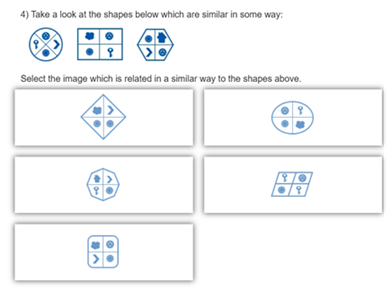](https://schoolentranceexam.com/cat4/)*CAT4 Question Example*
The [CAT4](https://en.wikipedia.org/wiki/School_and_College_Ability_Test "School Cognitive Ability Tests") (Cognitive Ability Test) is a popular entrance exam used by schools to assess pupil ability and likely future academic performance. The practice school entrance tests available on this site are designed to familiarize students with format, style and online delivery method used. Students coming to the end of secondary – from age 10 to 17 will benefit from reviewing these tests. Try a **CAT4** test now ([Non-verbal Figure Classification](/practice-cat4-tests/ "Try a CAT4 Non-Verbal Figure Classification Test Now")).
## 11 Plus Practice Test
[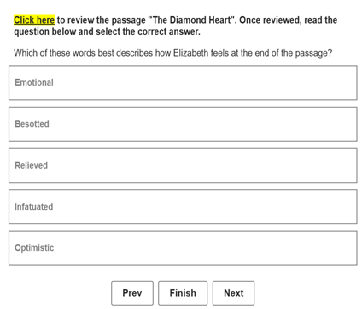](https://schoolentranceexam.com/11-plus/)*11 Plus Example English Question*
Many secondary independent schools and grammar schools use 11+ tests as part of their admission process. Only pupils who gain a high score in this school entrance exam are invited for interview. These assessments evaluate a student’s knowledge of Mathematics and English, along with their verbal and non-verbal reasoning ability. It is normally administered at the end of year 5 or the beginning of year 6. Try a FREE short version of the **11 plus** now ([Online 11+ Test ](/11-plus-practice-test-pack-1/ "Try an online 11plus test now"))
## IGCSE / GCSE Success
International GCSEs / GCSEs are the first set of exams whose results will have an impact on your future. As parents, we need to provide direction on how to get the best grades possible. To this end I’ve created a **[7-step process](/igcse-secret-techniques/ "How to smash your exams using my 7-step process")** for anyone to follow – it’s simple, straightforward and all about maximizing your grades. Of course, if you need my help its available – but if you can find the time and pull up your sleeves it is very possible to do this yourself. It’s key that your child doesn’t get disadvantaged.
## Smashing Your A-Levels
A-Levels are the **ultimate entrance exam** – the one which is critical to the course and university your child attends. A lack of support from the school, a difficult home life, busy parents will all contribute to underperformance. Using the same principles as the **[7-step process](https://schoolentranceexam.com/igcse-secret-techniques/ "7 step exam busting technique")** your child can be as successful as anyone. The key here is creating a plan, staying consistent, and using all the resources available. In the old days we had to read books – today we have YouTube and unlimited, free resources on the internet. The truth is we as parents don’t know how to leverage these advantages to ensure our children do their very best ….
… **[coming soon](/igcse-secret-techniques/ "Make you an exam buster using my secret techniques")**
---
### [CAT4 Tests - Questions Answered](https://schoolentranceexam.com/cat4/)
**Published:** September 12, 2026
**Author:** Admin
**Content:**
[CAT4 PRACTICE TEST](/practice-cat4-tests/)
- [What is the CAT4 Test?](#aioseo-what-is-the-cat4-test-2)
- [What Age is the CAT4 Test Designed for?](#aioseo-what-age-is-the-cat4-test-designed-for-57)
- [What do CAT4 Test Questions Look Like?](#aioseo-what-are-test-questions-like)
- [What do CAT4 Tests Involve?](#aioseo-what-do-cat-4-tests-involve)
- [What are the Results Used For?](#aioseo-what-are-the-results-used-for)
- [Can My Child Revise for the CAT4 Test?](#aioseo-can-i-revise-for-cognitive-tests)
- [Will Parents Get the CAT4 Test Results?](#aioseo-will-parents-get-the-results)
- [What is a Standard Age Score (SAS) in CAT4?](#aioseo-standard-age-scores)
- [Implications for Educational Planning](#aioseo-implications-for-educational-planning)
- [My Child is Dyslexic – Is CAT4 Testing Still Possible?](#aioseo-my-child-is-dyslexic-is-cat4-testing-still-possible)
## What is the CAT4 Test?
The **CAT4** **test** (**cognitive ability test**) is used to predict student success through the evaluation of **verbal**, **non-verbal**, **mathematical**, and **spatial reasoning**. It’s a predictive test to help teachers place students in an academic bracket or set. A **CAT4 test** is used as a school entrance test to assess student ability and future success. Try a **CAT4 practice test** by clicking [here](javascript:void(0);) .
## What Age is the CAT4 Test Designed for?
The CAT4 has multiple levels designed for different year groups: Level A (Year 4), Level B (Year 5), Level C (Year 6), Level D (Year 7), Level E (Year 8), Level F (Year 9 and 10), and Level G (Year 11 and above), covering students roughly aged 7 to 17.
***CAT4** – The fourth edition of the cognitive abilities test published by GL Education*
The **CAT4** test focuses on evaluating different aspects of a child’s learning ability through 8 short quizzes. Understanding a child’s learning ability can help determine if additional support or more challenging work is needed. The **CAT4 tests** provide valuable information for teachers to indicate the academic potential of a child and how best to deliver education for each child or group of students. However, CAT4 tests do not focus on discovering if a child is an auditory, kinesthetic, or visual learner.
## GL Assessment CAT4 Introduction Video Below
**CAT4** is developed and delivered by GL-Assessment and can only be purchased by a teacher from a school. The exam is based on years of research and is very similar to an IQ test for adults. The fourth edition (current) took 5 years to develop and has been proven to accurately determine a child’s potential capability and future academic success at both school and university. It has been tested and validated against thousands of students in the United Kingdom.
## What do CAT4 Test Questions Look Like?
**CAT4** test questions are designed as “puzzles” rather than knowledge-based questions. They evaluate core cognitive skills that are critical for academic success across all subjects. Here’s a breakdown of the types of questions:
- **Non-Verbal Reasoning**: Tests the ability to think about shapes and patterns. Shapes and patterns are presented and the student is asked to determine what comes next, or what the patterns are within the shapes.
- **Verbal Reasoning**: Evaluates a child’s ability to understand and manipulate words. Word patterns are presented with the student asked to determine which words belong, which don’t, and how they are connected.
- **Quantitative Reasoning**: Focuses on identifying numerical patterns. Number patterns are shown and the student is expected to quickly work out the next value.
- **Spatial Ability**: Assesses how well a child can assess visual images. Generating and transforming visual images by being presented with shapes and their transformation – the student is then asked to select the final shape.
You can try a free **CAT4 practice** test by clicking [here](https://schoolentranceexam.com/practice-cat4-tests/ "FREE Basic CAT4 Level D and Level E test").
All skills being evaluated are foundational to a child’s ability and academic performance in both curriculum subjects and real jobs. An architect, for instance will need excellent spatial awareness and quantitative reasoning skills. An English teacher on the other hand will need the ability to see patterns in text and use high verbal reasoning skills.
*Spatial Awareness Skills are Key to a High CAT4 Score*
## What do CAT4 Tests Involve?
A **CAT4 test** battery consists of the following short CAT4 sub-tests with each focusing on different cognitive abilities:
1. [Non-Verbal Figure Classification](https://schoolentranceexam.com/non-verbal-figure-classification/)
2. [Non-Verbal Figure Analysis](https://schoolentranceexam.com/non-verbal-figure-analysis)
3. [Non-Verbal Figure Matrices](https://schoolentranceexam.com/non-verbal-figure-matrices)
4. [Non-Verbal Figure Recognition](https://schoolentranceexam.com/non-verbal-figure-recognition)
5. [Numerical Analogies](https://schoolentranceexam.com/numerical-analogies/)
6. [Numerical Series](https://schoolentranceexam.com/numerical-series/)
7. [Verbal Analogies](https://schoolentranceexam.com/verbal-analogies/)
8. [Verbal Classification](https://schoolentranceexam.com/verbal-classification/)
The **CAT4** test is a well-known assessment in many schools across the UK and teachers use it to understand a child’s capability. [Click here](/list-of-schools-using-the-11-plus-or-cat4 "Grammar and Private Selective School List") to find your school and get further details on the type of admission test they use.
## What are the Results Used For?
The **CAT4** results show a breakdown of the student’s abilities in the four areas mentioned. This can determine if the student is a good fit for the school or place in the right academic group. Generally the **CAT4** test is not used in isolation except for admission tests. If a **CAT4** is taken at school then the results of more traditional assessments are also used. When the **CAT4** is used as a school admission test, an interview is also used to determine acceptance.
Student profiles can be used to understand learning preferences and match learning material to improve educational approach. Placing students in academic sets of similar levels can also help to ensure the pace of teaching is not too fast or too slow.
## Can My Child Revise for the CAT4 Test?
Teachers and schools will strongly advice against revising / practicing for **CAT4** tests. If this is the first time your child is doing these types of “puzzle” questions then they will be at a serious disadvantage. Someone who has done similar tests in the past will almost certainly be able to save some valuable seconds to understand the questions. (Check out suggested CAT4 practice activities – [click here](https://schoolentranceexam.com/cat4-practice/ "CAT4 Practice Activities")). Schools which actively use a more problem solving type of approach will help the child develop these abilities. Parents to can help immensely by ensuring the child is presented with environment which nurtures the foundational skills required for learning.
The “cognitive load” can be significant and may mean that your child under performs simply due to him or her never having experienced these types of questions in an online test before. Typically at school we all do knowledge based assessments but these types of “puzzle” questions testing our abilities are rarely undertaken.
It is ethically incorrect to test yourselves on exactly the same questions but to run through a set of tests so the student appreciates the format and the online manner of delivery takes nothing away from the results themselves. Also due to the tests being timed its a good idea to be familiar with the format so valuable seconds are not wasted when doing the **real CAT4 tests**.
## Will Parents Get the CAT4 Test Results?
Teachers are provided guidelines on what information and how to share it with parents. The [CAT4 Teacher Guide Pack](https://www.gl-assessment.co.uk/media/352239/29759-cat4-uk-combined-v9.pdf "Official Teacher Pack for the CAT4") provides further information in this regard but generally teachers are happy to share areas of improvement and the strengths of your child. At the end of the day the **CAT4** is a diagnostic test used to determine how we can deliver education better and which areas a child needs to focus on to further develop their skills and become a more rounded individual.
### What is a Standard Age Score (SAS) in CAT4?
CAT4 test results are expressed in [Standard Age Scores (SAS)](https://support.gl-education.com/knowledge-base/guides/a-guide-to-standardised-tests/a-guide-to-standardised-tests/how-are-standardised-test-results-described/ "Standardized Age Score"). The Standard Age Score (SAS) is used to compare against performance of peers in the same age group and is calculated using a national sample of pupils. The average SAS is set at 100, with a standard deviation of 15. Scores falling within the range of 85-115 are considered typical and within the expected average performance.
- Above-Average Performance (SAS >115): Signifies above-average cognitive abilities in the specific area tested. This may indicate a student’s potential for excelling in related academic subjects and potential giftedness in those domains.
- Below-Average Performance (SAS < 85): Highlights potential areas of weakness that may require additional support or intervention. Identifying weak areas early on can help educators and parents tailor their teaching strategies to address these challenges effectively.
### Implications for Educational Planning
CAT4 test results offer valuable information for educational planning and student support. Identifying a student’s cognitive strengths and weaknesses enables educators to develop personalized learning plans that cater to individual needs. For students with above-average scores, enrichment programs can be tailored to stimulate their abilities further. Those with below-average scores can benefit from targeted interventions and remedial programs to boost their skills and confidence and bring them to acceptable levels. The results will also help the school understand what resources they will need and the skills they should focus on to ensure they produce well rounded students.
## Try a Practice CAT 4 Test
*CAT4 Tests Evaluate Foundational Intelligence*
The practice CAT4 tests on this site are not official tests but use a similar format that can be used to help your child become acquainted with format and medium used. If your child has never sat a computer exam before or answered similar visual / numerical / verbal reasoning questions then he or she will be at a significant disadvantage to other children that have.
To try an example of the format and types of questions that may come up click below.
[Start CAT4 PRACTICE NOW](/practice-cat4-tests/)
## My Child is Dyslexic – Is CAT4 Testing Still Possible?
This is a difficult question and generally depends on what the school hopes to gain from the test. Dyslexia can be mild and severe and everything in-between so its impossible to say 100% that the test will not be possible for a particular student.
*Dyslexic Children Shine in Other Ways*Dyslexia can also create more pronounced abilities in certain areas – similar to autistic children. These children may score much higher in the CAT4 subtests measuring non-verbal, mathematical and spatial reasoning abilities but do poorly on the other tests related to verbal skills. The CAT4 tests may also help discover children who have mild forms of dyslexia which have remained undiscovered during their schooling until now.
For severely dyslexic children it may not be appropriate to run the **CAT4 tests**. Other tests may be more appropriate or should at least supplement the **CAT 4 test** results. It is best to speak with your learning support advisor at your school to understand your options.

Helping you help your child do their very best.
[Admin](https://schoolentranceexam.com/author/admin/)
---
### [Maze With Math to Improve Logical Reasoning](https://schoolentranceexam.com/improve-cat4-numerical-reasoning/)
**Published:** October 11, 2025
**Author:** Admin
**Content:**
Welcome to **A Maze’n Math**, the interactive online game that challenges your brain while improving skills that matter most for **[CAT4 tests](https://schoolentranceexam.com/cat4-assessment/ "CAT4")**. Designed to combine maze navigation with engaging number puzzles, this game is not just fun—it’s a practical way to develop **problem-solving, spatial reasoning, logical thinking, and numerical agility**, all essential components of the CAT4 cognitive abilities test. Whether you are preparing for school entrance exams, practicing for higher-level thinking skills, or just looking to give your brain a workout, A Maze’n Math is the perfect choice. Use the link below to launch the puzzle and start improving today.
[Launch Math 'n Maze](javascript:void(0);) [Pattern Detectives](javascript:void(0);) ---
## Why Mazes and Math Boost CAT4 Skills
The **CAT4 (Cognitive Abilities Test)** measures students’ potential rather than their academic knowledge, focusing on reasoning skills in **verbal, non-verbal, quantitative, and spatial domains**. One of the most effective ways to build these skills is through activities that stimulate your brain in a variety of ways—just like A Maze’n Math does.
- **Spatial reasoning**: Navigating a maze requires visualizing paths, predicting turns, and understanding the relationship between your current position and the goal. Practicing this develops **[non-verbal reasoning](https://schoolentranceexam.com/wp-content/uploads/2020/05/non-verbal-reasoning-figure-classification-1.png "CAT4 Non-verbal Reasosning")**, a core part of CAT4.
- **Problem-solving**: Each maze is randomly generated, presenting a new challenge every time. Players must plan moves carefully and react quickly to obstacles, improving **[logical reasoning](https://schoolentranceexam.com/how-to-improve-your-ucat-abstract-reasoning-score/ "Abstract logical reasoning")** and decision-making skills.
- **Numerical reasoning**: The number puzzles at the end of each maze require fast mental calculations, strengthening **quantitative reasoning**, which mirrors the math-based questions on CAT4 tests.
- **Concentration and focus**: As difficulty increases, players must track paths, monitor time, and solve puzzles simultaneously—enhancing **working memory** and attention, vital for exam performance.
By regularly playing A Maze’n Math, students naturally strengthen the same cognitive abilities assessed in CAT4, giving them a **competitive edge** in both school assessments and academic challenges.
---
## How A Maze’n Math Works
A Maze’n Math blends two engaging elements into a single game:
1. **Maze Navigation**: Each game played presents a randomly generated maze. Your goal is to navigate from the starting point to the target as efficiently as possible. The longer you take, the more challenging the game becomes, which trains speed, planning, and **strategic thinking**.
2. **Number Puzzles**: As you navigate the maze number puzzles will appear which require solving. These puzzles will be at varying difficulty helping you improve your **quantitative reasoning skills**.
Just like **[CAT4 practice tests](https://schoolentranceexam.com/practice-cat4-tests/ "Level D and E CAT4 Practice")** this activity helps to improve your problem solving and numerical reasoning abilities.
---
## Mobile-Friendly and Accessible Anywhere
Understanding that students learn on a variety of devices, A Maze’n Math is fully **mobile-friendly**. The game adjusts to any screen size, from desktop monitors to tablets and smartphones. Touch controls allow you to move through the maze easily, ensuring that **learning and fun are never limited by device**.
Whether practicing at home, during breaks, or on the go, players can keep building their CAT4 skills anytime, anywhere. This **flexibility in practice** is essential for consistent skill improvement.
---
## Why Playing Games Can Be More Effective Than Traditional Study
Unlike traditional worksheets or drills, interactive games like A Maze’n Math make **skill-building engaging and rewarding**. Immediate feedback from maze completion, timed challenges, and math puzzles creates a **dynamic learning loop**: players learn from mistakes, adjust strategies, and strive to improve.
This kind of **active learning** has been shown to improve retention, mental agility, and confidence—all factors that contribute to better performance on cognitive assessments like **[CAT4](https://schoolentranceexam.com/cat4/ "CAT4 practice for your child")**.
---
## Start Your CAT4 Training Today
A Maze’n Math isn’t just a game—it’s a **practical CAT4 skill-building tool** wrapped in a fun, interactive experience. By combining maze navigation, number puzzles, and timed challenges, it trains the same reasoning abilities that the CAT4 test measures, giving students a **strategic advantage** before exams.
**Ready to challenge your brain and boost your CAT4 performance?**
Every maze solved and puzzle answered brings you one step closer to **sharper reasoning, faster thinking, and higher CAT4 potential**.
---
### [Proven Exercises to Increase Your Cognitive Abilities Test Performance](https://schoolentranceexam.com/improve-cognitive-abilities/)
**Published:** October 9, 2025
**Author:** Admin
**Content:**
## Maze Game
Boost CAT4 test performance with the interactive maze game below. Strengthen spatial reasoning, logic, memory, and problem-solving skills while having fun.
The interactive maze below strengthens the same problem-solving and spatial reasoning skills used in cognitive tests such as the CAT4 and 11+ reasoning tests.
Use the following link to launch the maze game and improve your spatial awareness: [Launch Maze Game](javascript:void(0);) or alternatively try the [Math ‘N Maze game ](https://schoolentranceexam.com/improve-cat4-numerical-reasoning/ "Numerical Reasoning for the CAT4")which combines non-verbal and numerical reasoning skills.
## 🧠 1. Spatial Reasoning (CAT4 Spatial Ability)
Cognitive abilities tests like **CAT4** include spatial reasoning sections where students must visualize, rotate, and manipulate shapes.
✅ **How the maze helps:**
- Navigating a maze requires **mental visualization** — imagining the layout, turns, and possible routes.
- The student constantly anticipates spatial movement (“if I move up, I’ll hit a wall; if right, I’ll reach the corner”), reinforcing **spatial planning** and **spatial awareness**.
- This directly trains **mental rotation** and **pattern recognition** — key CAT4 spatial subtests (Figures, Folding, and Rotation).
---
## 🔍 2. Problem Solving & Logical Thinking
Cognitive ability tests measure how efficiently a student can **reason through unfamiliar problems**.
✅ **How the maze helps:**
- Every path choice is a **mini logical puzzle**.
- The player learns to reason **step-by-step**, predicting cause and effect.
- It builds persistence, **systematic thinking**, and the ability to eliminate wrong choices — the same process needed for **verbal and non-verbal reasoning** questions.
---
## ⚙️ 3. Working Memory & Attention
In CAT4 and other reasoning tests, students must remember information while solving a question — that’s **working memory**.
✅ **How the maze helps:**
- The player must hold the maze structure in mind — “I came from there, that route was blocked.”
- This engages **short-term memory**, **attention control**, and **sequential processing** — all vital for reasoning under time pressure.
---
## ⏱ 4. Processing Speed & Decision-Making
Cognitive tests are timed. Students who process patterns faster tend to perform better.
✅ **How the maze helps:**
- Repeated play trains **rapid decision-making** under mild pressure.
- Over time, students learn to **balance accuracy with speed** — a transferable skill to test-taking.
---
## 🎯 5. Emotional Regulation & Perseverance
Cognitive tests also reward **mental stamina** and composure under challenge.
✅ **How the maze helps:**
- Mazes provide immediate feedback (wrong turns, dead ends).
- This encourages **resilience**, **strategic retrying**, and the ability to stay calm while problem-solving — all key traits for top performers.
---
## 💡 Summary Table
Skill TrainedMaze Game ActivityRelated CAT4 AreaSpatial visualizationNavigating turns, imagining pathsSpatial AbilityLogical reasoningPlanning next steps logicallyNon-verbal ReasoningWorking memoryRemembering previous pathsQuantitative & Verbal ReasoningProcessing speedQuick decision-makingAll timed subtestsResilience & focusOvercoming dead endsTest-taking stamina
---
### [CAT4 Practice Activities - How to Help Your Child](https://schoolentranceexam.com/cat4-practice/)
**Published:** July 24, 2022
**Author:** Admin
**Content:**
Will **CAT4 practice** help? Can students practice their cognitive abilities? Will doing similar exams especially **practicing the CAT4** help with performance in the real test? The **CAT4** is the fourth edition of the cognitive abilities test published by GL Education and used widely across the UK and internationally. It is either part of the admission process or predicts the future performance of students. Questions presented within the CAT4 are similar to an IQ test but simplified depending on the level – also there is no domain specific knowledge being assessed e.g. science, formulas, etc..
[](https://schoolentranceexam.com/improve-cognitive-abilities/)CAT4 Practice Activity – [Click here](https://schoolentranceexam.com/improve-cognitive-abilities/ "Improve Your Cognitive Abilities Using Proven Exercises") to Develop Spatial Skills
The different dimensions of our cognitive skills provide insight into our potential academic performance;
- Sustained Attention
- Divided Attention
- Long-Term Memory
- Working Memory
- Logic and Reasoning
- Auditory Processing
- Visual Processing
- Processing Speed
These abilities help your brain “**think, read, learn, reason, pay attention and remember.**” *([International School of Arizona](https://isaz.org/9-cognitive-skills-to-develop/ "9 Cognitive Skills we should Practice"))*. For every parent the next question arises is “how can I help my child develop and practice and improve these cognitive skills?”
## CAT4 Practice to Improve Assessed Cognitive Skills
Questions presented in the CAT4 are split into [8 different subtests](https://schoolentranceexam.com/what-type-of-questions-are-in-a-cat4-test/ "Questions to Practice for the CAT4") in order to measure four different cognitive areas – each of which assess the 9 cognitive skills areas identified above. Various CAT4 practice activities can help your child develop and perform well in the CAT4 exam – but a word of warning – CAT4 skills develop over time so start finding and practicing activities as soon as possible:
**Verbal**
**Reasoning** (VR)Thinking using words – measures the ability to identify patterns, determining groupings, and comprehend information in words. Scrabble, word association exercisesNon **Verbal Reasoning** (NVR) Thinking in shapes – measures ability to see patterns and classify, understand rules within shapes and match.Pairs, video gaming**Quantitative Reasoning** (QR) Thinking in numbers – ability to understand numbers, their relationships, and patterns between them.Banking games, monopoly, stocks and shares, graph interpretation **Spatial Awareness** (SA)Thinking in space – uses shapes in space to assess ability to understand how things can transform in a particular space or be seen from in different perspectives.Lego, model building, origami, video games (oculus) – in moderation of course !CAT4 Practice Activities## Basic Cognitive Skills Practice
We all have innate abilities, but practice is the number one factor that helps any child improve – so here are a a few examples of how to **practice cognitive** skills and accelerate a child’s development of fundamental core skills:
**Sustained Attention**Staying focused one task for a long time. Many children have trouble with this -this could be practiced by gradually increasing activity lengths and even having one project which spans multiple sessions over a period of days, weeks, months, and even years. A child needs to practice their ability to focus it doesn’t come naturally especially with longer tasks, and is even more difficult when tasks span multiple sessions.Short projects, activities, which are gradually increased in length. Long term projects over multiples sessions.**Selective Attention**Being able to focus on one thing even with all the distractions in the world practicing this would be when doing your homework in front of the TV. Most children try this and fail miserably again explicit cognitive practice with a deliberate goal is key to improvement.Working in a coffee shop, working while eating, working in front of the TV.**Divided Attention**Multi-tasking, or doing more than one task at a time; this is not entirely accurate since their still is a switch between one task and the other but developing the ability to do this quickly and efficiently is key to working in the real world. Again providing two tasks for child to practice which interrupt the child at regular intervals while doing the other task. Doing your homework while eating may progress to playing two chess games – takes a lot of practice to be able to multi-task efficiently !Assigning multiple tasks at the same time. Playing two games of chess a the same time etc..**Long-Term Memory**A key skill in any test or activity – memorizing key information from past events; reviewing work for a week ago, two weeks ago, a month ago, a year ago. Gradually build up and ask for details as well as the big picture to help your child understand.Ask questions on most recent work, older work, events from the past. Repeat consistently.**Working Memory**Quick instructions for a child to retain in working memory in order to complete a task. Practicing giving your child tasks and activities in this way will gradually strengthen their ability to retain information in working memory. House chores, simple instructions, gradually building up to more complex tasks.**Logic and Reasoning**Logic and reasoning is modelled – and staying calm in overwhelming situations is a key skill to ensure these cognitive abilities are being used. Again parents can help children practice and develop these skills through activities.Lego, real work problem solving, put together the next Ikea flatpack ! Variety is key.**Auditory Processing**This critical skill allows a child’s brain to better analyze, blend, and segment information. Auditory processing is especially useful when learning to read by helping better understand the information being presented.Listening to the radio, listening to the TV without watching it. Listening to you – always ask follow up questions to ensure the listening is active.**Visual Processing**Just like auditory processing, visual processing helps interpret visual information better. Things such as images, maps, graphs, and tables will be much easier to analyze and understand.Video games in moderation are an easy way to practice this cognitive skills. Jigsaws are another.**Processing Speed**Speed of thinking needs to be practiced. By throwing out random questions helps your child improve their neural pathways and practice their skills in information recall and processing.Practice using quick fire tests, quizzes, and activities.Cognitive Skills Practice Activities## CAT4 Skills Practice to Score Higher
Cognitive skills develop as we grow and however we break them down (the 9 areas from *[International School of Arizona](https://isaz.org/9-cognitive-skills-to-develop/ "9 Cognitive Skills we should Practice")* or the 4 areas assessed in the CAT4 from [*GL Education*](https://www.gl-education.com/ "CAT4 Pubilsher")) exposing your child to as many different experiences and providing opportunities for them to practice is key.
Cognitive Skills Building Blocks
Developing cognitive skills will improve a child’s performance, but it is incredibly important to appreciate that every child is unique and will learn at their own speed. Also one child may have a tendency to be more comfortable with auditory tasks while another visual – we provide practice opportunities for both their strengths and their weaknesses.
Cognitive skills and IQ test makers will adamantly state you should not revise for a cognitive skills test – so this implies **CAT4 practice tests** are out of the question – I disagree with this and believe our children our developing and practicing their cognitive skills as soon as they are born. If we provide deliberate cognitive skill practice which will focus on the four areas in the **CAT4** then this is simply a way of providing the opportunity to develop. CAT4 practice involving actual question can even form a part of this and may even help in developing a child’s basic cognitive skills outside the area of skills assessment.
Bottom line is you should provide your child with as many experiences as you can to practice the cognitive skills described above (this will ultimately include the areas involving any **CAT4 Practice**). Every child can improve and every child has the potential through the correct practice and developmet.
---
### [Products](https://schoolentranceexam.com/products/)
**Published:** October 2, 2025
**Author:** Admin
**Content:**
Select sorting optionSort by latestSort by titleSort by price (low to high)Sort by price(high to low)

£1,695.00
Complete GCSE Success
[View Item](https://schoolentranceexam.com/asp-products/complete-gcse-success/)

£1,095.00
Core GCSE Focus
[View Item](https://schoolentranceexam.com/asp-products/core-gcse-focus/)

£695.00
Focused GCSE Improvement
[View Item](https://schoolentranceexam.com/asp-products/focused-gcse-improvement/)

£19.99
11 Plus Pack 1
[View Item](https://schoolentranceexam.com/asp-products/11-plus-pack-1/)

£29.99
CAT4 Level A
[View Item](https://schoolentranceexam.com/asp-products/cat4-level-a/)

£29.99
CAT4 Level B
[View Item](https://schoolentranceexam.com/asp-products/cat4-level-b/)

£29.99
CAT4 Level C
[View Item](https://schoolentranceexam.com/asp-products/cat4-level-c/)

£29.99
CAT4 Level D
[View Item](https://schoolentranceexam.com/asp-products/cat4-level-d/)

£29.99
CAT4 Level E
[View Item](https://schoolentranceexam.com/asp-products/cat4-level-e/)

£29.99
CAT4 Level F
[View Item](https://schoolentranceexam.com/asp-products/cat4-level-f/)

£29.99
CAT4 Level G
[View Item](https://schoolentranceexam.com/asp-products/cat4-level-g/)

£14.99
CAT4 Original Level E
[View Item](https://schoolentranceexam.com/asp-products/cat4-original-level-e/)
---
### [CAT4 Level E Practice Test (Year 8)](https://schoolentranceexam.com/cat4-level-e-year-8-tests/)
**Published:** January 9, 2023
**Author:** Admin
**Content:**
$(document).ready(function(){ $("select").change(function(){ $(this).find("option:selected").each(function(){ var optionValue = $(this).attr("value"); switch(optionValue) {
case "O": window.location.href = "/practice-cat4-tests/"; break; case "A": window.location.href = "/cat4-level-a-year-4-tests/"; break; case "B": window.location.href = "/cat4-level-b-year-5-tests/"; break; case "C": window.location.href = "/cat4-level-c-year-6-tests/"; break; case "D": window.location.href = "/cat4-level-d-year-7-tests/"; break; case "E": window.location.href = "/cat4-level-e-year-8-tests/"; break; case "F": window.location.href = "/cat4-level-f-year-9-year-10-tests/"; break; case "G": window.location.href = "/cat4-level-g-year-11-tests/"; break; default: // code block } }); }).change(); });
document.addEventListener('DOMContentLoaded', function () { // Select all elements with the class 'paoc-popup-click' const popupClickElements = document.querySelectorAll('.paoc-popup-click');
// Add a click event listener to each element popupClickElements.forEach(function (element) { element.addEventListener('click', function () { // Scroll to the top of the page window.scrollTo({ top: 0, behavior: 'smooth' // Smooth scrolling animation }); }); }); });
The **CAT4 Level E test** is a cognitive assessment taken by students aged **11 years 6 months to 13 years 11 months** for **Year 8 entry** in secondary schools. Many schools also use the **CAT4 Level E** internally to assess pupil ability, helping teachers tailor instruction and set **ability-based groups (sets)** for GCSEs. They use the results are a predictor for future GCSE success. The eight sub-tests evaluate different cognitive skills and provide educators with a measure of a child’s learning potential, strengths and weaknesses, and future academic performance.
**Click on the images** below to launch the practice tests.
Select another level Level A Level B Level C Level D Level E Level F Level G Basic Level D/E
[](javascript:void(0);)
[](javascript:void(0);)
[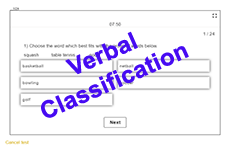](javascript:void(0);)
[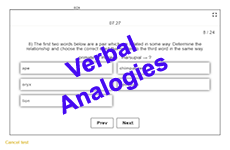](javascript:void(0);)
[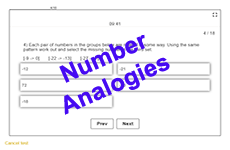](javascript:void(0);)
[](javascript:void(0);)
[](javascript:void(0);)
[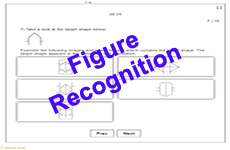](javascript:void(0);)
Results for each of the practice **CAT4 Level E** tests will be available in your [practice history](https://schoolentranceexam.com/school-entrance-exam-practice-history/ "Test practice history to measure improvement.") page.
Check out the [full breakdown ](https://schoolentranceexam.com/cat4-levels/)of each level and which age group it applies to.
### **Best Approach for CAT4 Level E Practice**
1️⃣ **Take a Subtest & Review Thoroughly**
- Complete one section, then analyze answers and solutions in detail.
- This builds familiarity with question patterns, reducing surprises on test day.
2️⃣ **Retest After a Break**
- Reattempt the practice test after a few hours or a day to reinforce understanding.
- Questions are randomized, ensuring fresh challenges (though some may reappear in different formats).
3️⃣ **Aim for 80-90% Mastery**
- Consistently hitting this range indicates strong readiness for the **real CAT4 Level E exam**.
- Note: Practice tests are indicators—final performance depends on actual test conditions.
**Parent Tip:** Many families see success with this method, but the real goal is helping your child **do their best**. As a parent, focus on progress over perfection.
All the best to your child achieving their future success!
---
### [CAT4 Level D Practice Test (for entry into Year 7)](https://schoolentranceexam.com/cat4-level-d-year-7-tests/)
**Published:** January 9, 2023
**Author:** Admin
**Content:**
$(document).ready(function(){ $("select").change(function(){ $(this).find("option:selected").each(function(){ var optionValue = $(this).attr("value"); switch(optionValue) {
case "O": window.location.href = "/practice-cat4-tests/"; break; case "A": window.location.href = "/cat4-level-a-year-4-tests/"; break; case "B": window.location.href = "/cat4-level-b-year-5-tests/"; break; case "C": window.location.href = "/cat4-level-c-year-6-tests/"; break; case "D": window.location.href = "/cat4-level-d-year-7-tests/"; break; case "E": window.location.href = "/cat4-level-e-year-8-tests/"; break; case "F": window.location.href = "/cat4-level-f-year-9-year-10-tests/"; break; case "G": window.location.href = "/cat4-level-g-year-11-tests/"; break; default: // code block } }); }).change(); });
document.addEventListener('DOMContentLoaded', function () { // Select all elements with the class 'paoc-popup-click' const popupClickElements = document.querySelectorAll('.paoc-popup-click');
// Add a click event listener to each element popupClickElements.forEach(function (element) { element.addEventListener('click', function () { // Scroll to the top of the page window.scrollTo({ top: 0, behavior: 'smooth' // Smooth scrolling animation }); }); }); });
The **CAT4 Level D** is one of the most popular tests used by school admission teams and is normally taken after or at the end of Year 6 for children aged between **10 years 6 months to 12 years 11 months**. Many schools use this test as a predictor of future performance and to determine which ability set to place students in during the next school term. The **CAT4 test Level D** assesses different cognitive abilities which can then be analysed to identify weaknesses, strengths, and future potential.
**Click on the images** below to launch the practice tests.
Select another level Level A Level B Level C Level D Level E Level F Level G Basic Level D/E
[](javascript:void(0);)
[](javascript:void(0);)
[](javascript:void(0);)
[](javascript:void(0);)
[](javascript:void(0);)
[](javascript:void(0);)
[](javascript:void(0);)
[](javascript:void(0);)
The best approach to using the tests is to do one of the subtests and then review the answers and solutions in detail so you completely understand how to approach similar questions in the future. This is key to improvement – do the test and then review the questions and their solutions in detail – this essential step will help to understand the different question types and if another similar question is presented in the real test then it won’t be a surprise. I also suggest you repeat the test possibly after a day or a few hours to allow your mind to absorb the approach and come back fresh. When you redo the test it will randomly select questions from the question bank and also display them in a random order along with the answers – although this will be quite unique each time there may be a question or two which are similar but its unlikely to be exactly the same in placement and order as before.
You should aim to get 80-90% to have a solid chance at the real **CAT4 Level D test**. These practice test questions and answers are randomly ordered and will help familiarise you with the questions but ultimately it is the performance in the real test and any practice tests are simply an indicator. A lot of parents have had a good results using the process above but as a parent myself all I can hope for is for my child to do the very best they can.
All the best to your child achieving their future success!
Results for each of the **CAT4 Level D** practice tests will be available in your [practice history](https://schoolentranceexam.com/school-entrance-exam-practice-history/ "Test practice history to measure improvement.") page.
Check out the [full breakdown ](https://schoolentranceexam.com/cat4-levels/)of each level and which age group it applies to.
---
### [Practice and Improve by Using Past Exam Papers](https://schoolentranceexam.com/practice-and-improve-by-using-past-exam-papers/)
**Published:** May 8, 2020
**Author:** Admin
**Content:**
Past exam papers for GCSE / A-Levels are key to filling in any gaps and getting used to the real thing. Here are some useful links. You’ll find different boards and different years along with the marking schemes (which are really important). My advice is to print out at least 3 sets of each subject / paper from different years – best to start with the older papers and work up to the more recent so that your child is accustomed to the most current versions just before they sit the exam:
[Pastpapers.co](https://pastpapers.co "Past papers from different exam boards")
[Pearsons Past Papers](https://qualifications.pearson.com/en/support/support-topics/exams/past-papers.html "Pearsons Past exam papers")
The actual board website also will have past papers and possibly some sample tests using the most recent specification.
I know it’s difficult to find practice exams, mark them and do the whole process so I’m offering to do it all for you.
Let me manage the whole process for your child’s GCSEs. Get the GCSE support your child needs to do their best by [clicking here](https://schoolentranceexam.com/get-ongoing-gcse-coaching-and-support-for-your-child/).
---
### [CAT4 Verbal Classification Practice Test](https://schoolentranceexam.com/verbal-classification/)
**Published:** June 21, 2018
**Author:** Admin
**Content:**
One of the key components of the Cognitive Abilities Test Fourth Edition ([CAT4](https://en.wikipedia.org/wiki/Cognitive_Abilities_Test "CAT4 Admissions Test")) exam is the Verbal Classification section. This sub test assesses a student’s ability to identify relationships between words and categorize them accordingly. In this article, we will delve into the Verbal Classification section of the CAT4 exam, providing you with a thorough understanding of what it entails, how to prepare for it, and tips to excel.
How much is your child’s education worth? Get access to the rest of the site to avoid your child being disadvantaged. [Click here](/membership-join/) now.
## Understanding Verbal Classification in the CAT4 Exam
### What is Verbal Classification?
Verbal classification involves identifying similarities among words or letters to pick the odd one out. It’s a key logical reasoning skill that is evaluated in many competitive exams to determine if the test taker has the ability to learn effectively. Verbal Classification is a critical part of the CAT4 exam and helps to ascertain a child’s ability to absorb verbal patterns and information; a skill that will be used across topics. Questions present students with a set of words and requires them to identify the one which does not belong with the others. The task involves recognizing patterns, understanding relationships, and applying logical reasoning to determine the correct classification.
### Why is Verbal Classification Important?
Verbal Classification isn’t just about vocabulary but rather its about how a student thinks critically and analytically in a “verbal” context. These skills are good indicators for future success in a variety of subjects, including language, science, and social studies. Students can enhance their problem-solving abilities, improve their reading comprehension, and develop a deeper understanding of language structure by developing their verbal classification skills.
## Structure of the Verbal Classification Section
### Types of Questions
1. **Synonym and Antonym Relationships**: Identifying words that are synonyms or antonyms of each other.
2. **Category Membership**: Recognizing words that belong to a specific category.
3. **Part-to-Whole Relationships**: Understanding how a part relates to the whole.
4. **Degree of Intensity**: Identifying words that represent different levels of intensity or magnitude.
To better understand the types of questions here are a few examples:
### Verbal Classification **Synonym and Antonym Relationships** Question
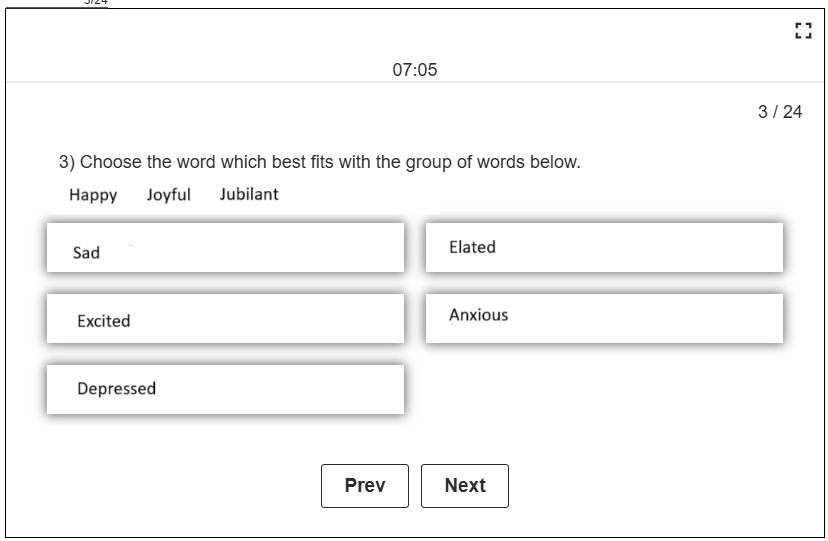### Verbal Classification **Category Membership** Question
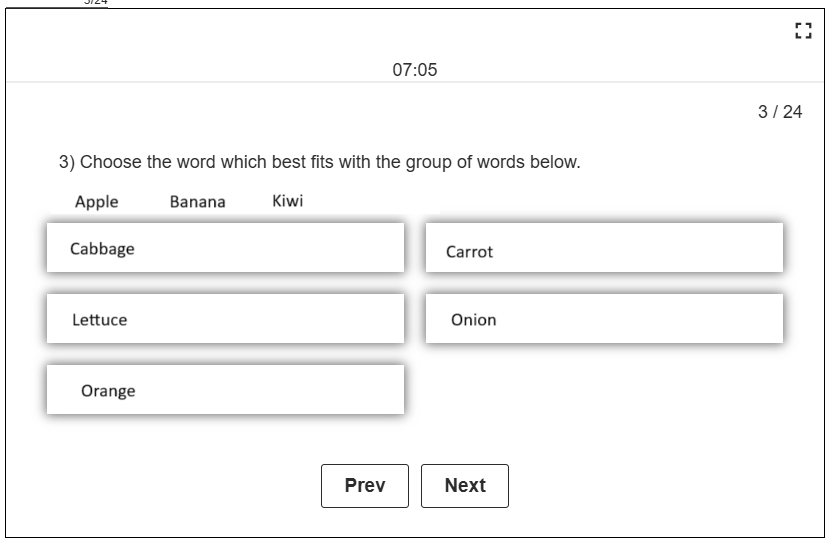### Verbal Classification **Part-to-Whole Relationships** Question
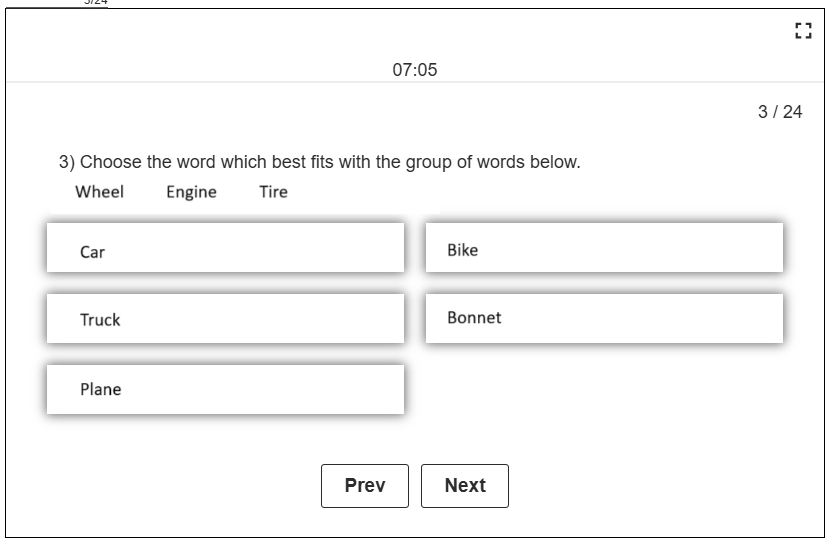### Verbal Classification **Degree of Intensity** Question:
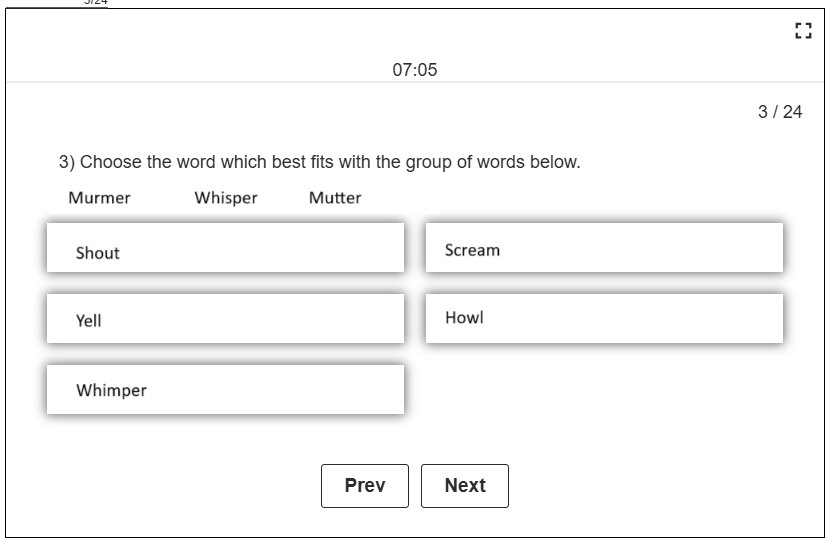## How to Prepare for the Verbal Classification Section
### Build a Strong Vocabulary
Vocabulary is the foundation of success in the Verbal Classification section and developing one takes time so make sure to start early through consistent, regular practice:
1. **Read Widely**: Engage with a variety of texts, including books, articles, and essays. Pay attention to new words and their meanings.
2. **Use Flashcards**: Create flashcards with new words and their definitions. Review them regularly to reinforce your memory.
3. **Practice Word Games**: Play word games like Scrabble, Boggle, or crossword puzzles to enhance your word recognition and understanding.
### Understand Word Relationships
To do really well in Verbal Classification, you need to appreciate the different types of word relationships there are and how to use different strategies to help you:
1. **Study Synonyms and Antonyms**: Familiarize yourself with common synonyms and antonyms. This will help you identify words that are similar or opposite in meaning.
2. **Learn Categories**: Understand the categories that words belong to, such as animals, fruits, vehicles, etc. This will help you recognize words that do not fit within a specific category.
3. **Analyze Part-to-Whole Relationships**: Practice identifying how parts relate to the whole. For example, understand that a “wheel” is part of a “car.”
### Practice with Sample Questions
Regular practice is essential and using sample questions and past papers to familiarize yourself with the format and types of questions you may encounter is key. Here are some tips for effective practice:
1. **Time Yourself**: Simulate exam conditions by timing yourself as you practice. This will help you manage your time effectively during the actual exam.
2. **Review Mistakes**: After completing practice questions, review your mistakes to understand where you went wrong. This will help you avoid similar errors in the future.
3. **Seek Feedback**: If possible, get feedback from on your performance. You will glean valuable insights and tips for improvement during this step.
### Develop Critical Thinking Skills
Verbal Classification requires more than just vocabular; it requires critical thinking and analytical skills. To develop these skills:
1. **Engage in Discussions**: Participate in discussions and debates to enhance your ability to think critically and articulate your thoughts.
2. **Solve Puzzles**: Engage in puzzles and brain teasers that require logical reasoning and problem-solving.
3. **Reflect on Your Thinking**: After solving a problem, reflect on your thought process. Consider alternative approaches and evaluate their effectiveness.
## Tips for Excelling in the Verbal Classification Section
### Read the Questions Carefully
One of the most common mistakes students make is misreading the questions. Take your time to read each question carefully and understand what is being asked. Pay attention to keywords and instructions to ensure you are answering the question correctly.
### Eliminate Incorrect Options
If you are unsure of the correct answer, use the process of elimination to narrow down your options. Eliminate the words that clearly do not belong and focus on the remaining choices. This strategy can increase your chances of selecting the correct answer.
### Look for Patterns
Verbal Classification questions often involve patterns or relationships between words. Look for common themes, such as synonyms, antonyms, categories, or part-to-whole relationships. Identifying these patterns can help you determine the word that does not belong.
### Stay Calm and Focused
The CAT4 exam can be challenging, but it’s important to stay calm and focused. If you encounter a difficult question, take a deep breath and approach it methodically. Remember that it’s okay to skip a question and come back to it later if needed.
### Practice Regularly
Consistent practice is essential for success in the Verbal Classification section. Set aside time each day to practice sample questions and review your progress. The more you practice, the more confident and prepared you will feel on exam day.
## Conclusion
The Verbal Classification section of the CAT4 exam is a critical component that assesses a student’s verbal reasoning skills. By understanding the structure of the section, building a strong vocabulary, and practicing regularly, students can enhance their performance and achieve success. Remember to approach each question methodically, look for patterns, and stay calm under pressure. With the right preparation and mindset, you can excel in the Verbal Classification section and unlock your full potential in the CAT4 exam.
If you haven’t already, read my story by **[clicking here](/pass-the-cat4-for-future-success/ "My Story on Passing the CAT4")** on how I helped my son pass with flying colours.
Explanations on the other sub-tests that are part of the CAT4 assessment can be found at the links below:
- [Non-Verbal Figure Classification](https://schoolentranceexam.com/non-verbal-figure-classification/ "Learn about Non-Verbal Figure Classification for school entrance exams")
- [Non-Verbal Figure Analysis](https://schoolentranceexam.com/non-verbal-figure-analysis "Explore Non-Verbal Figure Analysis techniques for school entrance exams")
- [Non-Verbal Figure Matrices](https://schoolentranceexam.com/non-verbal-figure-matrices "Understand Non-Verbal Figure Matrices with detailed examples")
- [Non-Verbal Figure Recognition](https://schoolentranceexam.com/non-verbal-figure-recognition "Master Non-Verbal Figure Recognition skills for assessments")
- [Numerical Analogies](https://schoolentranceexam.com/numerical-analogies/ "Practice Numerical Analogies for cognitive and school entrance tests")
- [Numerical Series](https://schoolentranceexam.com/numerical-series/ "Enhance your skills in Numerical Series for entrance exams")
- [Verbal Analogies](https://schoolentranceexam.com/verbal-analogies/ "Improve your Verbal Analogies proficiency for tests")
- [Verbal Classification](https://schoolentranceexam.com/verbal-classification/ "Develop Verbal Classification techniques for reasoning exams")
---
### [CAT4 Level G Practice Test (Year 11)](https://schoolentranceexam.com/cat4-level-g-year-11-tests/)
**Published:** January 9, 2023
**Author:** Admin
**Content:**
$(document).ready(function(){ $("select").change(function(){ $(this).find("option:selected").each(function(){ var optionValue = $(this).attr("value"); switch(optionValue) {
case "O": window.location.href = "/practice-cat4-tests/"; break; case "A": window.location.href = "/cat4-level-a-year-4-tests/"; break; case "B": window.location.href = "/cat4-level-b-year-5-tests/"; break; case "C": window.location.href = "/cat4-level-c-year-6-tests/"; break; case "D": window.location.href = "/cat4-level-d-year-7-tests/"; break; case "E": window.location.href = "/cat4-level-e-year-8-tests/"; break; case "F": window.location.href = "/cat4-level-f-year-9-year-10-tests/"; break; case "G": window.location.href = "/cat4-level-g-year-11-tests/"; break; default: // code block } }); }).change(); });
document.addEventListener('DOMContentLoaded', function () { // Select all elements with the class 'paoc-popup-click' const popupClickElements = document.querySelectorAll('.paoc-popup-click');
// Add a click event listener to each element popupClickElements.forEach(function (element) { element.addEventListener('click', function () { // Scroll to the top of the page window.scrollTo({ top: 0, behavior: 'smooth' // Smooth scrolling animation }); }); }); });
The **CAT4 Level G** test is taken for entry into **Year 11** by children aged between **14 years 6 months to 17 years and above**. It is a more advanced then the other levels and is equivalent in difficulty to the [UCAT ](https://schoolentranceexam.com/what-is-the-ucat-and-how-to-prepare-for-it/ "UCAT Questions Answered")(university clinical aptitude test), but more general in nature. It takes the same format as the other CAT4 tests consisting of eight sub-tests; each of which assess a different cognitive ability. **Click on the images** below to launch the practice tests and get your child ready for the real thing.
Select another level Level A Level B Level C Level D Level E Level F Level G Basic Level D/E
[](javascript:void(0);)
[](javascript:void(0);)
[](javascript:void(0);)
[](javascript:void(0);)
[](javascript:void(0);)
[](javascript:void(0);)
[](javascript:void(0);)
[](javascript:void(0);)
The best approach to using the tests is to firstly do one of the subtests and then review the answers and solutions in detail so you completely understand how to approach a similar question in the future. This is key to improvement – do the test and then review the questions and their solutions in detail – this essential step will help to understand the different question types and if another similar question is presented in the real test then it won’t be a surprise. I also suggest you repeat the test possibly after a day or a few hours to allow your mind to absorb the approach and come back fresh. When you redo the test it will randomly select questions from the question bank and also display them in a random order along with the answers – although this will be quite unique each time there may be a question or two which are similar but its unlikely to be exactly the same in placement and order as before.
You should aim to get 80-90% to have a solid chance at the real **CAT4 Level G test**. These practice test questions and answers are randomly ordered and will help familiarise you with the questions but ultimately it is the performance in the real test and any practice tests are simply an indicator. A lot of parents have had a good results using the process above but as a parent myself all I can hope for is for my child to do the very best they can.
All the best to your child achieving their future success!
Results for each of the **CAT4 Level G** practice tests will be available in your [practice history](https://schoolentranceexam.com/school-entrance-exam-practice-history/ "Test practice history to measure improvement.") page.
Check out the [full breakdown ](https://schoolentranceexam.com/cat4-levels/)of each level and which age group it applies to.
---
### [CAT4 Level F Practice Tests (Year 9 & Year 10)](https://schoolentranceexam.com/cat4-level-f-year-9-year-10-tests/)
**Published:** January 9, 2023
**Author:** Admin
**Content:**
$(document).ready(function(){ $("select").change(function(){ $(this).find("option:selected").each(function(){ var optionValue = $(this).attr("value"); switch(optionValue) {
case "O": window.location.href = "/practice-cat4-tests/"; break; case "A": window.location.href = "/cat4-level-a-year-4-tests/"; break; case "B": window.location.href = "/cat4-level-b-year-5-tests/"; break; case "C": window.location.href = "/cat4-level-c-year-6-tests/"; break; case "D": window.location.href = "/cat4-level-d-year-7-tests/"; break; case "E": window.location.href = "/cat4-level-e-year-8-tests/"; break; case "F": window.location.href = "/cat4-level-f-year-9-year-10-tests/"; break; case "G": window.location.href = "/cat4-level-g-year-11-tests/"; break; default: // code block } }); }).change(); });
document.addEventListener('DOMContentLoaded', function () { // Select all elements with the class 'paoc-popup-click' const popupClickElements = document.querySelectorAll('.paoc-popup-click');
// Add a click event listener to each element popupClickElements.forEach(function (element) { element.addEventListener('click', function () { // Scroll to the top of the page window.scrollTo({ top: 0, behavior: 'smooth' // Smooth scrolling animation }); }); }); });
The **CAT4 Level F** test is generally taken by children aged between **12 years 6 months to 15 years 11 months** for entry into **Year 9 & 10** (college). A complete CAT4 test consists of eight sub-tests; each of these tests assess a different cognitive ability which help to determine a child’s future potential. **Click on the images** below to launch the practice tests and get your child ready for the real thing.
Select another level Level A Level B Level C Level D Level E Level F Level G Basic Level D/E
[](javascript:void(0);)
[](javascript:void(0);)
[](javascript:void(0);)
[](javascript:void(0);)
[](javascript:void(0);)
[](javascript:void(0);)
[](javascript:void(0);)
[](javascript:void(0);)
The best approach to using the tests is to firstly do one of the subtests and then review the answers and solutions in detail so you completely understand how to approach a similar question in the future. This is key to improvement – do the test and then review the questions and their solutions in detail – this essential step will help to understand the different question types and if another similar question is presented in the real test then it won’t be a surprise. I also suggest you repeat the test possibly after a day or a few hours to allow your mind to absorb the approach and come back fresh. When you redo the test it will randomly select questions from the question bank and also display them in a random order along with the answers – although this will be quite unique each time there may be a question or two which are similar but its unlikely to be exactly the same in placement and order as before.
You should aim to get 80-90% to have a solid chance at the real **CAT4 Level F test**. These practice test questions and answers are randomly ordered and will help familiarise you with the questions but ultimately it is the performance in the real test and any practice tests are simply an indicator. A lot of parents have had a good results using the process above but as a parent myself all I can hope for is for my child to do the very best they can.
All the best to your child achieving their future success!
Results for each of the **CAT4 Level F practice** tests taken will be available in your [practice history](https://schoolentranceexam.com/school-entrance-exam-practice-history/ "Test practice history to measure improvement.") page.
Check out the [full breakdown ](https://schoolentranceexam.com/cat4-levels/)of each level and which age group it applies to.
---
### [CAT4 Level C Practice Test (Year 6)](https://schoolentranceexam.com/cat4-level-c-year-6-tests/)
**Published:** January 9, 2023
**Author:** Admin
**Content:**
$(document).ready(function(){ $("select").change(function(){ $(this).find("option:selected").each(function(){ var optionValue = $(this).attr("value"); switch(optionValue) {
case "O": window.location.href = "/practice-cat4-tests/"; break; case "A": window.location.href = "/cat4-level-a-year-4-tests/"; break; case "B": window.location.href = "/cat4-level-b-year-5-tests/"; break; case "C": window.location.href = "/cat4-level-c-year-6-tests/"; break; case "D": window.location.href = "/cat4-level-d-year-7-tests/"; break; case "E": window.location.href = "/cat4-level-e-year-8-tests/"; break; case "F": window.location.href = "/cat4-level-f-year-9-year-10-tests/"; break; case "G": window.location.href = "/cat4-level-g-year-11-tests/"; break; default: // code block } }); }).change(); });
document.addEventListener('DOMContentLoaded', function () { // Select all elements with the class 'paoc-popup-click' const popupClickElements = document.querySelectorAll('.paoc-popup-click');
// Add a click event listener to each element popupClickElements.forEach(function (element) { element.addEventListener('click', function () { // Scroll to the top of the page window.scrollTo({ top: 0, behavior: 'smooth' // Smooth scrolling animation }); }); }); });
The **CAT4 Level C** test is taken by children between the ages **9 years 6 months to 11 years 11 months** for entry into **Year 6**. It is normally by schools when assessing a student that has moved either from a different country or different region. A complete CAT4 test consists of eight sub-tests; each of these tests assess a different cognitive ability which help to determine a child’s future potential. **Click on the images** below to launch the practice tests and get your child ready for the real thing.
Select another level Level A Level B Level C Level D Level E Level F Level G Basic Level D/E
[](javascript:void(0);)
[](javascript:void(0);)
[](javascript:void(0);)
[](javascript:void(0);)
[](javascript:void(0);)
[](javascript:void(0);)
[](javascript:void(0);)
[](javascript:void(0);)
The best approach to using the tests is to firstly do one of the subtests and then review the answers and solutions in detail so you completely understand how to approach a similar question in the future. This is key to improvement – do the test and then review the questions and their solutions in detail – this essential step will help to understand the different question types and if another similar question is presented in the real test then it won’t be a surprise. I also suggest you repeat the test possibly after a day or a few hours to allow your mind to absorb the approach and come back fresh. When you redo the test it will randomly select questions from the question bank and also display them in a random order along with the answers – although this will be quite unique each time there may be a question or two which are similar but its unlikely to be exactly the same in placement and order as before.
You should aim to get 80-90% to have a solid chance at the real **CAT4 Level C test**. These practice test questions and answers are randomly ordered and will help familiarise you with the questions but ultimately it is the performance in the real test and any practice tests are simply an indicator. A lot of parents have had a good results using the process above but as a parent myself all I can hope for is for my child to do the very best they can.
All the best to your child achieving their future success!
Results for each of the **CAT4 Level C** practice tests will be available in your [practice history](https://schoolentranceexam.com/school-entrance-exam-practice-history/ "Test practice history to measure improvement.") page.
Check out the [full breakdown ](https://schoolentranceexam.com/cat4-levels/)of each level and which age group it applies to.
---
### [CAT4 Level B Practice Test (Year 5)](https://schoolentranceexam.com/cat4-level-b-year-5-tests/)
**Published:** January 9, 2023
**Author:** Admin
**Content:**
$(document).ready(function(){ $("select").change(function(){ $(this).find("option:selected").each(function(){ var optionValue = $(this).attr("value"); switch(optionValue) {
case "O": window.location.href = "/practice-cat4-tests/"; break; case "A": window.location.href = "/cat4-level-a-year-4-tests/"; break; case "B": window.location.href = "/cat4-level-b-year-5-tests/"; break; case "C": window.location.href = "/cat4-level-c-year-6-tests/"; break; case "D": window.location.href = "/cat4-level-d-year-7-tests/"; break; case "E": window.location.href = "/cat4-level-e-year-8-tests/"; break; case "F": window.location.href = "/cat4-level-f-year-9-year-10-tests/"; break; case "G": window.location.href = "/cat4-level-g-year-11-tests/"; break; default: // code block } }); }).change(); });
document.addEventListener('DOMContentLoaded', function () { // Select all elements with the class 'paoc-popup-click' const popupClickElements = document.querySelectorAll('.paoc-popup-click');
// Add a click event listener to each element popupClickElements.forEach(function (element) { element.addEventListener('click', function () { // Scroll to the top of the page window.scrollTo({ top: 0, behavior: 'smooth' // Smooth scrolling animation }); }); }); });
The CAT4 Level B test is generally taken by children between the ages of **8 years 6 months to 10 years 11 months** for entry into **Year 5**. Selective schools will use this test when a new student has moved nearby and an assessment of the child’s ability is required to determine if the school is a good fit. A complete CAT4 test consists of eight sub-tests; each of these tests assess a different cognitive ability which help to determine a child’s future potential. **Click on the images** below to launch the practice tests and get your child ready for the real thing.
Select another level Level A Level B Level C Level D Level E Level F Level G Basic Level D/E
[](javascript:void(0);)
[](javascript:void(0);)
[](javascript:void(0);)
[](javascript:void(0);)
[](javascript:void(0);)
[](javascript:void(0);)
[](javascript:void(0);)
[](javascript:void(0);)
The best approach to using the tests is to firstly do one of the subtests and then review the answers and solutions in detail so you completely understand how to approach a similar question in the future. This is key to improvement – do the test and then review the questions and their solutions in detail – this essential step will help to understand the different question types and if another similar question is presented in the real test then it won’t be a surprise. I also suggest you repeat the test possibly after a day or a few hours to allow your mind to absorb the approach and come back fresh. When you redo the test it will randomly select questions from the question bank and also display them in a random order along with the answers – although this will be quite unique each time there may be a question or two which are similar but its unlikely to be exactly the same in placement and order as before.
You should aim to get 80-90% to have a solid chance at the real **CAT4 Level B test**. These practice test questions and answers are randomly ordered and will help familiarise you with the questions but ultimately it is the performance in the real test and any practice tests are simply an indicator. A lot of parents have had a good results using the process above but as a parent myself all I can hope for is for my child to do the very best they can.
All the best to your child achieving their future success!
Results for each of the practice CAT4 Level B tests will be available in your [practice history](https://schoolentranceexam.com/school-entrance-exam-practice-history/) page.
Check out the [full breakdown ](https://schoolentranceexam.com/cat4-levels/)of each level and which age group it applies to.
---
### [CAT4 Level A Practice Test (Year 4)](https://schoolentranceexam.com/cat4-level-a-year-4-tests/)
**Published:** January 9, 2023
**Author:** Admin
**Content:**
$(document).ready(function(){ $("select").change(function(){ $(this).find("option:selected").each(function(){ var optionValue = $(this).attr("value"); switch(optionValue) {
case "O": window.location.href = "/practice-cat4-tests/"; break; case "A": window.location.href = "/cat4-level-a-year-4-tests/"; break; case "B": window.location.href = "/cat4-level-b-year-5-tests/"; break; case "C": window.location.href = "/cat4-level-c-year-6-tests/"; break; case "D": window.location.href = "/cat4-level-d-year-7-tests/"; break; case "E": window.location.href = "/cat4-level-e-year-8-tests/"; break; case "F": window.location.href = "/cat4-level-f-year-9-year-10-tests/"; break; case "G": window.location.href = "/cat4-level-g-year-11-tests/"; break; default: // code block } }); }).change(); });
document.addEventListener('DOMContentLoaded', function () { // Select all elements with the class 'paoc-popup-click' const popupClickElements = document.querySelectorAll('.paoc-popup-click');
// Add a click event listener to each element popupClickElements.forEach(function (element) { element.addEventListener('click', function () { // Scroll to the top of the page window.scrollTo({ top: 0, behavior: 'smooth' // Smooth scrolling animation }); }); }); });
The CAT4 Level A test is used for children between the ages of **7 years 6 months to 9 years 11 months** which is generally taken for entry into **Year 4** and normally used by schools as an admission test for new children rather than a diagnostic test by teachers. A complete CAT4 test consists of eight sub-tests; each of these tests assess a different cognitive ability which help to determine a child’s future potential. **Click on the images** below to launch the practice tests and get your child ready for the real thing.
Select another level Level A Level B Level C Level D Level E Level F Level G Basic Level D/E
[](javascript:void(0);)
[](javascript:void(0);)
[](javascript:void(0);)
[](javascript:void(0);)
[](javascript:void(0);)
[](javascript:void(0);)
[](javascript:void(0);)
[](javascript:void(0);)
The best approach to using the tests is to firstly do one of the subtests and then review the answers and solutions in detail so you completely understand how to approach a similar question in the future. This is key to improvement – do the test and then review the questions and their solutions in detail – this essential step will help to understand the different question types and if another similar question is presented in the real test then it won’t be a surprise. I also suggest you repeat the test possibly after a day or a few hours to allow your mind to absorb the approach and come back fresh. When you redo the test it will randomly select questions from the question bank and also display them in a random order along with the answers – although this will be quite unique each time there may be a question or two which are similar but its unlikely to be exactly the same in placement and order as before.
You should aim to get 80-90% to have a solid chance at the real **CAT4 Level A test**. These practice test questions and answers are randomly ordered and will help familiarise you with the questions but ultimately it is the performance in the real test and any practice tests are simply an indicator. A lot of parents have had a good results using the process above but as a parent myself all I can hope for is for my child to do the very best they can.
All the best to your child achieving their future success!
Results for each of the **CAT4 Level A** Practice tests will be available in your [practice history](https://schoolentranceexam.com/school-entrance-exam-practice-history/ "Test practice history to measure improvement.") page.
Check out the [full breakdown ](https://schoolentranceexam.com/cat4-levels/)of each level and which age group it applies to.
---
### [CAT4 Verbal Analogies Practice Test](https://schoolentranceexam.com/verbal-analogies/)
**Published:** June 21, 2018
**Author:** Admin
**Content:**
This verbal analogies test will test your child’s verbal reasoning skills. All the questions require the learner to understand and analyse the information to solve the problem.
**Verbal analogies** are a critical component of the **CAT4 test**, designed to assess a student’s ability to identify and understand relationships between words and concepts. This section of the **verbal reasoning** battery evaluates skills such as vocabulary, logical thinking, and the ability to draw connections between ideas. By analyzing pairs of words and determining their relationships, students demonstrate their capacity for abstract reasoning and problem-solving. Mastering verbal analogies not only enhances performance in the **CAT4** but also strengthens essential cognitive skills for academic success.
How much is your child’s education worth? Get access to the rest of the site to avoid your child being disadvantaged. [Click here](/membership-join/) now.
## What Are Verbal Analogies?
Verbal analogies are a type of question that presents a pair of words with a specific relationship, followed by a third word. The task is to identify a fourth word that has the same relationship to the third word as the first word has to the second. For example:
**Example:** Book : Read Music : ?
In this analogy, the relationship is that a book is something you read, so the correct answer would be “Listen” because music is something you listen to.
### Why Are Verbal Analogies Important?
Verbal analogies test your ability to understand and manipulate language, which is a critical skill for academic success. They assess your vocabulary, comprehension, and logical reasoning abilities. Mastering verbal analogies can significantly improve your performance in the CAT4 and other standardized tests.
## Strategies for Solving Verbal Analogies
### 1. Identify the Relationship
The first step in solving a verbal analogy is to identify the relationship between the first pair of words. Common relationships include:
- **Synonyms:** Words that have similar meanings (e.g., Happy : Joyful)
- **Antonyms:** Words that have opposite meanings (e.g., Hot : Cold)
- **Part to Whole:** A part of something and the whole (e.g., Wheel : Car)
- **Category to Example:** A category and an example within that category (e.g., Fruit : Apple)
- **Function:** The purpose or function of something (e.g., Scissors : Cut)
### 2. Create a Sentence
Once you’ve identified the relationship, try to create a sentence that describes it. This can help you visualize the connection and make it easier to find the correct answer.
**Example:**
A doctor works in a hospital, so a teacher works in a school.
### 3. Look for Multiple Relationships
Sometimes, there may be more than one possible relationship between the words. In such cases, consider all possible relationships and choose the one that best fits the context.
**Practice Question:** Fish : School Lion : ?
Here, “school” can refer to a group of fish, so the correct answer would be “pride,” which is a group of lions.
### 4. Use Process of Elimination
If you’re unsure of the correct answer, use the process of elimination to narrow down your options. Eliminate any choices that don’t fit the relationship you’ve identified.
**Practice Question:** Pen : Write Knife : ?
Options: a) Cut, b) Spoon, c) Fork, d) Plate
The correct answer is “Cut,” as a knife is used to cut, just as a pen is used to write.
### 5. Practice Regularly
Regular practice is key to mastering verbal analogies. The more you practice, the more familiar you’ll become with common relationships and the better you’ll get at identifying them quickly.
**Practice Question:** Tree : Leaf Flower : ?
## Common Pitfalls in the CAT4 Verbal Analogies Test
### 1. Overcomplicating the Relationship
Sometimes, students overthink the relationship between the words, leading to incorrect answers. Keep it simple and focus on the most obvious relationship.
**Example:** Dog : Bark Cat : ?
The correct answer is “Meow,” as a dog barks and a cat meows. Don’t overcomplicate it by thinking of less obvious relationships.
### 2. Ignoring Context
Context is crucial in verbal analogies. Make sure to consider the context in which the words are used, as this can affect the relationship.
**Practice Question:** Bank : River Bank : ?
Here, the word “bank” has two different meanings. In the first pair, it refers to the side of a river, so the correct answer would be “Money,” as a bank can also refer to a financial institution.
### 3. Rushing Through Questions
Take your time to carefully analyze each analogy. Rushing can lead to mistakes, especially if the relationship isn’t immediately obvious.
**Practice Question:** Clock : Time Thermometer : ?
Take a moment to think about the relationship. A clock measures time, so a thermometer measures temperature.
## Practice Test Tips for Verbal Analogies
### 1. Simulate Test Conditions
When practicing, try to simulate test conditions as closely as possible. This means timing yourself and working in a quiet environment. This will help you get used to the pressure of the actual test. The mock tests on this site will do this for you.
### 2. Review Your Mistakes
After completing a practice test, review your mistakes and understand why you got them wrong. This will help you learn from your errors and avoid making the same mistakes in the future.
**Reviewing the Question:**
If you got the analogy “Doctor : Hospital :: Teacher : ?” wrong, review the relationship and understand why “School” is the correct answer.
### 3. Expand Your Vocabulary
A strong vocabulary is essential for success in verbal analogies. Make an effort to learn new words and their meanings, as this will help you recognize relationships more easily.
Learn new words daily and try to use them in sentences to reinforce your understanding.
### 4. Use Analogies in Daily Life
Incorporate analogies into your daily life by noticing relationships between objects, concepts, and ideas. This will help you develop a natural understanding of how analogies work.
When you see a pair of objects, try to think of an analogy that describes their relationship. For example, “Spoon : Eat Broom : Sweep.”
## Sample CAT4 Verbal Analogies Practice Test
To help you get started, here are some sample verbal analogies similar to those you might encounter on the CAT4:
1. **Book : Read Movie : ?**
a) Watch
b) Listen
c) See
d) Hear
2. **Pen : Write Knife : ?**
a) Cut
b) Spoon
c) Fork
d) Plate
3. **Tree : Leaf Flower : ?**
a) Petal
b) Stem
c) Root
d) Branch
4. **Doctor : Hospital** **Teacher : ?**
a) School
b) Classroom
c) Office
d) Library
5. **Fish : School** **Lion : ?**
a) Pride
b) Pack
c) Herd
d) Flock
6. **Clock : Time** **Thermometer : ?**
a) Temperature
b) Heat
c) Weather
d) Cold
7. **Dog : Bark** **Cat : ?**
a) Meow
b) Purr
c) Hiss
d) Roar
8. **Spoon : Eat** **Broom : ?**
a) Sweep
b) Clean
c) Dust
d) Mop
9. **Happy : Joyful** **Sad : ?**
a) Miserable
b) Angry
c) Excited
d) Tired
**Answers:**
1. a) Watch
2. a) Cut
3. a) Petal
4. a) School
5. a) Pride
6. a) Temperature
7. a) Money
8. a) Meow
9. a) Sweep
10. a) Miserable
## Conclusion
The CAT4 Verbal Analogies section requires a combination of strong vocabulary, logical reasoning, and regular practice. By understanding the different types of relationships, creating sentences to describe them, and avoiding common pitfalls, you can significantly improve your performance. Remember to simulate test conditions, review your mistakes, and expand your vocabulary to ensure you’re fully prepared for the CAT4 Verbal Analogies Practice Test. With dedication and the right strategies, you’ll be well on your way to achieving success in the CAT4 and beyond.
To learn more about the other sub-tests that make up the **CAT4** assessment, click below:
- [Non-Verbal Figure Classification](https://schoolentranceexam.com/non-verbal-figure-classification/ "Learn about Non-Verbal Figure Classification for school entrance exams")
- [Non-Verbal Figure Analysis](https://schoolentranceexam.com/non-verbal-figure-analysis "Explore Non-Verbal Figure Analysis techniques for school entrance exams")
- [Non-Verbal Figure Matrices](https://schoolentranceexam.com/non-verbal-figure-matrices "Understand Non-Verbal Figure Matrices with detailed examples")
- [Non-Verbal Figure Recognition](https://schoolentranceexam.com/non-verbal-figure-recognition "Master Non-Verbal Figure Recognition skills for CAT4")
- [Numerical Analogies](https://schoolentranceexam.com/numerical-analogies/ "Practice Numerical Analogies for cognitive and school entrance tests")
- [Numerical Series](https://schoolentranceexam.com/numerical-series/ "Enhance your skills in Numerical Series for CAT4 entrance exams")
- [Verbal Analogies](https://schoolentranceexam.com/verbal-analogies/ "Improve your Verbal Analogies proficiency for CAT4 test")
- [Verbal Classification](https://schoolentranceexam.com/verbal-classification/ "Develop Verbal Classification techniques for CAT4 reasoning exams")
If you haven’t already, read my story by **[clicking here](/pass-the-cat4-for-future-success/ "My Story on Passing the CAT4")** on how I helped my son pass with flying colours.
---
### [Schools Using the CAT4 or 11 Plus](https://schoolentranceexam.com/list-of-schools-using-the-11-plus-or-cat4/)
**Published:** September 3, 2020
**Author:** Admin
**Content:**
[11 PLUS PRACTICE TEST](/11-plus-practice-test-pack-1-try/) [CAT4 PRACTICE TEST](/non-verbal-figure-classification)
- [Schools in the UK Who Use the CAT4 or 11 Plus](#aioseo-schools-in-the-uk-who-use-the-cat4-or-11-plus)
- [Hong Kong Schools Using CAT4 Entrance Test](#aioseo-hong-kong-schools-using-cat4-entrance-test)
- [Schools in Singapore Using the CAT4 Test](#aioseo-schools-in-singapore-using-cat4-entrance-test)
- [Schools in Malaysia Which Use the CAT4](#aioseo-schools-in-malaysia-which-use-the-cat4)
- [Indian Schools Which Use the CAT4](#aioseo-indian-schools-which-use-the-cat4)
- [Schools in Oman Using the CAT4](#aioseo-schools-in-oman-using-the-cat4)
- [Schools Using the CAT4 for Admissions in Qatar](#aioseo-schools-using-the-cat4-for-admissions-in-qatar)
- [Schools in Thailand Using the CAT4 Entrance Test](#aioseo-schools-in-thailand-using-the-cat4-entrance-test)
- [Schools in Vietnam Using the CAT4](#aioseo-schools-in-vietnam-using-the-cat4)
- [China Using the CAT4 in Schools for Admissions](#aioseo-china-using-the-cat4-in-schools-for-admissions)
## Schools in the UK Who Use the CAT4 or 11 Plus
The list of below provides links to UK Grammar Schools and Selective Schools where the 11+ / CAT4 is used as part of the admission process. You need to contact the school to confirm since admission procedures do change.
NAME OF SCHOOLREGION**Type**[Adams Grammar School](https://www.adamsgs.uk/ "Adams Grammar School Admission Process and Entrance Exam Details")Wolverhampton & WrekinBoys[Alcester Grammar School](https://www.alcestergs.co.uk/page/?title=Home&pid=1 "Alcester Grammar School Admission Process and Entrance Exam Details")WarwickshireMixed[Altrincham Grammar School for Boys](https://www.agsb.co.uk/ "Altrincham Grammar School for Boys Admissions Page - CAT4 / 11+ entrance exam")TraffordBoys[Altrincham Grammar School for Girls](https://www.aggs.trafford.sch.uk/ "Altrincham Grammar School Admission Process and Entrance Exam Details")TraffordGirls[Archbishop’s School](https://www.archbishopholgates.org/ "Archibishop's School Admission Process and Entrance Exam Details")KentMixed[Ashlawn School](https://www.ashlawn.org.uk/ "Ashlawn School Admission Process and Entrance Exam Details")WarwickshireMixed[Aylesbury Grammar School](https://www.ags.bucks.sch.uk/ "Aylesbury Grammar School Admission Process and Entrance Exam Details")BuckinghamshireBoys[Aylesbury High School](https://ahs.bucks.sch.uk/ "Aylesbury School Admission Process and Entrance Exam Details")BuckinghamshireGirls[Bacup & Rawtenstall Grammar School](https://www.brgs.org.uk/ "Backup & Rawtenstall Grammar School Admission Process and Entrance Exam Details")LancashireMixed[Barton Court Grammar School](https://www.bartoncourt.org/ "Barton Court Grammar School Admission Process and Entrance Exam Details")KentMixed[Beaconsfield High School](https://www.beaconsfieldhigh.bucks.sch.uk/ "Beaconsfield High School Admission Process and Entrance Exam Details")BuckinghamshireGirls[Beths Grammar School](https://www.beths.bexley.sch.uk/ "Beths Grammar School Admission Process and Entrance Exam Details")BexleyBoys[Bexley Grammar School](https://www.bexleygs.co.uk/ "Bexley Grammar School Admission Process and Entrance Exam Details")BexleyMixed[Bishop Vesey’s Grammar School](https://www.bvgs.co.uk/ "Bishop Vesey's Grammar School Admission Process and Entrance Exam Details")BirminghamBoys[Bishop Wordsworth School for Boys](https://www.bws-school.org.uk/)DevonBoys[Bishops Stortford High School](https://www.tbshs.org/)HertfordshireBoys[Borden Grammar School](https://www.bordengrammar.kent.sch.uk/ "Bordon Grammar School Admission Process and Entrance Exam Details")KentBoys[Boston Grammar School](https://www.bostongrammarschool.co.uk/ "Boston Grammar School Admission Process and Entrance Exam Details")LincolnshireBoys[Boston High School](https://www.bostonhighschool.co.uk/ "Boston School Admission Process and Entrance Exam Details")LincolnshireGirls[Bourne Grammar School](https://www.bourne-grammar.lincs.sch.uk/page/default.asp?title=Home&pid=1 "Bourne Grammar School Admission Process and Entrance Exam Details")LincolnshireMixed[Bournemouth School](https://www.bournemouth-school.org/ "Bournemouth School Admission Process and Entrance Exam Details")DorsetBoys[Bushey Meads School](https://www.busheymeads.herts.sch.uk/ "Bushey Meads School Admission Process and Entrance Exam Details")HertfordshireUnknown[Caistor Grammar School](https://www.caistorgrammar.com/ "Caistor Grammar School Admission Process and Entrance Exam Details")LincolnshireMixed[Carre’s Grammar School](https://www.carres.lincs.sch.uk/ "Carre's Grammar School Admission Process and Entrance Exam Details")LincolnshireBoys[Chancellors School](https://www.chancellors.herts.sch.uk/ "Chancellors School Admission Process and Entrance Exam Details")HertfordshireUknown[Chatham & Clarendon Grammar School](https://www.ccgrammarschool.co.uk/ "Chatham &Clarendon Grammar School Admission Process and Entrance Exam Details")KentMixed[Chatham Grammar School for Girls](https://www.chathamgirlsgrammar.medway.sch.uk/ "Chatham Grammar School for Girls Admission Process and Entrance Exam Details")MedwayGirls[Chelmsford County High School](https://www.cchs.co.uk/ch/home "Chelmsford Grammar School Admission Process and Entrance Exam Details")EssexGirls[Chislehurst & Sidcup Grammar School](https://www.csgrammar.com/ "Chiselhurst and Sidup Grammar School")BexleyMixed[Churston Ferrers Grammar](https://www.churstongrammar.com/ "Churston Ferrers Grammar ")DevonMixed[Clitheroe Royal Grammar School](https://www.crgs.org.uk/ "Clitheroe Royal Grammar School")LancashireMixed[Colchester County High School](https://www.cchsg.com/ "Colchester Country High School")EssexGirls[Colyton Grammar School](https://www.colytongrammar.com/ "Colyton Grammar School")DevonMixed[Cranbrook School](https://www.cranbrookschool.co.uk/ "Cranbrook School")KentMixed[Dame Alice Owen’s School](https://www.damealiceowens.herts.sch.uk/ "Dame Alice Owen's School")HertfordshireMixed[Dane Court Grammar School](https://danecourt.kent.sch.uk/ "Dane Court Grammar School")KentMixed[Dartford Grammar School](https://www.dartfordgrammarschool.org.uk/ "Dartford Grammar School")KentBoys[Dartford Grammar School for Girls](https://www.dartfordgrammargirls.kent.sch.uk/ "Dartford Grammar School for Girls")KentGirls[Devonport High School for Boys](https://www.dhsb.org/ "Devonport High School for Boys ")DevonBoys[Devonport High School for Girls](https://www.devonportgirls.plymouth.sch.uk/)DevonGirls[Dover Grammar School for Boys](https://www.dgsb.co.uk/ "Dover Grammar School for Boys")KentBoys[Dover Grammar School for Girls](https://dggs.kent.sch.uk/)KentGirls[Dr. Challoners Grammar School](https://www.challoners.com/ "Dr Challoners Grammar School Admissions page - CAT4 / 11+ entrance exam")BuckinghamshireBoys[Dr. Challoners High School](https://www.challonershigh.com/page/default.asp?title=HOME&pid=1 "Dr Challoners High School")BuckinghamshireGirls[Ermysted’s Grammar School](https://www.ermysteds.uk/ "Ermysted's Grammar School")YorkshireBoys[Fort Pitt Grammar School](https://www.fortpitt.co.uk/ "Fort Pitt Grammar School")MedwayGirls[Gravesend Grammar School](https://gravesendgrammar.eu/ "Gravesend Grammar School")KentBoys[Greenshaw High School](https://www.greenshaw.co.uk/ "Greenshaw High School")SurreyMixed[Handsworth Grammar School for Boys](https://www.handsworth.bham.sch.uk/ "Handsworth Grammar School for Boys")BirminghamBoys[Heckmondwike Grammar School](https://www.heckgrammar.co.uk/online/ "Heckmondwike Grammar School")YorkshireMixed[Henrietta Barnett](https://www.hbschool.org.uk/ "Henrietta Barnett Grammar School")BarnetGirls[Hershel Grammar](https://www.herschel.slough.sch.uk/ "Hershel Grammar School")BerkshireMixed[Hertfordshire & Essex High School](https://www.hertsandessex.herts.sch.uk/ "Herfordshire & Essex High School")HertfordshireGirls[Denmark Road High School for Girls](https://www.hsfg.org/ "Denmark Road High School for Girls")GloucestershireGirls[Highsted School](https://www.highsted.kent.sch.uk/ "Highsted School")KentGirls[Highworth Grammar School](https://www.highworth.kent.sch.uk/ "Highworth Grammar School")KentGirls[Holcombe Grammar School](https://www.cgsb.co.uk/ "Holcombe Grammar School")MedwayBoys[Homewood School](https://www.homewood-school.co.uk/ "Homewood School")KentMixed[Ilford County High School for Boys](https://www.ichs.org.uk/)Essex (Redbridge)Boys[Invicta Grammar School](https://www.invicta.kent.sch.uk/)KentGirls[John Hampden Grammar School](https://www.jhgs.bucks.sch.uk/)BuckinghamshireBoys[Kendrick School](https://www.kendrick.reading.sch.uk/)BerkshireGirls[Kesteven & Grantham Girls’ School](https://www.kestevengrantham.lincs.sch.uk/)LincolnshireGirls[Kesteven & Sleaford High School Selective Academy](https://www.kshssa.co.uk/)LincolnshireGirls[King David High School](https://www.kdhs.org.uk/)LiverpoolMixed[King Edward VI Academy](https://www.king-edward.lincs.sch.uk/)LincolnshireMixed[King Edward VI Aston School](https://www.keaston.bham.sch.uk/)BirminghamBoys[King Edward VI Camp Hill School for Boys](https://www.camphillboys.bham.sch.uk/)BirminghamBoys[King Edward VI Camp Hill School for Girls](https://www.kechg.org.uk/)BirminghamGirls[King Edward VI Chelmsford](https://www.kegs.org.uk/)EssexBoys[King Edward VI Five Ways School](https://www.kefw.org/)BirminghamMixed[King Edward VI Grammar School](https://www.kegs.org.uk/)LincolnshireMixed[King Edward VI Handsworth School](https://www.kingedwardvi.bham.sch.uk/)BirminghamGirls[King Edward VI School](https://www.kes.net/)WarwickshireBoys[Lancaster Girls’ Grammar School](https://www.lggs.org.uk/)LancashireGirls[Lancaster Royal Grammar School](https://www.lrgs.org.uk/)LancashireBoys[Langley Grammar](https://www.lgs.slough.sch.uk/page/?title=Home&pid=1)BerkshireMixed[Lawrence Sheriff School](https://www.lawrencesheriffschool.net/)WarwickshireBoys[Liverpool Blue Coat School](https://www.bluecoatschoolliverpool.org.uk/)LiverpoolMixed[Loreto Grammar School](https://www.loretogrammar.co.uk/)TraffordGirls[Maidstone Grammar School](https://www.mgs.kent.sch.uk/)KentBoys[Maidstone Grammar School for Girls](https://www.mggs.org/)KentGirls[Marling School](https://www.marling.gloucs.sch.uk/)GloucestershireBoys[Mayfield Grammar School](https://www.mgsg.kent.sch.uk/)KentGirls[Mill Hill County](https://www.mhchs.org.uk/)BarnetMixed[Newport Girls’ High School](https://www.nghs.org.uk/)Wolverhampton & WrekinGirls[Newstead Wood](https://www.newsteadwood.bromley.sch.uk/)BromleyGirls[Nonsuch Grammar](https://www.nonsuchschool.org/)SurreyGirls[Oakwood Park Grammar School](https://www.opgs.org/)KentBoys[Parkstone Grammar School](https://www.parkstone.poole.sch.uk/)DorsetGirls[Parmiter’s School](https://www.parmiters.herts.sch.uk/)Hertfordshire [Pate’s Grammar School](https://www.patesgs.org/)GloucestershireMixed[Plymouth High School for Girls](https://www.phsg.org/)DevonGirls[Queen Elizabeth](https://www.qebarnet.co.uk/)BarnetBoys[Queen Elizabeth Grammar School](https://www.qegs.cumbria.sch.uk/)CumbriaMixed[Queen Elizabeth’s Grammar School](https://www.queenelizabeths.kent.sch.uk/)KentMixed[Queen Elizabeth’s Grammar School](https://www.qegs.co.uk/)LincolnshireMixed[Queen Elizabeth’s Grammar School](https://www.qegs.lincs.sch.uk/)LincolnshireMixed[Queen Elizabeth’s High School](https://www.qehs.lincs.sch.uk/)LincolnshireMixed[Queen Mary’s Grammar School](https://www.qmgs.walsall.sch.uk/)Wolverhampton & WrekinMixed[Queen Mary’s High School](https://www.qmhs.org.uk/)Wolverhampton & WrekinGirls[Queens’ School](https://www.queens.herts.sch.uk/)HertfordshireMixed[Rainham Mark Grammar School](https://www.rainhammark.com/)MedwayMixed[Reading School for Boys](https://www.reading-school.co.uk/)BerkshireBoys[Reading School for Girls](https://www.readinggirlsschool.co.uk/page/default.asp?title=Home&pid=1)BerkshireGirls[Ribston Hall High School](https://www.ribstonhall.gloucs.sch.uk/)GloucestershireGirls[Rickmansworth School](https://www.rickmansworth.herts.sch.uk/)HertfordshireMixed[Ripon Grammar School](https://www.ripongrammar.co.uk/)YorkshireMixed[Royal Grammar School](https://www.rgshw.com/)BuckinghamshireBoys[Royal Grammar School Colchester](https://www.crgs.co.uk/)EssexBoys[Royal Latin Grammar School](https://www.royallatin.org/)BuckinghamshireMixed[Rugby High School](https://www.rugbyhighschool.co.uk/)WarwickshireGirls[Sale Grammar School](https://www.salegrammar.co.uk/)TraffordMixed[Shoeburyness High School](https://shoeburynesshigh.co.uk/)EssexMixed[Simon Langton Girls’ Grammar School](https://www.langton.kent.sch.uk/)KentGirls[Simon Langton Grammar School for Boys](https://www.thelangton.org.uk/)KentBoys[Sir Henry Floyd Grammar School](https://www.sirhenryfloyd.co.uk/)BuckinghamshireMixed[Sir Joseph Williamson’s Mathematical School](https://sjwms.org.uk/ "Sir Joseph Williamsons Mathematical School")MedwayBoys[Sir Roger Manwood’s School](https://www.srms.kent.sch.uk/)KentMixed[Sir Thomas Rich’s School](https://strschool.co.uk/)GloucestershireBoys[Sir William Borlase School](https://www.swbgs.com/)BuckinghamshireMixed[Skegness Grammar School](https://www.sgs.lincs.sch.uk/)LincolnshireMixed[Skipton Girls’ High School](https://www.sghs.org.uk/)YorkshireGirls[South Wiltshire Grammar School](https://www.swgs.wilts.sch.uk/)WiltshireGirls[Southend High School for Boys](https://www.shsb.org.uk/page/default.asp?title=Home&pid=1)EssexBoys[Southend High School for Girls](https://www.shsg.org/)EssexGirls[Spalding Grammar School](https://www.spaldinggrammar.lincs.sch.uk/)LincolnshireBoys[Spalding High School](#)LincolnshireBoys[St Bernards Catholic](https://www.st-bernards.slough.sch.uk/)BerkshireMixed[St Bernards High School](https://www.stbernardswestcliff.org.uk/)EssexGirls[St Clement Danes School](https://www.stclementdanes.org.uk/)HertfordshireMixed[St Michael’s Catholic](https://www.st-michaels.barnet.sch.uk/)BarnetGirls[St Olaves](https://www.saintolaves.net/)BromleyBoys[St Thomas More High School](https://www.st-thomasmore.southend.sch.uk/)EssexMixed[St. Ambrose College](https://www.st-ambrosecollege.org.uk/)TraffordBoys[St. Anselm’s College](https://www.st-anselms.com/)WirralBoys[St. Hilda’s C of E High School](https://www.st-hildas.co.uk/)LiverpoolMixed[St. Margaret’s C of E High School](https://www.stmargaretsacademy.com/)LiverpoolBoys[Stratford Upon Avon Grammar School for Girls](https://www.sggs.org.uk/)WarwickshireGirls[Stretford Grammar School](https://www.stretfordgrammar.com/)TraffordMixed[Stroud High School](https://stroudhigh.gloucs.sch.uk/)GloucestershireGirls[Sutton Coldfield Grammar School for Girls](https://www.suttcold.bham.sch.uk/)BirminghamGirls[Sutton Grammar School](https://www.suttongrammar.sutton.sch.uk/)SurreyBoys[The Crossley Heath Grammar School](https://www.crossleyheath.org.uk/)YorkshireMixed[The Crypt School](https://www.cryptschool.org/)GloucestershireBoys[The Folkestone School for Girls](https://www.folkestonegirls.kent.sch.uk/)KentGirls[The Harvey Grammar School](https://www.harveygs.kent.sch.uk/)KentBoys[The Howard School](https://www.thehowardschool.co.uk/)MedwayBoys[The Judd School](https://www.judd.online/)KentBoys[The King John School](https://www.thekjs.essex.sch.uk/)EssexMixed[The King’s School Grantham](https://www.kings.lincs.sch.uk/page/default.asp?title=Home&pid=1)LincolnshireBoys[The North Halifax Grammar School](https://www.nhgs.co.uk/index.php?option=com_content&view=article&id=173&Itemid=983)YorkshireMixed[The Norton Knatchbull School](https://www.nks.kent.sch.uk/)KentBoys[The Rochester Grammar School](https://www.rochestergrammar.medway.sch.uk/)MedwayGirls[The Skinners’ School](https://www.skinners-school.co.uk/)KentBoys[The Spires College](https://www.thespirescollege.com/)DevonMixed[The Tiffin Girls School](https://www.tiffingirls.kingston.sch.uk/)SurreyGirls[The Tiffin School](https://www.tiffinschool.co.uk/home.html)SurreyBoys[Tonbridge Grammar School](https://www.tgs.kent.sch.uk/)KentGirls[Torquay Boys Grammar School](https://www.tbgs.co.uk/)DevonBoys[Torquay Girls Grammar School](https://www.tggs.torbay.sch.uk/)DevonGirls[Townley Grammar School](https://www.townleygrammar.org.uk/)BexleyGirls[Tunbridge Wells Girls’ Grammar School](https://www.twggs.kent.sch.uk/)KentGirls[Tunbridge Wells Grammar School for Boys](https://www.twgsb.org.uk/)KentBoys[Upton Court](https://www.uptoncourtgrammar.org.uk/)BerkshireMixed[Upton Hall School](https://www.uptonhallschool.co.uk/page/default.asp?title=Home&pid=1)WirralGirls[Urmston Grammar School](https://www.urmstongrammar.org.uk/)TraffordMixed[Wallington County Grammar School](https://www.wcgs.org.uk/drupal/)SurreyBoys[Wallington High School for Girls](https://www.wallingtongirls.sutton.sch.uk/)SurreyGirls[Watford Grammar School for Boys](https://www.watfordboys.org/)HertfordshireBoys[Watford Grammar School for Girls](https://www.watfordgrammarschoolforgirls.org.uk/)HertfordshireGirls[Weald of Kent Grammar School](https://www.wealdofkent.kent.sch.uk/)KentGirls[West Kirby Grammar School](https://www.westkirby-grammar.wirral.sch.uk/)WirralGirls[Westcliff High School for Boys](https://www.whsb.essex.sch.uk/)EssexBoys[Westcliff High School for Girls](https://www.whsg.info/)EssexGirls[Westlands School](https://www.westlands.org.uk/)KentMixed[Wilmington Grammar School for Boys](https://www.wgsb.org.uk/)KentBoys[Wilmington Grammar School for Girls](https://www.gsgw.org.uk/)KentGirls[Wirral Grammar School](https://www.wirralgrammarboys.com/)WirralBoys[Wirral Grammar School for Girls](https://www.wirralgirls.co.uk/ "Wirral Grammar School for Girls Admissions Page - CAT4 / 11+ entrance exam")WirralGirls[Wolverhampton High School for Girls](https://www.wghs.org.uk/ "Wolverhampton High School for Girls Admissions Page - CAT4 / 11+ test")Wolverhampton & WrekinGirls[Woodford County High School for Girls](https://www.woodford.redbridge.sch.uk/page/default.asp?title=Home&pid=1 "Woodford Country High School for Girls CAT4 test")Essex (Redbridge)Girls[Wycombe High School](https://www.whs.bucks.sch.uk/ "Wycombe High School CAT4 admissions test")BuckinghamshireGirls## Hong Kong Schools Using CAT4 Entrance Test
School NameCurriculumNotes[Harrow International School Hong Kong](https://www.harrowschool.hk/)BritishCAT4 is used for Year 7 admissions.[Kellett School Hong Kong](https://www.kellettschool.com/)BritishCAT4 is used for secondary school admissions.[English Schools Foundation (ESF)](https://www.esf.edu.hk/)BritishCAT4 is used for Year 7 admissions across ESF schools.[Canadian International School of Hong Kong](https://www.cdnis.edu.hk/)IB (International Baccalaureate)CAT4 is used for secondary school admissions.[Hong Kong International School](https://www.hkis.edu.hk/)AmericanCAT4 may be used for placement in certain grades.[German Swiss International School Hong Kong](https://www.gsis.edu.hk/)IB (International Baccalaureate)CAT4 is used for secondary school admissions.[French International School Hong Kong](https://www.fis.edu.hk/)French & IB (International Baccalaureate)CAT4 may be used for placement in certain grades.[Singapore International School Hong Kong](https://www.sis.edu.hk/)SingaporeanCAT4 may be used for placement in certain grades.[Korean International School Hong Kong](https://www.koreaninternationalschool.org/)Korean & IB (International Baccalaureate)CAT4 may be used for placement in certain grades.[Yew Chung International School Hong Kong](https://www.ycis-hk.com/)IB (International Baccalaureate)CAT4 is used for secondary school admissions.## Schools in Singapore Using the CAT4 Test
School NameCurriculumNotes[Dulwich College Singapore](https://www.dulwich.org/singapore)BritishCAT4 is used for Year 7 admissions.[German European School Singapore](https://www.gess.sg/)IB (International Baccalaureate)CAT4 is used for secondary school admissions.[UWC South East Asia](https://www.uwcsea.edu.sg/)IB (International Baccalaureate)CAT4 is used for secondary school admissions.[Singapore International School (Hong Kong)](https://www.singapore.edu.hk/)SingaporeanCAT4 may be used for placement in certain grades.[Nexus International School Singapore](https://www.nexus.edu.sg/)IB (International Baccalaureate)CAT4 is used for secondary school admissions.[Stamford American International School](https://www.stamfordschool.edu.sg/)AmericanCAT4 may be used for placement in certain grades.[Canadian International School Singapore](https://www.cis.edu.sg/)IB (International Baccalaureate)CAT4 is used for secondary school admissions.[Invictus International School Singapore](https://www.invictus.edu.sg/)BritishCAT4 is used for Year 7 admissions.[Australian International School Singapore](https://www.ais.com.sg/)AustralianCAT4 may be used for placement in certain grades.[International School Singapore](https://www.iss.edu.sg/)IB (International Baccalaureate)CAT4 is used for secondary school admissions.## Schools in Malaysia Which Use the CAT4
School NameCurriculumNotes[The Alice Smith School](https://www.alice-smith.edu.my/)BritishCAT4 is used for Year 7 admissions.[The Garden International School](https://www.gardenschool.edu.my/)BritishCAT4 is used for secondary school admissions.[Nexus International School Malaysia](https://www.nexus.edu.my/)IB (International Baccalaureate)CAT4 is used for Year 7 admissions.[The International School of Penang (Uplands)](https://www.ise.edu.my/)IB (International Baccalaureate)CAT4 is used for secondary school admissions.[Marlborough College Malaysia](https://www.marlboroughcollege.my/)BritishCAT4 is used for Year 7 admissions.[Kuala Lumpur High School](https://www.klhigh.edu.my/)Malaysian National CurriculumCAT4 may be used for placement in certain grades.[Tenby Schools Malaysia](https://www.tenby.edu.my/)BritishCAT4 is used for secondary school admissions.[Sri KDU International School](https://www.sri.edu.my/)BritishCAT4 is used for Year 7 admissions.[Fairview International School](https://www.fairview.edu.my/)IB (International Baccalaureate)CAT4 is used for secondary school admissions.[IGB International School](https://www.igs.edu.my/)IB (International Baccalaureate)CAT4 is used for Year 7 admissions.## Indian Schools Which Use the CAT4
School NameCurriculumNotes[DPS International India](https://www.dpsinternationalindia.com/)CBSE & CambridgeCAT4 is used for admissions in certain grades.[Pathways School](https://www.pathways.in/)IB (International Baccalaureate)CAT4 is used for secondary school admissions.[Step by Step School](https://www.sgischoolindia.com/)CBSE & CambridgeCAT4 is used for Year 7 admissions.[Shiv Nadar School](https://www.shivnadarschool.edu.in/)CBSECAT4 is used for secondary school admissions.[The Heritage School](https://www.theheritageschool.in/)CBSECAT4 is used for Year 7 admissions.[Sanskriti School](https://www.sanskrititheschool.org/)CBSECAT4 is used for secondary school admissions.[Mahindra International School](https://www.misindia.net/)IB (International Baccalaureate)CAT4 is used for admissions in certain grades.[Oberoi International School](https://www.oberoi-is.org/)IB (International Baccalaureate)CAT4 is used for secondary school admissions.[DRS International School](https://www.drsinternational.com/)CBSE & CambridgeCAT4 is used for Year 7 admissions.[GD Goenka World School](https://www.gdgoenka.com/)CBSE & CambridgeCAT4 is used for secondary school admissions.## Schools in Oman Using the CAT4
School NameCurriculumNotes[The British School Muscat](https://www.bso.myschools.om/)BritishCAT4 is used for Year 7 admissions.[American British Academy](https://www.abaoman.org/)IB (International Baccalaureate)CAT4 is used for secondary school admissions.[International School of Muscat](https://www.isom.sch.om/)AmericanCAT4 may be used for placement in certain grades.[The American International School of Muscat](https://www.taism.com/)AmericanCAT4 may be used for placement in certain grades.[The British School Salalah](https://www.britishschoolsalalah.com/)BritishCAT4 is used for Year 7 admissions.[Al Batinah International School](https://www.albatrosschool.edu.om/)BritishCAT4 is used for secondary school admissions.[Azhar International School](https://www.ais.edu.om/)BritishCAT4 is used for Year 7 admissions.[Indian School Muscat](https://www.ism.edu.om/)CBSE (Indian)CAT4 may be used for placement in certain grades.[Pakistan School Muscat](https://www.pdoschool.com/)FBISE (Pakistan)CAT4 may be used for placement in certain grades.[Sultan’s School](https://www.sms.edu.om/)BritishCAT4 is used for Year 7 admissions.## Schools Using the CAT4 for Admissions in Qatar
School NameCurriculumNotes[Doha College](https://www.dohacollege.com/)BritishCAT4 is used for Year 7 admissions.[Compass International School Doha](https://www.compassinternational.qa/)BritishCAT4 is used for secondary school admissions.[Nord Anglia International School Doha](https://www.nordangliaeducation.com/our-schools/doha)BritishCAT4 is used for Year 7 and above.[The English Modern School Doha](https://www.englishmodernschool.net/)BritishCAT4 is used for secondary school admissions.[The American School of Doha](https://www.taqschool.com/)AmericanCAT4 may be used for placement in certain grades.[Qatar Academy Sidra](https://www.qasidoha.com/)IB (International Baccalaureate)CAT4 is used for secondary school admissions.[Qatar Academy Doha](https://www.qadoha.com/)IB (International Baccalaureate)CAT4 is used for secondary school admissions.[Park House English School](https://www.psqatar.com/)BritishCAT4 is used for Year 7 admissions.[GEMS World Academy Qatar](https://www.gemsworldacademy-qatar.com/)IB (International Baccalaureate)CAT4 is used for secondary school admissions.[Doha English Speaking School](https://www.dess.org/)BritishCAT4 is used for Year 7 admissions.## Schools in Thailand Using the CAT4 Entrance Test
School NameCurriculumNotes[Bangkok Patana School](https://www.patana.ac.th/)BritishCAT4 is used for Year 7 admissions.[NIST International School](https://www.nist.ac.th/)IB (International Baccalaureate)CAT4 is used for secondary school admissions.[Shrewsbury International School Bangkok](https://www.shrewsbury.ac.th/)BritishCAT4 is used for Year 7 admissions.[Harrow International School Bangkok](https://www.harrowschool.ac.th/)BritishCAT4 is used for Year 7 admissions.[St. Andrews International School Bangkok](https://www.standrews.ac.th/)BritishCAT4 is used for secondary school admissions.[KIS International School Bangkok](https://www.kis.ac.th/)IB (International Baccalaureate)CAT4 is used for secondary school admissions.[Regents International School Bangkok](https://www.regents.ac.th/)BritishCAT4 is used for Year 7 admissions.[UWC Thailand International School](https://www.uwc.ac.th/)IB (International Baccalaureate)CAT4 is used for secondary school admissions.[International School of Chonburi](https://www.iscm.ac.th/)BritishCAT4 is used for Year 7 admissions.[Chiang Mai International School](https://www.cmis.ac.th/)AmericanCAT4 may be used for placement in certain grades.## Schools in Vietnam Using the CAT4
School NameCurriculumNotes[British International School Ho Chi Minh City](https://www.bisvietnam.com/)BritishCAT4 is used for Year 7 admissions.[United Nations International School of Hanoi](https://www.unishanoi.org/)IB (International Baccalaureate)CAT4 may be used for placement in certain grades.[Saigon South International School](https://www.ssis.edu.vn/)AmericanCAT4 may be used for placement in certain grades.[Australian International School Vietnam](https://www.ais.edu.vn/)Australian/IBCAT4 is used for secondary school admissions.[International School Ho Chi Minh City](https://www.ishcmc.com/)IB (International Baccalaureate)CAT4 may be used for placement in certain grades.[Renaissance International School Saigon](https://www.renaissance.edu.vn/)BritishCAT4 is used for Year 7 admissions.[British Vietnamese International School Hanoi](https://www.nordangliaeducation.com/our-schools/vietnam)BritishCAT4 is used for secondary school admissions.[Australian International School Vietnam](https://www.ais.edu.vn/)Australian/IBCAT4 is used for secondary school admissions.[International School Ho Chi Minh City](https://www.ishcmc.com/)IB (International Baccalaureate)CAT4 may be used for placement in certain grades.[Renaissance International School Saigon](https://www.renaissance.edu.vn/)BritishCAT4 is used for Year 7 admissions.## China Using the CAT4 in Schools for Admissions
School NameLocationCurriculumNotes[Dulwich College International (Multiple Campuses)](https://www.dulwich.org/)Shanghai, Beijing, Suzhou, and moreBritishCAT4 is used for Year 7 admissions.[Nord Anglia International Schools (Multiple Campuses)](https://www.nordangliaeducation.com/our-schools/china)Shanghai, Beijing, Guangzhou, and moreBritish/IBCAT4 is used for Year 7 and above.[Harrow International Schools (Multiple Campuses)](https://www.harrowschool.org.cn/)Beijing, Shanghai, Shenzhen, and moreBritishCAT4 is used for Year 7 admissions.[Wellington College International (Multiple Campuses)](https://www.wellingtoncollege.cn/)Shanghai, Tianjin, HangzhouBritishCAT4 is used for Year 7 admissions.[British International School Shanghai (BISS)](https://www.bisshanghai.com/)ShanghaiBritishCAT4 is used for secondary school admissions.[Yew Chung International School of Shanghai (YCIS)](https://www.ycis-sh.com/)ShanghaiIB (International Baccalaureate)CAT4 may be used for placement in certain grades.[Shanghai Community International School (SCIS)](https://www.scis-china.org/)ShanghaiIB (International Baccalaureate)CAT4 may be used for placement in certain grades.[Shanghai American School (SAS)](https://www.saschina.org/)ShanghaiAmericanCAT4 may be used for placement in certain grades.[International School of Beijing (ISB)](https://www.isb.bj.edu.cn/)BeijingAmericanCAT4 may be used for placement in certain grades.[Western Academy of Beijing (WAB)](https://www.wab.edu/)BeijingIB (International Baccalaureate)CAT4 may be used for placement in certain grades.
---
### [CAT4 Numerical Series Practice Test](https://schoolentranceexam.com/numerical-series/)
**Published:** June 21, 2018
**Author:** Admin
**Content:**
This test will test your child’s numerical reasoning skills in recognising patterns and rules. All the questions require the learner to understand and analyse the numerical series and solve the problem. Analyse two numbers to work out the rule that connects them. Apply this rul to another to calculate the number – more complex questions at the higher levels involve, multi-steps, inverse, and exponential relationships .
CAT4 Number Series ExplainerHow much is your child’s education worth? Get access to the rest of the site to avoid your child being disadvantaged. [Click here](/membership-join/) now.
**Numerical series** is a critical component of the **CAT4 test**, designed to assess a student’s ability to identify patterns, relationships, and logical sequences within number-based problems. This section of the **quantitative reasoning** battery evaluates skills such as recognizing arithmetic progressions, geometric sequences, and more complex numerical patterns. Mastering numerical series not only enhances problem-solving abilities but also builds a strong foundation for mathematical reasoning, making it an essential skill for academic success. Prepare effectively by practicing pattern recognition, understanding number relationships, and developing strategies to tackle challenging sequences with confidence.
## What is the CAT4 Numerical Series Test?
The CAT4 Numerical Series test is designed to assess your ability to recognize patterns and relationships between numbers. You’ll be presented with a sequence of numbers, and your task is to determine the rule governing the sequence and predict the next number(s). This section evaluates your **numerical reasoning**, **logical thinking**, and **problem-solving skills**.
### Why is the CAT4 Numerical Series Important?
- It tests your ability to think critically and analytically.
- It measures your proficiency in identifying numerical patterns.
- It is a key component of the CAT4, which is often used for school admissions and academic placements.
## Key Concepts for CAT4 Numerical Series Practice
Before diving into practice questions, it’s essential to understand the common types of numerical patterns you may encounter. Here are some key concepts to master:
### 1. **Arithmetic Sequences**
In an arithmetic sequence, each term increases or decreases by a constant difference.
**Example:** 2, 5, 8, 11, 14, …
*Rule:* Add 3 to the previous term.
### 2. **Geometric Sequences**
In a geometric sequence, each term is multiplied or divided by a constant factor.
**Example:** 3, 6, 12, 24, 48, …
*Rule:* Multiply the previous term by 2.
### 3. **Mixed Sequences**
These sequences combine arithmetic and geometric rules or involve multiple operations.
**Example:** 1, 3, 6, 10, 15, …
*Rule:* Add 2, then 3, then 4, and so on.
### 4. **Alternating Sequences**
In alternating sequences, the pattern switches between different rules.
**Example:** 5, 10, 7, 14, 11, …
*Rule:* Multiply by 2, then subtract 3, and repeat.
### 5. **Prime Numbers and Special Sequences**
Some sequences involve prime numbers, squares, cubes, or Fibonacci-like patterns.
**Example:** 2, 3, 5, 7, 11, …
*Rule:* List of prime numbers.
## Tips for Solving CAT4 Numerical Series Questions
### 1. **Look for the Obvious First**
Start by checking for simple arithmetic or geometric patterns. Calculate the difference or ratio between consecutive terms.
### 2. **Check for Alternating Patterns**
If the sequence doesn’t follow a straightforward rule, check if it alternates between two different patterns.
### 3. **Break Down Complex Sequences**
For mixed sequences, break them down into smaller parts and analyze each segment separately.
### 4. **Use the Process of Elimination**
If you’re unsure of the rule, test each option by applying it to the sequence.
### 5. **Practice Regularly**
Familiarize yourself with different types of sequences by practicing regularly. This will help you recognize patterns more quickly.
## Numerical Series Practice Questions
### Practice Question 1:
**Sequence:** 4, 8, 16, 32, 64, …
*Rule:* Multiply each term by 2.
**Next Number:** 128
### Practice Question 2:
**Sequence:** 10, 15, 20, 25, 30, …
*Rule:* Add 5 to each term.
**Next Number:** 35
### Practice Question 3:
**Sequence:** 3, 6, 11, 18, 27, …
*Rule:* Add 3, then 5, then 7, then 9, and so on.
**Next Number:** 38
### Practice Question 4:
**Sequence:** 1, 1, 2, 3, 5, 8, …
*Rule:* Fibonacci sequence (add the two previous terms).
**Next Number:** 13
### Practice Question 5:
**Sequence:** 12, 24, 48, 96, 192, …
*Rule:* Multiply each term by 2.
**Next Number:** 384
## Advanced Strategies for CAT4 Numerical Series
Some sequences may involve squares, cubes, or factorial operations.
**Example:** 1, 4, 9, 16, 25, …
*Rule:* Square of natural numbers (1², 2², 3², …).
For more complex sequences, try to derive an algebraic formula that describes the pattern.
## Final Thoughts
The CAT4 Numerical Series test is a challenging but manageable section of the CAT4 exam. By understanding the key concepts, practicing regularly, and applying effective strategies, you can improve your performance and achieve your desired score. Use the tips and practice questions in this guide to prepare effectively and approach the test with confidence.
To learn more about the other sub-tests that make up the **CAT4** assessment, click below:
- [Non-Verbal Figure Classification](https://schoolentranceexam.com/non-verbal-figure-classification/ "Learn about Non-Verbal Figure Classification for school entrance exams")
- [Non-Verbal Figure Analysis](https://schoolentranceexam.com/non-verbal-figure-analysis "Explore Non-Verbal Figure Analysis techniques for school entrance exams")
- [Non-Verbal Figure Matrices](https://schoolentranceexam.com/non-verbal-figure-matrices "Understand Non-Verbal Figure Matrices with detailed examples")
- [Non-Verbal Figure Recognition](https://schoolentranceexam.com/non-verbal-figure-recognition "Master Non-Verbal Figure Recognition skills for CAT4")
- [Numerical Analogies](https://schoolentranceexam.com/numerical-analogies/ "Practice Numerical Analogies for cognitive and school entrance tests")
- [Numerical Series](https://schoolentranceexam.com/numerical-series/ "Enhance your skills in Numerical Series for CAT4 entrance exams")
- [Verbal Analogies](https://schoolentranceexam.com/verbal-analogies/ "Improve your Verbal Analogies proficiency for CAT4 test")
- [Verbal Classification](https://schoolentranceexam.com/verbal-classification/ "Develop Verbal Classification techniques for CAT4 reasoning exams")
If you haven’t already, read my story by **[clicking here](/pass-the-cat4-for-future-success/ "My Story on Passing the CAT4")** on how I helped my son pass with flying colours.
---
### [CAT4 Numerical Analogies Practice Test](https://schoolentranceexam.com/numerical-analogies/)
**Published:** June 21, 2018
**Author:** Admin
**Content:**
This CAT4 Numerical Analogies test will assess your child’s numerical reasoning skills. All the questions require the learner to understand and analyse the numerical information to solve a given problem. Numerical ability and quickness of mind are the key skills being assessed.
CAT4 Number Analogies ExplanationHow much is your child’s education worth? Get access to the rest of the site to avoid your child being disadvantaged. [Click here](/membership-join/) now.
**Number analogies** are a critical component of the **CAT4** test, designed to assess a student’s ability to **identify and apply numerical relationships and patterns**. This section of the **quantitative reasoning** domain evaluates skills such as recognizing sequences, understanding mathematical operations, and solving problems by identifying logical connections between numbers. By mastering number analogies, students can enhance their problem-solving abilities, improve their numerical fluency, and build a strong foundation for success in the CAT4 and beyond. This skill is essential for developing critical thinking and analytical reasoning, which are vital for academic achievement and real-world applications.
## What Are Numerical Analogies questions?
Numerical analogies are problems that present a pair of numbers with a specific relationship, followed by a third number. The task is to identify the relationship between the first two numbers and apply the same logic to find the missing number that corresponds to the third number. For example:
2 -> 4 3 -> ?
In this analogy, the relationship between 2 and 4 is that 2 multiplied by 2 equals 4. Applying the same logic, 3 multiplied by 2 equals 6. Therefore, the missing number is 6.
### Why Are Numerical Analogies Important?
Numerical analogies are a crucial part of the CAT4 because they assess a student’s ability to:
1. **Recognize Patterns:** Identifying the underlying pattern or relationship between numbers.
2. **Apply Logical Reasoning:** Using the identified pattern to solve for the missing number.
3. **Enhance Problem-Solving Skills:** Developing the ability to approach and solve numerical problems systematically.
## Strategies for Solving CAT4 Numerical Analogies
### 1. Identify the Relationship
The first step in solving a numerical analogy is to identify the relationship between the first pair of numbers. Common relationships include:
- **Addition or Subtraction:** The second number is obtained by adding or subtracting a specific value from the first number.
- **Multiplication or Division:** The second number is obtained by multiplying or dividing the first number by a specific value.
- **Squares or Cubes:** The second number is the square or cube of the first number.
- **Sequential Patterns:** The numbers follow a sequence, such as Fibonacci or arithmetic progression.
**Example:** 5 -> 25 6 -> ?
In this case, the relationship is that 5 squared equals 25. Applying the same logic, 6 squared equals 36. Therefore, the missing number is 36.
### 2. Apply the Relationship to the Second Pair
Once you’ve identified the relationship, apply it to the second pair of numbers to find the missing number. Ensure that the relationship is consistent and logical.
**Example:** 8 -> 4 12 -> ?
Here, the relationship is that 8 divided by 2 equals 4. Applying the same logic, 12 divided by 2 equals 6. Therefore, the missing number is 6.
### 3. Check for Multiple Relationships
Sometimes, a numerical analogy may involve more than one step or relationship. In such cases, carefully analyze the numbers to identify all relevant relationships.
**Example:** 3 -> 9 4 -> ?
At first glance, the relationship might appear to be that 3 multiplied by 3 equals 9. However, another possible relationship is that 3 squared equals 9. Both relationships lead to the same result, but it’s important to consider all possibilities and review the choices available.
### 4. Practice with Different Types of Numerical Analogies
To become good at solving numerical analogies, practice with a variety of problems that involve different types of relationships. This will help you develop a deeper understanding of the patterns and improve your problem-solving speed.
**Example:** 7 -> 49 8 -> ?
In this analogy, the relationship is that 7 squared equals 49. Applying the same logic, 8 squared equals 64. Therefore, the missing number is 64.
## Tips for Excelling in the CAT4 Numerical Analogies Test
### 1. Develop a Strong Number Sense
A strong understanding of numbers and their properties is essential for solving numerical analogies. Practice basic arithmetic operations, such as addition, subtraction, multiplication, and division, to build a solid foundation.
### 2. Enhance Your Pattern Recognition Skills
Pattern recognition is a key skill in solving numerical analogies. Engage in activities that require you to identify patterns, such as solving puzzles, playing number games, or working with sequences.
### 3. Time Management
The **CAT4** is a timed test, so it’s important to manage your time effectively. Practice solving numerical analogies under timed conditions to improve your speed and accuracy.
### 4. Stay Calm and Focused
Test anxiety can negatively impact your performance. Practice relaxation techniques, such as deep breathing or visualization, to stay calm and focused during the test.
## Practice Questions for CAT4 Numerical Analogies
To help you understand the types of questions in the CAT4 Numerical Analogies test, here are some further questions with detailed explanations:
**Practice Question 1:** 4 -> 16 5 -> ?
The relationship is that 4 squared equals 16. Applying the same logic, 5 squared equals 25. Therefore, the missing number is 25.
**Practice Question 2:** 10 -> 5 14 -> ?
The relationship is that 10 divided by 2 equals 5. Applying the same logic, 14 divided by 2 equals 7. Therefore, the missing number is 7.
**Practice Question 3:** 6 -> 36 7 -> ?
The relationship is that 6 squared equals 36. Applying the same logic, 7 squared equals 49. Therefore, the missing number is 49.
**Practice Question 4:** 9 -> 27 12 -> ?
The relationship is that 9 multiplied by 3 equals 27. Applying the same logic, 12 multiplied by 3 equals 36. Therefore, the missing number is 36.
**Practice Question 5:** 15 -> 5 21 -> ?
The relationship is that 15 divided by 3 equals 5. Applying the same logic, 21 divided by 3 equals 7. Therefore, the missing number is 7.
## Conclusion
Understanding the different types of relationships, practicing with a variety of problems, and developing effective test-taking strategies, you can significantly improve your performance on the CAT4 Numerical Analogies test. Use the practice questions provided in this article and also in the mock tests on the site to hone your skills and build confidence in your ability to solve **numerical analogies**.
To learn more about the other sub-tests that make up the **CAT4** assessment, click below:
- [Non-Verbal Figure Classification](https://schoolentranceexam.com/non-verbal-figure-classification/ "Learn about Non-Verbal Figure Classification for school entrance exams")
- [Non-Verbal Figure Analysis](https://schoolentranceexam.com/non-verbal-figure-analysis "Explore Non-Verbal Figure Analysis techniques for school entrance exams")
- [Non-Verbal Figure Matrices](https://schoolentranceexam.com/non-verbal-figure-matrices "Understand Non-Verbal Figure Matrices with detailed examples")
- [Non-Verbal Figure Recognition](https://schoolentranceexam.com/non-verbal-figure-recognition "Master Non-Verbal Figure Recognition skills for CAT4")
- [Numerical Analogies](https://schoolentranceexam.com/numerical-analogies/ "Practice Numerical Analogies for cognitive and school entrance tests")
- [Numerical Series](https://schoolentranceexam.com/numerical-series/ "Enhance your skills in Numerical Series for CAT4 entrance exams")
- [Verbal Analogies](https://schoolentranceexam.com/verbal-analogies/ "Improve your Verbal Analogies proficiency for CAT4 test")
- [Verbal Classification](https://schoolentranceexam.com/verbal-classification/ "Develop Verbal Classification techniques for CAT4 reasoning exams")
If you haven’t already, read my story by **[clicking here](/pass-the-cat4-for-future-success/ "My Story on Passing the CAT4")** on how I helped my son pass with flying colours.
---
### [CAT4 Non-verbal Figure Analysis Practice Test](https://schoolentranceexam.com/non-verbal-figure-analysis/)
**Published:** October 2, 2017
**Author:** Admin
**Content:**
The **Non-Verbal Figure Analysis Test** is one of the eight sub-tests within the **CAT4 (Cognitive Abilities Test) assessment battery**, specifically designed to measure a child’s ability to analyze, interpret, and manipulate visual patterns and abstract figures. This test assesses **non-verbal reasoning skills**, helping to determine how well a student can recognize relationships between shapes, understand transformations, and identify logical sequences in visual information.
How much is your child’s education worth? Get access to the CAT4 Practice Tests to avoid your child being disadvantaged. [Click here](/membership-join/) now.
**Figure analysis** is a critical component of the **non-verbal reasoning** section in the **CAT4** test. This segment assesses a student’s ability to examine and interpret visual information, identifying underlying patterns, relationships, and rules within geometric shapes, sequences, or diagrams. Students are required to analyze figures, recognize similarities and differences, and apply logical reasoning to predict or classify visual data.
This skill is essential for problem-solving, spatial reasoning, and understanding complex visual structures, making it a key indicator of cognitive flexibility and analytical thinking. These abilities are essential for subjects like **math, science, engineering, and design**, where logical reasoning and spatial understanding are critical.
Practicing **CAT4 Non-Verbal Figure Analysis questions** can help improve academic performance and enhance the ability to spot similarities, differences, and rules governing the transformations of images in both 2d and 3d planes. Strong performance in this test indicates an aptitude for solving complex, visual-based problems, which are valuable skills for academic success and cognitive development.
**Non-verbal figure analysis** plays a pivotal role not only in visual interpretation and manipulation but also in understanding non-verbal cues. Mastering non-verbal cues helps improve emotional intelligence and is essential for effective communication, building connections, and succeeding in professional and social settings. It can be developed through practice and reflection and is a foundational skill which is useful in so many areas of life.
## What is Non-Verbal Figure Analysis?
**Non verbal figure analysis** is the process of interpreting visual information without relying on verbal cues and involves identifying patterns, relationships, and shared characteristics in visual data such as shapes, diagrams, and patterns. This foundational skill is a core component of non-verbal reasoning and is assessed is the **CAT4** (Cognitive Abilities Test).
### Key Components of Non-Verbal Figure Analysis:
1. **Pattern Recognition**: Identifying recurring themes or sequences in visual data.
2. **Spatial Reasoning**: Understanding the relationships between objects or shapes in both 2d and possible 3d.
3. **Logical Thinking**: Drawing conclusions based on visual information and manipulation of images.
## Importance of Non-Verbal Figure Analysis in Education and Beyond
Non-verbal figure analysishas far-reaching implications from putting together furniture to understanding evidence in a crime scene. Here’s why it matters:
### 1. **Academic Success**
Non-verbal reasoning skills, including figure analysis and figure classification, are crucial for excelling in subjects like mathematics, physics, and engineering. These type of subjects require the interpretation of visual data, such as graphs, charts, and diagrams. By developing these skills, students can improve their problem-solving abilities and achieve much better academic results.
### 2. **Real-World Applications**
- **Healthcare**: Medical professionals rely on this skill to interpret scans like X-rays and MRIs, enabling accurate diagnoses.
- **Everyday Life**: From organizing spaces to reading maps, non-verbal reasoning simplifies daily tasks.
- **Technology**: Non-verbal figure analysis is used in image recognition and artificial intelligence to develop advanced models.
### 3. **Professional Growth**
Fields such as architecture, graphic design, and engineering require strong visual-spatial skills. Non-verbal figure analysis enables professionals to interpret blueprints, design innovative solutions, and solve complex problems.
## How Non-Verbal Figure Analysis Enhances Communication
Non-verbal cues are an integral part of face-to-face communication. Understanding these cues can significantly improve interpersonal interactions. Similar to figure classification figure analysis provides the understanding of non-verbal cues and the messages they are communication Here are some key non-verbal communication elements:
- **Facial Expressions**: Facial expressions are powerful indicators of emotions. Recognizing and being able to analyse the smiles, frowns, or raised eyebrows of the other person helps you to gauge their emotional state.
- **Body Language**: Posture, gestures, and movements convey confidence, nervousness, or indifference and an appreciating how the other person is feeling helps you to determine how to communicate appropriately to have a productive conversation.
- **Eye Contact**: Eye contact and eye movement can reflect levels of engagement and emotional state.
## Practical Applications of Non-Verbal Figure Analysis
- **Deception Detection**: Non-verbal cues like micro-expressions, changes in body language, along with inconsistencies in tone can help detect deception. This skill is valuable in fields like law enforcement and psychology.
- **Emotional Intelligence**: Understanding non-verbal cues enhances emotional intelligence, enabling individuals to respond empathetically and build stronger relationships.
- **Professional Settings**: In sales, negotiation, and leadership, decoding non-verbal communication helps tailor approaches to meet the emotional needs of others.
## How to Improve Non-Verbal Figure Analysis Skills
- **Practice Figure Classification**: Engage in activities that require categorizing visual information, such as puzzles, pattern recognition games, and diagram analysis.
- **Enhance Spatial Reasoning**: Activities like assembling furniture, reading maps, and solving spatial puzzles can improve spatial reasoning skills.
- **Develop Logical Thinking**: Practice solving logic-based problems and visual puzzles to strengthen your ability to draw conclusions from visual data.
- **Observe Non-Verbal Cues**: Pay attention to facial expressions, body language, and gestures in everyday interactions to improve your ability to interpret non-verbal communication.
- **Use CAT4 Practice Tests**: The CAT4 test is an excellent tool for developing non-verbal reasoning skills. Practicing figure classification and other sub-tests can boost confidence and performance.
## Conclusion
Non-verbal figure analysis is a foundational cognitive skill that enhances abilities, improves communication, and has significant real-world applications. This skill is a good indicator of potential academic success and indicator of a child’s potential. Whether preparing for the **CAT4 test** or looking to improve non-verbal reasoning skills, practicing cognitive tests in figure analysis and figure classification will provide a strong foundation for future success.
To learn more about the other sub-tests that make up the **CAT4** assessment, click below:
- [Non-Verbal Figure Classification](https://schoolentranceexam.com/non-verbal-figure-classification/ "Learn about Non-Verbal Figure Classification for school entrance exams")
- [Non-Verbal Figure Analysis](https://schoolentranceexam.com/non-verbal-figure-analysis "Explore Non-Verbal Figure Analysis techniques for school entrance exams")
- [Non-Verbal Figure Matrices](https://schoolentranceexam.com/non-verbal-figure-matrices "Understand Non-Verbal Figure Matrices with detailed examples")
- [Non-Verbal Figure Recognition](https://schoolentranceexam.com/non-verbal-figure-recognition "Master Non-Verbal Figure Recognition skills for CAT4")
- [Numerical Analogies](https://schoolentranceexam.com/numerical-analogies/ "Practice Numerical Analogies for cognitive and school entrance tests")
- [Numerical Series](https://schoolentranceexam.com/numerical-series/ "Enhance your skills in Numerical Series for CAT4 entrance exams")
- [Verbal Analogies](https://schoolentranceexam.com/verbal-analogies/ "Improve your Verbal Analogies proficiency for CAT4 test")
- [Verbal Classification](https://schoolentranceexam.com/verbal-classification/ "Develop Verbal Classification techniques for CAT4 reasoning exams")
If you haven’t already, read my story by **[clicking here](/pass-the-cat4-for-future-success/ "My Story on Passing the CAT4")** on how I helped my son pass with flying colours.
---
### [CAT4 Non-verbal Figure Matrices Practice Test](https://schoolentranceexam.com/non-verbal-figure-matrices/)
**Published:** June 21, 2018
**Author:** Admin
**Content:**
A **non-verbal figure matrices test** is used to assess your child’s ability to recognize patterns, analyze visual information, and solve problems. These tests determine your child’s ability to understand and identify the specific rule or logic that a series of images are connected by. The challenge lies in identifying the underlying pattern and selecting the missing image from the provided options. These skills sharpen critical thinking and pattern recognition and foster problem-solving abilities that are essential for everyday life.
How much is your child’s education worth? Get access to the rest of the site to avoid your child being disadvantaged. [Click here](/membership-join/) now.
**Figure matrices** in the CAT4 test are a key component of the **non-verbal reasoning section**, designed to assess a student’s ability to analyze, interpret, and classify visual patterns. This task evaluates critical cognitive skills, including pattern recognition, logical reasoning, and the ability to identify relationships between shapes, figures, and diagrams. By mastering figure matrices, students enhance their problem-solving abilities and improve their overall performance in the **CAT4 assessment**.
## **Why Practice CAT4 Non-Verbal Figure Matrices?**
Non-Verbal Figure Matrices are a key part of the CAT4 test and challenge students to recognize patterns, shapes, and spatial relationships. This provides valuable insights into their **cognitive abilities**, particularly in areas like logical thinking and abstract reasoning. Given the complexity of these tasks, consistent **practice** is essential for improving performance. Using practice tests to review questions similar to those presented in the **CAT4 Non-Verbal Figure Matrices** assessment will help students enhance their spatial reasoning skills, build confidence, and achieve better results.
One of the key benefits of practicing **Non Verbal Figure Matrices** is the development of strong analytical skills. As students work through the exercises, they learn to break down complex visual patterns, identify underlying rules, and predict outcomes—skills that are fundamental to cognitive development. Consistent practice also helps reduce test anxiety by familiarizing students with the format and types of questions they will encounter. This allows them to approach the CAT4 with a calm and focused mind.
Test prep is an essential step since students may have never come across these types of questions before, thus regular **CAT4 practice** can remove any surprises and help sharpen the student’s critical thinking and pattern recognition abilities, which are essential not only for the test but also for academic success and problem-solving in real-life scenarios.
## **What to Expect in the CAT4 Non-Verbal Figure Matrices Section**
This section is entirely non-verbal, so only relies on shapes, figures, and designs rather than any words or numbers. The format is typically a 2×2 or 3×3 grid with one missing figure, and the student must work out what the correct figure should be to complete the matrix by analyzing the patterns or rules governing the sequence and applying them again. This section is a key part of the CAT4, as it evaluates critical thinking and problem-solving skills in a visual context.
### **CAT4 Question Types in the Non-Verbal Figure Matrices Section**
Students will encounter questions requiring them to identify patterns, complete sequences, or deduce relationships between the figures presented. Common question types include recognizing rotations, reflections, transformations, or progressive changes in shapes, sizes, or positions. For example, a question might show a shapes that gradually increase in size or change rotation in a specific sequence, and the student must choose the correct figure to complete the pattern in the matrix.
### **Non-Verbal Figure Matrices Example with Explanation**
Here’s a sample question to illustrate the format:
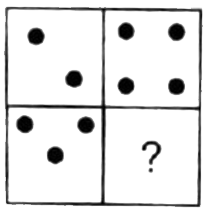A 2×2 grid with three figures and one empty space. Each square in this case is filled with black dots with the bottom-right square missing an image. The student needs to review the pattern within the squares and determine what the fourth square will be by applying the same rule. The student’s primary task is to identify the rule (e.g., is there a horizontal pattern, vertical pattern, number of dots etc..) and select the correct image from those presented (as shown below) to fill the empty space.
So if we analyse the question we may notice in the first row the number of dots doubled from two to four, so if we apply this rule to the second row the answer will be the square with six dots which is double the dots in the first column.
By practicing these types of questions, students can improve their ability to quickly identify visual patterns and apply logical reasoning, which are essential skills for success in the **CAT4 Non-Verbal Figure Matrices section**. For more **Non-Verbal Figure Matrices examples** and insights into the **test format**, explore our [CAT4 preparation tests](https://schoolentranceexam.com/practice-cat4-tests/ "CAT4 test preparation").
## **Frequently Asked Questions (FAQs) (H2)**
### **Q1: What is the CAT4 Non-Verbal Figure Matrices test?**
The CAT4 Non-Verbal Figure Matrices test is a core component of the Cognitive Abilities Test (CAT4), designed to assess a child’s non-verbal reasoning skills. It presents a series of visual puzzles where students must identify patterns, relationships, and logical sequences among shapes and figures. It evaluates the ability to think quickly and critically to solve problems without relying on language, making it an essential tool for understanding spatial reasoning and abstract thinking.
### **Q2: How can I improve my child’s performance in Non-Verbal Figure Matrices?**
To improve your child’s performance in the CAT4 Non-Verbal Figure Matrices test requires practice and exposure to similar visual puzzles. This will allow your child to develop strategies to solve problems based on pattern recognition, spatial awareness, and logical sequencing. Utilizing CAT4-specific practice materials, online resources, and timed mock tests can build further confidence and familiarity with the actual test format allowing the student to maintain a calm mindset during the test.
### **Q3: How long should my child practice for the CAT4 test?**
The ideal practice duration for the CAT4 test depends on your child’s current abilities and familiarity with the test and question format. Generally, practicing for 20-30 minutes daily over 3-4 weeks is much more effective for these types of tests than cramming. Consistent, short sessions reinforce learning and don’t burn your child out. As the test date approaches incorporate full-length mock tests so your child builds stamina and understands the importance of time management.
If you haven’t already, read my story by **[clicking here](/pass-the-cat4-for-future-success/ "My Story on Passing the CAT4")** on how I helped my son pass with flying colours.
- [Non-Verbal Figure Classification](https://schoolentranceexam.com/non-verbal-figure-classification/ "Learn about Non-Verbal Figure Classification for school entrance exams")
- [Non-Verbal Figure Analysis](https://schoolentranceexam.com/non-verbal-figure-analysis "Explore Non-Verbal Figure Analysis techniques for school entrance exams")
- [Non-Verbal Figure Matrices](https://schoolentranceexam.com/non-verbal-figure-matrices "Understand Non-Verbal Figure Matrices with detailed examples")
- [Non-Verbal Figure Recognition](https://schoolentranceexam.com/non-verbal-figure-recognition "Master Non-Verbal Figure Recognition skills for assessments")
- [Numerical Analogies](https://schoolentranceexam.com/numerical-analogies/ "Practice Numerical Analogies for cognitive and school entrance tests")
- [Numerical Series](https://schoolentranceexam.com/numerical-series/ "Enhance your skills in Numerical Series for entrance exams")
- [Verbal Analogies](https://schoolentranceexam.com/verbal-analogies/ "Improve your Verbal Analogies proficiency for tests")
- [Verbal Classification](https://schoolentranceexam.com/verbal-classification/ "Develop Verbal Classification techniques for reasoning exams")
---
### [CAT4 Non-verbal Figure Recognition Practice Test](https://schoolentranceexam.com/non-verbal-figure-recognition/)
**Published:** June 21, 2018
**Author:** Admin
**Content:**
The **Non-Verbal Figure Recognition Test** is one of the eight sub-tests within the **CAT4 (Cognitive Abilities Test) assessment battery**, specifically designed to measure a child’s ability to recognise and analyze visual patterns. Students are challenged to interpret and process visual information effectively and recognise a shape hidden within a complex web of other shapes. Each question presents a target image that the student must identify and depending on the student age and CAT4 level being used, the complexity of the imagery increases, with more intricate and detailed visuals being introduced.
How much is your child’s education worth? Get access to the rest of the site to avoid your child being disadvantaged. [Click here](/membership-join/) now.
**Figure recognition** is a key element of the **non-verbal reasoning** section in the **CAT4 test**. This component evaluates a student’s ability to identify and match visual patterns, shapes, or figures based on their characteristics, orientation, or transformations. Students are tasked with recognizing similarities, differences, and relationships between figures, often requiring them to mentally manipulate or compare shapes to find the correct match. This skill is crucial for developing spatial awareness, attention to detail, and the ability to process and interpret visual information efficiently.
## **What is CAT4 Non-Verbal Figure Recognition?**
CAT4 Non-Verbal Figure Recognition is one of the sub-tests of the Cognitive Abilities Test (CAT4), which is designed to assess a student’s ability to interpret and analyse visual information. It evaluates a students skills in identifying patterns, shapes, and sequences without relying on language, making it an essential measure of understanding spatial reasoning and problem-solving abilities. It is particularly useful for educators to identify strengths and areas for improvement in this area to better focus and customise learning experiences.
Students may encounter various types of questions in this section that challenge their ability to recognize and interpret visual data. These may include:
- **Identifying patterns** in a series of shapes or figures.
- **Analyzing sequences** to determine the next logical figure.
- **Matching shapes** based on similarities or transformations.
- **Solving visual puzzles** by understanding relationships between figures.
## How to Prepare for CAT4 Non-Verbal Figure Recognition
Preparing for the CAT4 Non Verbal Figure Recognition section requires a strategic approach to enhance spatial reasoning and pattern recognition skills. Start by **practicing with sample questions** = this will help to familiarize you with the test format and question types. Regular practice can build confidence and also helps identify areas for improvement. For a comprehensive preparation, explore our **CAT4 practice tests**, designed to simulate the actual exam experience.
Leverage **online resources and apps** for non-verbal reasoning practice – on this site you can find [CAT4 practice tests](https://schoolentranceexam.com/practice-cat4-tests/ "CAT4 practice tests") for different age groups and levels. Using game such as, puzzles, board games, and activities like Sudoku, Rubik’s Cube, or tangrams into your child’s routine can also significantly boost their **spatial reasoning skills**. These activities train the brain to visualize and manipulate shapes, a key skill for excelling in the Non-Verbal Figure Recognition section.
## **Common Challenges and How to Overcome Them**
When preparing for the CAT4 Non-Verbal Reasoning test, one of the most frequent challenges that hinder a students performance is **time pressure**. The test requires quick thinking and efficient use of time to problem-solve quite complex questions. Many students may also struggle with **complex patterns and abstract shapes**, and just find the images difficult to interpret simply due to not having built up any mental strategies because of a lack of exposure to these types of questions. A student can get frustrated and let more difficult questions impact the easy ones and thus score lower, but with the right strategies and mentally focusing on only the question being presented they can overcome these score-lowering habits.
To overcome **time pressure**, students need to focus their speed and accuracy through regular practice of mock questions. This not only simulates exam conditions but builds confidence in managing time effectively and being methodical. Tackling **complex patterns** by breaking them down to smaller, more manageable parts makes it easier to identify underlying logic and see patterns. Visual aids, such as diagrams or flashcards, can also enhance pattern recognition skills.
- [Non-Verbal Figure Classification](https://schoolentranceexam.com/non-verbal-figure-classification/ "Learn about Non-Verbal Figure Classification for school entrance exams")
- [Non-Verbal Figure Analysis](https://schoolentranceexam.com/non-verbal-figure-analysis "Explore Non-Verbal Figure Analysis techniques for school entrance exams")
- [Non-Verbal Figure Matrices](https://schoolentranceexam.com/non-verbal-figure-matrices "Understand Non-Verbal Figure Matrices with detailed examples")
- [Non-Verbal Figure Recognition](https://schoolentranceexam.com/non-verbal-figure-recognition "Master Non-Verbal Figure Recognition skills for assessments")
- [Numerical Analogies](https://schoolentranceexam.com/numerical-analogies/ "Practice Numerical Analogies for cognitive and school entrance tests")
- [Numerical Series](https://schoolentranceexam.com/numerical-series/ "Enhance your skills in Numerical Series for entrance exams")
- [Verbal Analogies](https://schoolentranceexam.com/verbal-analogies/ "Improve your Verbal Analogies proficiency for tests")
- [Verbal Classification](https://schoolentranceexam.com/verbal-classification/ "Develop Verbal Classification techniques for reasoning exams")
---
### [CAT4 Non-verbal Figure Classification Practice Test](https://schoolentranceexam.com/non-verbal-figure-classification/)
**Published:** June 21, 2018
**Author:** Admin
**Content:**
The **non-verbal figure classification test** is one of the 8 sub-tests that make up the battery of CAT4 assessments. The sub-test checks your child’s non-verbal figure classification skills which involves the ability to understand, analyse, and recognize visual information and patterns.
*CAT4 Non-Verbal Reasoning Figure Classification*Non-verbal figure classification is an essential part of understanding information and non-verbal cues. It allows an individual to categorise and interpret information through the identification of groups, patterns, and common traits. Understanding non-verbal cues when communicating face-to-face is pivotal to develop interpersonal connections, successful business interactions, and facilitate clear and unambiguous communication. You can try the free version of this subtest by clicking the image below – this has been taken from the Basic CAT4 Package which does not include tracking or analysis – the [Ultimate version](https://schoolentranceexam.com/cat4-level-d-year-7-tests/ "Ultimate CAT4 Tests ") provides a CAT4 Test History and CAT4 Test Analysis:
[](javascript:void(0);)#### Figure Classification
**Figure classification** is a foundational cognitive ability assessed in the **CAT4 test**. This component of the **non-verbal reasoning section** evaluates a student’s ability to analyze and categorize visual information based on shared characteristics or relationships, such as shapes, patterns, and diagrams. By improving this skill you not only improve your **CAT4 test score** but also enhances your ability to think and increase your cognitive skills in areas like **problem-solving**, **spatial reasoning**, and **logical thinking**. These are essential skills for academic success, particularly in **STEM subjects** like mathematics, physics, and engineering, where visual data interpretation is crucial.
For students preparing for the **CAT4 test**, practicing figure classification will boost confidence and performance, while also build a foundation for **critical thinking** and **adaptability**. This will prepare the student for success in their future academic life and professional career.
## Real World Application of Non-Verbal Figure Classification Skills
Outside of the classroom in the real world, figure classification is used all the time from analysing and classifying visual data like graphs and charts to enable better decision-making. In **technology** figure classification is used by image recognition and artificial intelligence to provide advanced models. In **healthcare**, it is required in order to interpret medical scans, such as X-rays and MRIs. Even in everyday life it helps to improve tasks like organizing spaces, reading maps, or solving puzzles.
Non verbal figure classification has significant real-world applications and is essential in fields that require visual-spatial skills, such as architecture, healthcare, engineering, graphic design, and technology. Interpreting diagrams, blueprints, x-rays, or complex visual data is crucial in these areas. This ability also supports problem-solving in everyday tasks, such as assembling furniture, reading maps, or navigating new environments.
In professions like medicine, non-verbal reasoning and classifications aids in understanding and grouping medical imaging, such as X-rays or MRIs helping doctors to identify tumours and other such anomolies. By helping enable individuals to recognize patterns, analyze relationships, and draw logical conclusions without relying on verbal cues it provides a foundation for problem solving. Creative industries, where visualizing concepts and designing innovative solutions benefit hugely for an individual’s ability to understand non-verbal concepts. Its a vital skills to help individuals approach challenges with a structured analytical mindset, and is very important in our understanding and classifying everyday non-verbal communication cues such as:
**Facial Expressions:** The human countenance serves as a reservoir of non-verbal indicators. Smiles, furrowed brows, raised eyebrows, or a downward curve of the mouth, all convey a spectrum of emotions. Proficiently recognizing these expressions empowers you to gauge the emotional disposition of the person you are engaging with and adapt your responses accordingly.
**Body Language:** The manner in which an individual carries themselves communicates a wealth of information, including confidence, nervousness, or indifference. For instance, an erect posture with shoulders squared exudes self-assuredness, while slumped shoulders can signify diminished confidence.
**Gestures:** The movements of one’s hands, be it pointing, waving, or offering a thumbs-up, are potent non-verbal signals conveying intentions and reactions devoid of linguistic expression. Proficiency in comprehending these gestures helps avert misunderstandings and enhances the clarity of communication.
**Eye Contact:** The eyes have long been regarded as the mirror to the soul, as they offer deep insight into one’s engagement and emotional state. The continuity or avoidance of eye contact can indicate levels of interest, discomfort, or even potential duplicity.
**Tone of Voice:** The tonal quality, pitch, and cadence of speech are replete with non-verbal nuances. For example, a rapid, high-pitched tone can convey enthusiasm, whereas a measured, lower-pitched voice may signify solemnity or sadness.
**Proximity:** The physical distance maintained during an interaction can signify the degree of comfort and intimacy between individuals. Recognizing the subtleties of personal space boundaries is pivotal in ensuring respectful and effective communication.
**Cultural Divergence:** It’s worth noting that non-verbal cues can diverge significantly across cultural contexts. What may be deemed an appropriate level of eye contact, specific gestures, or facial expressions in one culture could be entirely distinct in another. Acknowledging these cultural distinctions is essential for proficient cross-cultural communication.
**Deception Detection:** Proficiency in non-verbal classification is also instrumental in detecting potential deception. Micro expressions, discreet changes in body language, and inconsistencies in vocal modulation often serve as telltale signs of untruthfulness.
**Emotional Intelligence:** Cultivating emotional intelligence, which encompasses the ability to recognize and interpret non-verbal cues, is integral for personal and professional advancement. It equips individuals to respond empathetically to the emotional cues of others, foster trust, and establish more profound and enduring connections.
## Practical Utility
In a spectrum of domains, ranging from psychology to sales, negotiation, and leadership, adeptness in decoding non-verbal communication constitutes a potent asset. It enables individuals to customize their approach in accordance with the emotions and needs of those they engage with.
In summary, non-verbal classification is a skill that substantially elevates one’s capacity to understand information and communicate effectively. By discerning and interpreting non-verbal cues, individuals gain profound insights into the emotional states, intentions, and attitudes of their counterparts. Whether in personal or professional interactions, this skill proves indispensable for establishing rapport, defusing conflicts, and forging meaningful connections. Refining and honing one’s ability to classify non-verbal cues remains a valuable asset in our interconnected world.
Explanations on the other sub-tests that make up the CAT4 assessment can be accessed below:
- [Non-Verbal Figure Classification](https://schoolentranceexam.com/non-verbal-figure-classification/ "Learn about Non-Verbal Figure Classification for school entrance exams")
- [Non-Verbal Figure Analysis](https://schoolentranceexam.com/non-verbal-figure-analysis "Explore Non-Verbal Figure Analysis techniques for school entrance exams")
- [Non-Verbal Figure Matrices](https://schoolentranceexam.com/non-verbal-figure-matrices "Understand Non-Verbal Figure Matrices with detailed examples")
- [Non-Verbal Figure Recognition](https://schoolentranceexam.com/non-verbal-figure-recognition "Master Non-Verbal Figure Recognition skills for assessments")
- [Numerical Analogies](https://schoolentranceexam.com/numerical-analogies/ "Practice Numerical Analogies for cognitive and school entrance tests")
- [Numerical Series](https://schoolentranceexam.com/numerical-series/ "Enhance your skills in Numerical Series for entrance exams")
- [Verbal Analogies](https://schoolentranceexam.com/verbal-analogies/ "Improve your Verbal Analogies proficiency for tests")
- [Verbal Classification](https://schoolentranceexam.com/verbal-classification/ "Develop Verbal Classification techniques for reasoning exams")
If you haven’t already, read my story by **[clicking here](/pass-the-cat4-for-future-success/ "My Story on Passing the CAT4")** on how I helped my son pass with flying colours.
---
### [Is CAT4 an IQ Test? Understand the Cognitive Abilities Test and Its Purpose](https://schoolentranceexam.com/is-cat4-an-iq-test/)
**Published:** February 9, 2025
**Author:** Admin
**Content:**
The CAT4 (Cognitive Abilities Test) is often compared to IQ tests, but it is not a traditional IQ test. Instead, it is designed to measure a student’s cognitive abilities and potential in key areas such as verbal, non-verbal, quantitative, and spatial reasoning. While it shares similarities with IQ tests, the CAT4 focuses on educational development rather than providing a fixed IQ score.
This distinction is important for parents, educators, and students to understand, as it influences how the results are interpreted and used. In this article, we’ll explore what the CAT4 test is, how it differs from IQ tests, and why it’s a valuable tool in education.
## What is the CAT4 Test?
The CAT4 is a widely used assessment tool in schools to evaluate students’ cognitive abilities. Developed by GL Assessment, it helps educators identify strengths, weaknesses, and learning potential. Unlike IQ tests, which focus on general intelligence, the CAT4 provides insights into specific areas of cognitive functioning.
The test is typically administered to students aged 6 to 17 and is divided into four main sections:
1. **Verbal Reasoning:** Measures the ability to understand and reason using words.
2. **Non-Verbal Reasoning:** Assesses problem-solving skills using shapes and patterns.
3. **Quantitative Reasoning:** Evaluates numerical problem-solving and reasoning abilities.
4. **Spatial Reasoning:** Tests the ability to visualize and manipulate objects in space.
Each section provides a detailed profile of the student’s abilities, helping educators tailor teaching strategies to individual needs.
## How Does CAT4 Differ from an IQ Test?
While both the CAT4 and IQ tests assess cognitive abilities, they serve different purposes. IQ tests aim to measure general intelligence, often represented by a single score. In contrast, the CAT4 provides a detailed profile of a student’s abilities across multiple domains.
### Key Differences Between CAT4 and IQ Tests
1. **Purpose:**
- **CAT4:** Focuses on educational potential and identifying strengths and weaknesses.
- **IQ Test:** Measures general intelligence and provides a fixed IQ score.
2. **Scoring:**
- **CAT4:** Provides multiple scores for different cognitive abilities.
- **IQ Test:** Offers a single IQ score, often represented as a number (e.g., 100).
3. **Application:**
- **CAT4:** Used in schools for academic planning and identifying learning needs.
- **IQ Test:** Used in clinical and psychological settings to assess intelligence.
4. **Content:**
- **CAT4:** Focuses on verbal, non-verbal, quantitative, and spatial reasoning.
- **IQ Test:** Covers a broader range of cognitive abilities, including memory and processing speed.
## What Does the CAT4 Test Measure?
The CAT4 assesses four key areas of cognitive ability, each of which plays a crucial role in academic success.
1. **Verbal Reasoning:** Understanding and reasoning using words.
2. **Non-Verbal Reasoning:** Solving problems using shapes and patterns.
3. **Quantitative Reasoning:** Working with numbers and mathematical concepts.
4. **Spatial Reasoning:** Visualizing and manipulating objects in space.
### Cognitive Abilities Assessed by CAT4
1. **Verbal Reasoning:**
- **What it measures:** Vocabulary, comprehension, and verbal logic.
- **Why it matters:** Strong verbal reasoning skills are essential for reading, writing, and communication.
2. **Non-Verbal Reasoning:**
- **What it measures:** Pattern recognition and abstract thinking.
- **Why it matters:** Non-verbal reasoning is critical for problem-solving and understanding complex concepts.
3. **Quantitative Reasoning:**
- **What it measures:** Numerical problem-solving and reasoning.
- **Why it matters:** Quantitative reasoning is vital for mathematics and science subjects.
4. **Spatial Reasoning:**
- **What it measures:** Visualization and spatial awareness.
- **Why it matters:** Spatial reasoning is important for subjects like geometry, engineering, and art.
By assessing these abilities, the CAT4 provides a comprehensive picture of a student’s cognitive strengths and areas for improvement.
## Why is CAT4 Used in Schools?
The CAT4 is a valuable tool for educators for several reasons:
1. **Identifying Learning Needs:**
- The test helps identify students who may need additional support or enrichment.
2. **Tailoring Teaching Strategies:**
- Educators can use the results to adapt their teaching methods to suit individual learning styles.
3. **Predicting Academic Performance:**
- The CAT4 provides insights into a student’s potential, helping schools set realistic academic goals.
4. **Supporting Gifted and Talented Programs:**
- The test can identify students with exceptional abilities who may benefit from advanced programs.
## Common Misconceptions About CAT4 and IQ Tests
There are several misconceptions about the CAT4 and its relationship to IQ tests. Let’s clarify some of the most common ones:
1. **Misconception 1:** CAT4 is an IQ test.
- **Reality:** While the CAT4 measures cognitive abilities, it does not provide an IQ score.
2. **Misconception 2:** CAT4 results determine a student’s intelligence.
- **Reality:** The CAT4 highlights strengths and areas for improvement, not fixed intelligence.
3. **Misconception 3:** CAT4 is only for high-achieving students.
- **Reality:** The test is designed for all students, regardless of their academic performance.
## How to Prepare for the CAT4 Test
While the CAT4 is not a test that can be “studied” for, there are steps students can take to prepare:
1. **Practice Sample Questions:**
- Familiarize yourself with the format and types of questions.
2. **Develop Problem-Solving Skills:**
- Engage in activities that require critical thinking and reasoning.
3. **Stay Relaxed and Focused:**
- Ensure you’re well-rested and calm on the day of the test.
4. **Understand the Test Structure:**
- Knowing what to expect can help reduce anxiety and improve performance.
## Frequently Asked Questions (FAQs) About CAT4
**Q1: Is CAT4 harder than an IQ test?**
A: The difficulty depends on the individual’s strengths. CAT4 focuses on specific cognitive areas, while IQ tests assess general intelligence.
**Q2: Can CAT4 predict academic success?**
A: Yes, CAT4 results can help predict academic performance by identifying cognitive strengths and weaknesses.
**Q3: Is CAT4 used outside of schools?**
A: Primarily, CAT4 is used in educational settings, but it can also be used in research and talent identification programs.
**Q4: How long does the CAT4 test take?**
A: The test typically takes about 2 hours, divided into short sections.
**Q5: Can parents access CAT4 results?**
A: Yes, schools often share results with parents to discuss their child’s progress and needs.
### **Additional SEO Tips**
1. **Internal Linking:** Link to related pages on your site, such as “What is the CAT4 Test?” or “How to Prepare for Cognitive Ability Tests.”
2. **External Linking:** Link to authoritative sources, such as official CAT4 documentation or educational research.
3. **Image Optimization:** Use images like graphs or illustrations of cognitive abilities, with descriptive alt text (e.g., “CAT4 test structure and components”).
4. **Mobile Optimization:** Ensure the page is mobile-friendly and loads quickly.
5. **Schema Markup:** Add structured data for FAQs to enhance search visibility.
---
### [Log In and Start Practicing](https://schoolentranceexam.com/membership-login/)
**Published:** April 30, 2019
**Author:** Admin
**Content:**
To access the restricted areas of the school entrance exam enter the username or eMail that you set up during registration. If you joined but did not receive a registration eMail please [click here](https://schoolentranceexam.com/contact-us/) to let us know so another registration eMail can be sent.
Username Password Remember me
[Forgot Password?](https://schoolentranceexam.com/member-login/password-reset/) [Join Us](https://schoolentranceexam.com/membership-join/)
---
### [Get Access to CAT4 Practice Exams](https://schoolentranceexam.com/membership-join/)
**Published:** April 30, 2019
**Author:** Admin
**Content:**
***Start your CAT4 practice – one-time payment, no subscription required!
Select the option/level your child needs:*** Select one Basic Level D/E Ultimate Level A Ultimate Level B Ultimate Level C Ultimate Level D Ultimate Level E Ultimate Level F Ultimate Level G [**Basic CAT4 Level D/E**](https://schoolentranceexam.com/practice-cat4-tests/) Spans across year 6, year 7, and year 8 students
Processing *...*
Start Now
£14.99 Achieving Success
- Limited questions and answers shown randomly.
- Similar timing to the real thing.
- Explanations provided to understand mistakes.
- **No Results tracking** – only included with the ultimate options.

[**CAT4 Level A**](https://schoolentranceexam.com/cat4-level-a-year-4-tests/) Appropriate for students aged 7 years 6 months to 9 years 11 months
Processing *...*
Start Now
£29.99 Achieving Success
- Large question bank of over 500 questions and answers.
- Similar timing and testing environment to the real thing.
- Simple explanations to teach and understand generic techniques.
- **Results tracking** – measure improvement and identify weaknesses.
- Access to the basic Level D/E test is included for **free**.

[**CAT4 Level B**](https://schoolentranceexam.com/cat4-level-b-year-5-tests/) Appropriate for students aged 8 years 6 months to 10 years 11 months
Processing *...*
Start Now
£29.99 Achieving Success
- Large question bank of over 500 questions and answers.
- Similar timing and testing environment to the real thing.
- Simple explanations to teach and understand generic techniques.
- **Results tracking** – measure improvement and identify weaknesses.
- Access to the basic Level D/E test is included for **free**.

[**CAT4 Level C**](https://schoolentranceexam.com/cat4-level-c-year-6-tests/) Appropriate for students aged 9 years 6 months to 11 years 11 months
Processing *...*
Start Now
£29.99 Achieving Success
- Large question bank of over 500 questions and answers.
- Similar timing and testing environment to the real thing.
- Simple explanations to teach and understand generic techniques.
- **Results tracking** – measure improvement and identify weaknesses.
- Access to the basic Level D/E test is included for **free**.

[**CAT4 Level D**](https://schoolentranceexam.com/cat4-level-d-year-7-tests/) Appropriate for students aged 10 years 6 months to 12 years 11 months
Processing *...*
Start Now
£29.99 Achieving Success
- Large question bank of over 500 questions and answers.
- Similar timing and testing environment to the real thing.
- Simple explanations to teach and understand generic techniques.
- **Results tracking** – measure improvement and identify weaknesses.
- Access to the basic Level D/E test is included for **free**.

[**CAT4 Level E**](https://schoolentranceexam.com/cat4-level-e-year-8-tests/) Appropriate for students aged 11 years 6 months to 13 years 11 months
Processing *...*
Start Now
£29.99 Achieving Success
- Large question bank of over 500 questions and answers.
- Similar timing and testing environment to the real thing.
- Simple explanations to teach and understand generic techniques.
- **Results tracking** – measure improvement and identify weaknesses.
- Access to the basic Level D/E test is included for **free**.

[**CAT4 Level F**](https://schoolentranceexam.com/cat4-level-f-year-9-year-10-tests/) Appropriate for students aged 12 years 6 months to 15 years 11 months
Processing *...*
Start Now
£29.99 Achieving Success
- Large question bank of over 500 questions and answers.
- Similar timing and testing environment to the real thing.
- Simple explanations to teach and understand generic techniques.
- **Results tracking** – measure improvement and identify weaknesses.
- Access to the basic Level D/E test is included for **free**.

[**CAT4 Level G**](https://schoolentranceexam.com/cat4-level-g-year-11-tests/) Appropriate for students aged 14 years 6 months to 17 years +
Processing *...*
Start Now
£29.99 Achieving Success
- Large question bank of over 500 questions and answers.
- Similar timing and testing environment to the real thing.
- Simple explanations to teach and understand generic techniques.
- **Results tracking** – measure improvement and identify weaknesses.
- Access to the basic Level D/E test is included for **free**.

*\* Need more information on which level to choose in different countries – [click here](javascript:void(0);)*
---
*After joining you will receive an eMail (*check your junk folder) which will include:
1\) Instructions on completing your registration and getting 30-day access to practice a full battery of CAT4 school entrance exams.
2\) Simple steps fully explaining how to use these tests to improve your child’s performance.*
**If you do not get the eMail or have problems please [contact me](/contact-us/)**.
I created these practice CAT4 exams for my son to pass the school entrance exam – by making them available on this site many parents have also been able help their children. As my children have grown older I have also provided some other resources for the 11+, GCSEs, A-Levels, and UCAT.*
---
### [11 Plus Free Short Example Test To Try Now](https://schoolentranceexam.com/11plus-short-example/)
**Published:** October 7, 2020
**Author:** Admin
**Content:**
The 11 plus test below is a short taster using questions from all areas of the 11 plus exam. As you can see these questions are not easy and it will take a considerable of study and revision for your child to successfully pass a 11 plus exam.
[](javascript:void(0);)
## Full Length 11 Plus Tests
On this site there is a full length set of 11 plus tests which you can use to check your child’s current ability. The tests are online and automatically marked, providing you with feedback and the correct answer. Don’t sit the real thing until your child has done these tests to see if they are ready.
Click each of the links below for the full tests – each one is about 50 minutes similar to the real thing;
**-> **[English](/11plus-practice-test-english-pack-1/)****
**-> **[Mathematics](/11plus-practice-test-mathematics-pack-1/)****
**-> [](/11plus-practice-test-english-pack-1/ "11+ English Assessment Practice")**[Non-Verbal Reasoning](/11plus-practice-test-nonverbalreasoning-pack-1/ "Non Verbal Reasoning 11 Plus practice test")****
**-> [](/11plus-practice-test-mathematics-pack-1/ "11+ Mathematics Assessment Practice")**[Verbal Reasoning](/11plus-practice-test-verbalreasoning-pack-1/)****
---
### [HTML Site Map for SchoolEntranceExam.com](https://schoolentranceexam.com/sitemap/)
**Published:** November 16, 2024
**Author:** Admin
**Content:**
#### Posts
- [Realistic CAT4 Practice Tests – Level D & E (2026) (July 5, 2026)](https://schoolentranceexam.com/cat4-practice-tests-level-d-level-e-2025/)
- [Time Management to Smash the CAT4 Tests (March 17, 2026)](https://schoolentranceexam.com/time-management-during-the-cat4-tests/)
- [Breaking Down the CAT4 Assessment (March 17, 2026)](https://schoolentranceexam.com/cat4-assessment/)
- [How Kevin Improved His CAT4 Score: A Step-by-Step Guide to Success (February 28, 2026)](https://schoolentranceexam.com/cat4-success/)
- [How to Prepare for the CAT4 Test (February 4, 2026)](https://schoolentranceexam.com/cat4-test-preparation/)
- [What Type of Questions are in a CAT4 Test? (December 21, 2024)](https://schoolentranceexam.com/what-type-of-questions-are-in-a-cat4-test/)
- [Breaking Down the CAT4 Levels – X, Y, A to G (September 20, 2024)](https://schoolentranceexam.com/cat4-levels/)
- [How To Beat the UK and Ireland CAT4 School Admission Test (September 13, 2024)](https://schoolentranceexam.com/uk-and-ireland-cat4/)
- [Ultimate CAT4 Practice Test to Smash the School Entrance Exam (May 31, 2024)](https://schoolentranceexam.com/cat4-practice-test/)
- [How to CAT4 in China? The good, the bad, and the ugly ! (March 15, 2024)](https://schoolentranceexam.com/cat4-in-china/)
- [School Entrance Exams in the UAE (CAT4, ISEE, MAP, CPAA) (August 13, 2023)](https://schoolentranceexam.com/school-entrance-exams-in-the-uae-cat4-isee-map-cpaa/)
- [How to Understand Cognitive Skills in Children (July 7, 2023)](https://schoolentranceexam.com/improving-cognitive-skills/)
- [Get Your Child in the Best School Possible (July 27, 2022)](https://schoolentranceexam.com/get-your-child-into-the-best-school-possible/)
- [Why Subject Knowledge Doesn’t Matter In A CAT Test (December 4, 2021)](https://schoolentranceexam.com/why-subject-knowledge-doesnt-matter-in-a-cat-test/)
- [Powerful CAT Secrets To Boost Life Long Success (October 21, 2021)](https://schoolentranceexam.com/powerful-cat-secrets-to-boost-life-long-success/)
- [Unlock Your Child’s Hidden Potential Through The CAT4 (August 14, 2021)](https://schoolentranceexam.com/the-cat4-reveals-your-childs-hidden-potential/)
- [11 Plus – How to Pass and Smash the Exam? (January 5, 2021)](https://schoolentranceexam.com/how-to-pass-and-smash-the-11-plus-exam/)
- [How do CAT4 results help your child do better (October 1, 2020)](https://schoolentranceexam.com/how-does-the-cat4-test-really-help/)
- [How to improve your child’s vocabulary for the 11+ (September 29, 2020)](https://schoolentranceexam.com/how-to-improve-your-childs-vocabulary-for-the-11/)
- [COVID-19 And Its Impact On The 11 Plus (September 27, 2020)](https://schoolentranceexam.com/what-are-the-effects-of-covid-19-on-the-11-plus/)
- [What Skills Do You Need To Pass The 11+? (September 15, 2020)](https://schoolentranceexam.com/what-skills-do-you-need-to-pass-the-11/)
- [What Are The Changes To Exams For 2020-2021? (August 9, 2020)](https://schoolentranceexam.com/what-are-the-changes-to-exams-for-2020-2021/)
#### Pages
- [CAT4 Tests – Questions Answered (September 12, 2026)](https://schoolentranceexam.com/cat4/)
- [Get your child into the School of your choice (September 12, 2026)](https://schoolentranceexam.com/)
- [Maze With Math to Improve Logical Reasoning (October 11, 2025)](https://schoolentranceexam.com/improve-cat4-numerical-reasoning/)
- [Proven Exercises to Increase Your Cognitive Abilities Test Performance (October 9, 2025)](https://schoolentranceexam.com/improve-cognitive-abilities/)
- [Products (October 2, 2025)](https://schoolentranceexam.com/products/)
- [Is CAT4 an IQ Test? Understand the Cognitive Abilities Test and Its Purpose (February 9, 2025)](https://schoolentranceexam.com/is-cat4-an-iq-test/)
- [Basic CAT4 Practice Tests (Level D/E) (November 16, 2024)](https://schoolentranceexam.com/practice-cat4-tests/)
- [HTML Site Map for SchoolEntranceExam.com (November 16, 2024)](https://schoolentranceexam.com/sitemap/)
- [School Entrance Exam Practice Analysis (April 17, 2023)](https://schoolentranceexam.com/school-entrance-exam-practice-analysis/)
- [Checkout Result – You Now Have Access (April 1, 2023)](https://schoolentranceexam.com/stripe-checkout-result/)
- [Login and Start Practicing (March 30, 2023)](https://schoolentranceexam.com/member-login/)
- [Edit School Entrance Exam Profile (March 30, 2023)](https://schoolentranceexam.com/member-login/edit-profile/)
- [Reset Your School Entrance Exam Password (March 30, 2023)](https://schoolentranceexam.com/member-login/password-reset/)
- [Registration (March 30, 2023)](https://schoolentranceexam.com/registration/)
- [Exam Practice Dashboard (March 29, 2023)](https://schoolentranceexam.com/dashboard/)
- [CAT4 Level G Practice Test (Year 11) (January 9, 2023)](https://schoolentranceexam.com/cat4-level-g-year-11-tests/)
- [CAT4 Level F Practice Tests (Year 9 & Year 10) (January 9, 2023)](https://schoolentranceexam.com/cat4-level-f-year-9-year-10-tests/)
- [CAT4 Level E Practice Test (Year 8) (January 9, 2023)](https://schoolentranceexam.com/cat4-level-e-year-8-tests/)
- [CAT4 Level D Practice Test (for entry into Year 7) (January 9, 2023)](https://schoolentranceexam.com/cat4-level-d-year-7-tests/)
- [CAT4 Level C Practice Test (Year 6) (January 9, 2023)](https://schoolentranceexam.com/cat4-level-c-year-6-tests/)
- [CAT4 Level B Practice Test (Year 5) (January 9, 2023)](https://schoolentranceexam.com/cat4-level-b-year-5-tests/)
- [CAT4 Level A Practice Test (Year 4) (January 9, 2023)](https://schoolentranceexam.com/cat4-level-a-year-4-tests/)
- [School Entrance Exam Practice History (July 24, 2022)](https://schoolentranceexam.com/school-entrance-exam-practice-history/)
- [Try an 11 Plus Practice Test For FREE (July 24, 2022)](https://schoolentranceexam.com/11-plus-practice-test-try/)
- [CAT4 Practice Activities – How to Help Your Child (July 24, 2022)](https://schoolentranceexam.com/cat4-practice/)
- [Feedback – Enquire, Have Your Say, or Provide Suggestions (February 27, 2022)](https://schoolentranceexam.com/feedback-have-your-say/)
- [What is the UCAT made up of? Find out here. (January 31, 2022)](https://schoolentranceexam.com/what-is-the-ucat-made-up-of/)
- [How to Improve Your UCAT Situational Judgement Band? (June 12, 2021)](https://schoolentranceexam.com/how-to-improve-your-ucat-situational-judgement-band/)
- [How to Improve Your UCAT Abstract Reasoning Score? (June 12, 2021)](https://schoolentranceexam.com/how-to-improve-your-ucat-abstract-reasoning-score/)
- [How to Improve Your UCAT Quantitative Reasoning Score? (June 12, 2021)](https://schoolentranceexam.com/how-to-improve-your-ucat-quantitative-reasoning-score/)
- [How to Improve Your UCAT Decision Making Score? (June 12, 2021)](https://schoolentranceexam.com/how-to-improve-your-ucat-decision-making-score/)
- [How to Improve Your UCAT Verbal Reasoning Score? (June 12, 2021)](https://schoolentranceexam.com/how-to-improve-your-ucat-verbal-reasoning-score/)
- [What is the UCAT and how to prepare for it? (May 24, 2021)](https://schoolentranceexam.com/what-is-the-ucat-and-how-to-prepare-for-it/)
- [Renew and Extend Your Test Practice (November 15, 2020)](https://schoolentranceexam.com/renew-and-extend-your-practice/)
- [11 Plus Free Short Example Test To Try Now (October 7, 2020)](https://schoolentranceexam.com/11plus-short-example/)
- [Articles on How to Improve Your Child’s Learning (September 28, 2020)](https://schoolentranceexam.com/articles/)
- [Schools Using the CAT4 or 11 Plus (September 3, 2020)](https://schoolentranceexam.com/list-of-schools-using-the-11-plus-or-cat4/)
- [11 Plus Practice Test Pack 1 (Try) (August 31, 2020)](https://schoolentranceexam.com/11-plus-practice-test-pack-1-try/)
- [True Beginner English Progress Tests (August 24, 2020)](https://schoolentranceexam.com/true-beginner-english/)
- [True Beginner – Final Progress Test (August 24, 2020)](https://schoolentranceexam.com/true-beginner-chapter-5-8-test/)
- [True Beginner – Progress Check (August 15, 2020)](https://schoolentranceexam.com/true-beginner-chapter-1-4-test/)
- [11 Plus – Thank You (August 7, 2020)](https://schoolentranceexam.com/11-plus-thank-you/)
- [Get Access to 11 Plus Practice Tests (Pack 1) (August 7, 2020)](https://schoolentranceexam.com/get-access-to-11-plus-practice-tests-pack-1/)
- [11 Plus Exam – Questions and Answers for Parents (August 7, 2020)](https://schoolentranceexam.com/11-plus/)
- [11+ Practice Test – Non-Verbal Reasoning (August 1, 2020)](https://schoolentranceexam.com/11plus-practice-test-nonverbalreasoning-pack-1/)
- [11 Plus Verbal Reasoning Practice Test (August 1, 2020)](https://schoolentranceexam.com/11plus-practice-test-verbalreasoning-pack-1/)
- [11 Plus Mathematics Practice Test (August 1, 2020)](https://schoolentranceexam.com/11plus-practice-test-mathematics-pack-1/)
- [Try the 11 Plus Practice Test (Pack 1) And Get Prepared (August 1, 2020)](https://schoolentranceexam.com/11-plus-practice-test-pack-1/)
- [11 Plus English Practice Test (July 31, 2020)](https://schoolentranceexam.com/11plus-practice-test-english-pack-1/)
- [Annual Progress Tests to Check Your Child’s Academic Ability (July 1, 2020)](https://schoolentranceexam.com/yearly-progress-tests/)
- [Get the GCSE Support Your Child Needs To Do Their Best (June 21, 2020)](https://schoolentranceexam.com/get-ongoing-gcse-coaching-and-support-for-your-child/)
- [Ultimate GCSE Coaching to Improve Grades Now (June 21, 2020)](https://schoolentranceexam.com/gcse-coaching-thankyou/)
- [Revise the Gaps and Make Notes (June 18, 2020)](https://schoolentranceexam.com/revise-the-gaps-and-make-notes/)
- [How to get better and improve your exam scores (June 18, 2020)](https://schoolentranceexam.com/how-to-get-better-and-improve-your-exam-scores/)
- [Practice Test, Find Gaps and Improve Your Grade (June 18, 2020)](https://schoolentranceexam.com/practice-test-find-gaps-and-improve-your-grade/)
- [Creating Concise Revision Notes For Your Exams (June 18, 2020)](https://schoolentranceexam.com/creating-revision-notes-for-gcses/)
- [Create Topic Headings to Track Your Progress (June 18, 2020)](https://schoolentranceexam.com/create-topic-headings-to-track-your-progress/)
- [Create a Baseline for Your Exams (June 18, 2020)](https://schoolentranceexam.com/create-a-baseline-for-your-exams/)
- [Understand what IGCSE tests and GCSE tests are all about (May 26, 2020)](https://schoolentranceexam.com/gcse-tests-igcse-tests/)
- [Ace Your Exams With My 7-Step Process (May 25, 2020)](https://schoolentranceexam.com/how-to-ace-your-exams-with-a-7-step-process/)
- [School Entrance Exam – Learning Services (May 22, 2020)](https://schoolentranceexam.com/learning-services/)
- [Practice and Improve by Using Past Exam Papers (May 8, 2020)](https://schoolentranceexam.com/practice-and-improve-by-using-past-exam-papers/)
- [Passing the CAT 4 to Get My Child Into The School of My Choice (May 6, 2020)](https://schoolentranceexam.com/pass-the-cat4-for-future-success/)
- [School Entrance Exam – Membership Renewal (May 5, 2020)](https://schoolentranceexam.com/membership-renewal/)
- [Getting the Best Marks in Your GCSE Exams (September 4, 2019)](https://schoolentranceexam.com/igcse-secret-techniques/)
- [CAT4 Test or SAT Test: What’s the Difference? (August 26, 2019)](https://schoolentranceexam.com/year-7-cat-tests/)
- [Contact Us (August 20, 2019)](https://schoolentranceexam.com/contact-us/)
- [School Entrance Exam – Cookie Policy And Cookie Use (August 19, 2019)](https://schoolentranceexam.com/cookie-policy/)
- [School Entrance Exam Privacy Policy (August 19, 2019)](https://schoolentranceexam.com/privacy-policy/)
- [Terms and Conditions for School Entrance Exam (August 19, 2019)](https://schoolentranceexam.com/terms-and-conditions/)
- [CAT4 – Thank you (April 30, 2019)](https://schoolentranceexam.com/cat4-thank-you/)
- [Get Access to CAT4 Practice Exams (April 30, 2019)](https://schoolentranceexam.com/membership-join/)
- [Log In and Start Practicing (April 30, 2019)](https://schoolentranceexam.com/membership-login/)
- [Password Reset to Your School Entrance Exam Account (April 30, 2019)](https://schoolentranceexam.com/membership-login/password-reset/)
- [CAT4 Verbal Classification Practice Test (June 21, 2018)](https://schoolentranceexam.com/verbal-classification/)
- [CAT4 Verbal Analogies Practice Test (June 21, 2018)](https://schoolentranceexam.com/verbal-analogies/)
- [CAT4 Numerical Series Practice Test (June 21, 2018)](https://schoolentranceexam.com/numerical-series/)
- [CAT4 Numerical Analogies Practice Test (June 21, 2018)](https://schoolentranceexam.com/numerical-analogies/)
- [CAT4 Non-verbal Figure Recognition Practice Test (June 21, 2018)](https://schoolentranceexam.com/non-verbal-figure-recognition/)
- [CAT4 Non-verbal Figure Matrices Practice Test (June 21, 2018)](https://schoolentranceexam.com/non-verbal-figure-matrices/)
- [CAT4 Non-verbal Figure Classification Practice Test (June 21, 2018)](https://schoolentranceexam.com/non-verbal-figure-classification/)
- [CAT4 Non-verbal Figure Analysis Practice Test (October 2, 2017)](https://schoolentranceexam.com/non-verbal-figure-analysis/)
#### Products
- [CAT4 Original Level E (April 3, 2023)](https://schoolentranceexam.com/asp-products/cat4-original-level-e/)
- [CAT4 Level G (April 2, 2023)](https://schoolentranceexam.com/asp-products/cat4-level-g/)
- [CAT4 Level F (April 2, 2023)](https://schoolentranceexam.com/asp-products/cat4-level-f/)
- [CAT4 Level E (April 2, 2023)](https://schoolentranceexam.com/asp-products/cat4-level-e/)
- [CAT4 Level D (April 2, 2023)](https://schoolentranceexam.com/asp-products/cat4-level-d/)
- [CAT4 Level C (April 2, 2023)](https://schoolentranceexam.com/asp-products/cat4-level-c/)
- [CAT4 Level B (April 2, 2023)](https://schoolentranceexam.com/asp-products/cat4-level-b/)
- [CAT4 Level A (April 2, 2023)](https://schoolentranceexam.com/asp-products/cat4-level-a/)
- [11 Plus Pack 1 (April 2, 2023)](https://schoolentranceexam.com/asp-products/11-plus-pack-1/)
- [Focused GCSE Improvement (April 1, 2023)](https://schoolentranceexam.com/asp-products/focused-gcse-improvement/)
- [Core GCSE Focus (April 1, 2023)](https://schoolentranceexam.com/asp-products/core-gcse-focus/)
- [Complete GCSE Success (April 1, 2023)](https://schoolentranceexam.com/asp-products/complete-gcse-success/)
#### YT Players
- [School Entrance Exams in the UAE (May 11, 2024)](https://schoolentranceexam.com/ytplayer/education-and-entrance-exams-in-the-uae/)
- [UCAT Preparation Video (May 25, 2021)](https://schoolentranceexam.com/ytplayer/official-ucat-video/)
- [Failing the 11 Plus (January 5, 2021)](https://schoolentranceexam.com/ytplayer/failing-the-11-plus/)
- [Prepare for the 11 plus exam (August 10, 2020)](https://schoolentranceexam.com/ytplayer/what-is-the-11-plus-test/)
- [Changes to GCSE, AS & A Level Assessment in 2021 (August 9, 2020)](https://schoolentranceexam.com/ytplayer/changes-to-gcse-as-a-level-assessment-in-2021/)
- [ISEB 11 Plus Assessments Introduction (August 7, 2020)](https://schoolentranceexam.com/ytplayer/iseb-11-plus-assessments-introduction/)
- [11 Plus Preparation Without a Tutor (August 7, 2020)](https://schoolentranceexam.com/ytplayer/11-plus-preparation-without-a-tutor/)
- [GL Assessment Informational Video (July 1, 2020)](https://schoolentranceexam.com/ytplayer/gl-assessment-informational-video/)
#### Categories
- [Year 7 Apptitude Tests](https://schoolentranceexam.com/category/year-7-apptitude-tests/)
- [11 Plus](https://schoolentranceexam.com/category/11-plus/)
- [Education](https://schoolentranceexam.com/category/education/)
- [Cognitive Abilities Test](https://schoolentranceexam.com/category/cognitive-abilities-test/)
---
### [School Entrance Exam - Cookie Policy And Cookie Use](https://schoolentranceexam.com/cookie-policy/)
**Published:** August 19, 2019
**Author:** Admin
**Content:**
### About this cookie policy
This Cookie Policy explains what cookies are and how we use them. You should read this policy to understand what cookies are, how we use them, the types of cookies we use i.e., the information we collect using cookies and how that information is used and how to control the cookie preferences. For further information on how we use, store and keep your personal data secure, see our Privacy Policy.
You can at any time change or withdraw your consent from the Cookie Declaration on our website.
Learn more about who we are, how you can contact us and how we process personal data in our Privacy Policy.
Your consent applies to the following domains: [schoolentranceexam.com](https://schoolentranceexam.com)
### What are cookies ?
Cookies are small text files that are used to store small pieces of information. The cookies are stored on your device when the website is loaded on your browser. These cookies help us make the website function properly, make the website more secure, provide better user experience, and understand how the website performs and to analyze what works and where it needs improvement.
### How do we use cookies ?
As most of the online services, our website uses cookies first-party and third-party cookies for a number of purposes. The first-party cookies are mostly necessary for the website to function the right way, and they do not collect any of your personally identifiable data.
The third-party cookies used on our websites are used mainly for understanding how the website performs, how you interact with our website, keeping our services secure, providing advertisements that are relevant to you, and all in all providing you with a better and improved user experience and help speed up your future interactions with our website.
### What types of cookies do we use ?
Necessary: Some cookies are essential for you to be able to experience the full functionality of our site. They allow us to maintain user sessions and prevent any security threats. They do not collect or store any personal information. For example, these cookies allow you to log-in to your account and add products to your basket and checkout securely.
Analytics: These cookies store information like the number of visitors to the website, the number of unique visitors, which pages of the website have been visited, the source of the visit etc. These data help us understand and analyze how well the website performs and where it needs improvement.
Marketing: Our website displays advertisements. These cookies are used to personalize the advertisements that we show to you so that they are meaningful to you. These cookies also help us keep track of the efficiency of these ad campaigns.
The information stored in these cookies may also be used by the third-party ad providers to show you ads on other websites on the browser as well.
Functional: These are the cookies that help certain non-essential functionalities on our website. These functionalities include embedding content like videos or sharing contents on the website on social media platforms.
Preferences: These cookies help us store your settings and browsing preferences like language preferences so that you have a better and efficient experience on future visits to the website.
---
---
## How can I control the cookie preferences ?
Should you decide to change your preferences later through your browsing session, you can click on the “Privacy & Cookie Policy” tab on your screen. This will display the consent notice again enabling you to change your preferences or withdraw your consent entirely.
In addition to this, different browsers provide different methods to block and delete cookies used by websites. You can change the settings of your browser to block/delete the cookies. To find out more out more on how to manage and delete cookies, visit [wikipedia.org](https://en.wikipedia.org/wiki/HTTP_cookie), [aboutcookies.org ](https://www.aboutcookies.org/).

---
### [Edit School Entrance Exam Profile](https://schoolentranceexam.com/member-login/edit-profile/)
**Published:** March 30, 2023
**Author:** Admin
**Content:**
Please login to edit your profile.
---
### [11 Plus Mathematics Practice Test](https://schoolentranceexam.com/11plus-practice-test-mathematics-pack-1/)
**Published:** August 1, 2020
**Author:** Admin
**Content:**
The 11 plus practice tests includes a mathematics element. Maths is a fundamental skill measure by the 11 plus and is an accurate predictor to success in other subjeccts. This test attempts to assess the actual topic knowledge acquired by the student during their years in school and covers mainly KS2 material along with problem solving and other pattern focused questions. Review and practice is required to ensure your child has the best opportunity to achieve the highest grade they can.
You need to [Login](https://schoolentranceexam.com/membership-login/) to view this content. Not a Member? [Join Us](https://schoolentranceexam.com/get-access-to-11-plus-practice-tests-pack-1/) to practice a full 11+ similar to the real thing.
---
### [11 Plus Exam – Questions and Answers for Parents](https://schoolentranceexam.com/11-plus/)
**Published:** August 7, 2020
**Author:** Admin
**Content:**
[11 Plus PRACTICE TEST](/11-plus-practice-test-try/)
- [What is the 11 Plus?](#aioseo-what-is-the-11-plus)
- [Why sit the 11 Plus Exam?](#aioseo-why-sit-the-11-plus)
- [What is in 11 Plus test that my child will take?](#aioseo-what-is-in-11-plus-test-that-my-child-will-take)
- [What is the structure of the 11 Plus Exam?](#what-does-the-11-plus-consist-of)
- [How long is an 11 plus exam?](#how-long-is-an-11-plus-exam)
- [What does the 11 plus exam measure?](#what-does-the-11-plus-exam-measure)
- [What is the pass rate for the 11+?](#aioseo-what-is-the-pass-rate-for-the-11)
- [Identifying Top Performers of the 11+](#identifying-top-performers)
- [11+ Exam boards](#11-plus-exam-boards)
- [How do I prepare my child?](#how-do-i-prepare-my-child)
## What is the 11 Plus?
The **11 plus exam** was introduced to UK schools in 1944 to ensure resources were made available to the most able students in the country. It was gradually phased out in England and Wales by 1976. It is still used today by many private and grammar schools in a number of counties and boroughs. The 11+ is also known as the transfer test and still causes controversy among the education community due to its selective nature. Many opponents complain that children from a more privileged background will do better than the working class and that this is unfair.
The **11 plus** exam is a secondary school entrance examination used to identify the most academically able children for admission into private independent schools and state-funded grammar schools. They are administered in year 5 or year 6 when children are either 10 or 11 years old.
## Why sit the 11 Plus Exam?
One of the main reasons for sitting the 11+ test is to gain admission to a grammar school or another selective school. These schools are known for their focus on academic excellence and rigorous curriculum, which can provide students with a solid foundation for further education and career opportunities. Additionally, grammar schools often have smaller class sizes and more individualized instruction, which can lead to a more personalized and effective learning experience.
Students in school taking the 11 plus test
Furthermore, attending a grammar school can also open up a wider range of educational opportunities for students. These schools often have strong connections to universities and other higher education institutions, which can provide students with access to a wider range of academic programs and resources. Additionally, many grammar schools offer extracurricular activities and programs that can help students to develop important skills and interests.
Additionally, the 11+ test can also help parents to provide their children with the appropriate support and resources to help them reach their full potential. For example, if a child scores well on the test, parents may choose to invest in additional tutoring or enrichment programs to help them succeed in a grammar school environment. Similarly, if a child does not score well on the test, parents may choose to consider alternative educational options that may be more appropriate for their child’s needs and abilities.
In conclusion, sitting the 11+ examination can provide children with a range of benefits such as access to prestigious academic institutions, more personalised learning experience and opportunities to excel in a challenging and stimulating educational setting. Additionally, the examination can help parents to identify children who have a particular aptitude for academic studies and to provide them with the appropriate support and resources to help them reach their full potential.
## What exactly is the 11 Plus?
The 11 Plus is a test used in the United Kingdom to determine which type of secondary school a student should attend. It is typically taken by students in their last year of primary school, when they are 11 years old. The test assesses a student’s abilities in mathematics, English, and verbal reasoning, and is used to determine whether a student should attend a grammar school or a secondary modern school. The test format and content vary depending on the region, but it is generally used as a way to select students for entry into selective schools with a more academically-oriented curriculum.
## What is in 11 Plus test that my child will take?
The format and content of the 11 Plus test can vary depending on the region and the specific school or schools for which the test is being taken. However, most 11 Plus tests include assessments of a child’s abilities in mathematics, English, and verbal reasoning.
The mathematics section of the test generally includes questions on basic arithmetic, algebra, geometry, and problem-solving. The English section may include questions on grammar, vocabulary, comprehension, and writing. The verbal reasoning section may include questions on logical reasoning, word analogy, and word matching.
In some regions, the test may also include a non-verbal reasoning section, which assesses a child’s ability to understand and analyze visual information.
It’s important to check with the specific school or local authority to find out what format the test will take and what the content will be. Some schools or local authorities may also provide sample test questions or practice materials to help prepare your child.
## What is the structure of the 11 Plus Exam?
The 11 Plus consists of the following;
1. **[11 Plus English](https://schoolentranceexam.com/11plus-practice-test-english-pack-1/ "11+ plus English section")** – Reading and comprehension is key here. Spelling and grammar is evaluated but the bulk of the questions are centred around the child’s ability to comprehend a passage and answer questions related to it. Some general knowledge and a wide vocabulary is essential to achieve top marks in this area. Creative writing is also a requirement is some tests particularly those internally written by the school.
2. **[**11 Plus** Mathematics](https://schoolentranceexam.com/11plus-practice-test-mathematics-pack-1/ "11+ mathematics section")** – Consists of question related to all of the curriculum and stretches into all of year 6. It’s a good idea to review this material to ensure your child is not surprised with material he / she has not covered. Maths concepts and multi-step problems will be presented along with some basic formulas.
3. **[**11 Plus** Non-Verbal Reasoning](https://schoolentranceexam.com/11plus-practice-test-nonverbalreasoning-pack-1/ "11+ non-verbal reasoning section")** – Eleven plus tests in this area are very thorough and a variety of questions are asked about shapes and patterns with the student having to logically determine the answer through a process of deduction and step by step reasoning.
4. **[**11 Plus** Verbal Reasoning](https://schoolentranceexam.com/11plus-practice-test-verbalreasoning-pack-1/ "11+ verbal reasoning section")** – Vocabulary and the ability to see connections in words is key. Being able to group similar concepts and words will help but
The **11 Plus** is administered in many schools around the UK and reaching out to your local school is essential for further information, especially if an internally created test is used instead of the standard test from either CEM or GL Assessment.
## How long is an 11 plus exam?
The four individual tests are each between 45 to 60 minutes long and consist of approximately 50 questions. Basically the student will have 1 minute per question with some questions being more difficult than others.
Speed is of the essence and timed practice is key to ensure nothing is left to chance.
## What does the 11 plus exam measure?
The **11** plus attempts to evaluate a student’s knowledge of mathematics and English and his or her ability to solve problems. It provides a complete view of a child in terms of cognitive skills and curriculum knowledge. High cognitive ability but a poor school / home environment is unlikely to help a child score highly on the 11+ Mathematics and 11+ English sections. On the other hand a child with low cognitive abilities, but a supportive home / school environment will likely achieve better results in these areas, but not as high in the verbal and non-verbal reasoning sections.
## What is the pass rate for the 11+?
The pass rate for the 11 Plus varies depending on the region and the specific school or schools for which the test is being taken. Each school or local authority sets its own pass mark or cut-off score, which is based on the number of places available at the school and the number of students who pass the test. Some selective schools have very high pass rates, while others are more inclusive and have lower pass rates. It’s important to note that the test is not pass or fail, it’s used to identify which students will be able to attend a selective school, the score you get will position you relatively to the other students who took the test.
## Identifying Top Performers of the 11+
The 11 plus is used to ensure that all students in a class are capable of achieving a predetermined minimum mark. It attempts to avoid a situation where less able students are effectively taking up resources and slowing the progress of the class. Grammar schools and independent (private) schools have limited spaces and in order to ensure their high standards only want the very best students.
As horrible as it may sound but the effect of your child’s environment has a huge impact on their motivation and ultimate achievement. This view is supported in literature (Vygotsky theory on peer learning) and works in a similar way to Sets within a school where top performing students are placed in Set 1, lower performing in Set 2, and so forth – but obviously on a larger scale. Private schools in particular want to show high performance and thus only want to accept those children whose results will provide evidence to prospective parents in the future.
## 11+ Exam boards
The two main exam boards for the **11+** are [CEM (Durham University)](https://www.cem.org/entrance-assessments) and [GL Assessment](https://www.gl-assessment.co.uk/products/admissions-testing-including-11plus/). The exam board used in your area will depend on the grammar school you wish to attend and can vary considerably in the same area.
It is extremely important to know which exam board is being used, the subsequent testing procedures, along with the format and admission rules for assigning school places.
[Click here](/list-of-schools-using-the-11-plus-or-cat4 "Schools and the 11+ version") to find your school and get further details of the exam board and format.
## How do I prepare my child?
Competition for places at grammar schools and independent schools is high and so parents are willing to spend anywhere from £30 to £5000 on private tuition. A few hundred pounds seems acceptable for most and can help provide the necessary edge to beat the “competition”. The programme of work generally consists of reviewing the curriculum and then doing a few papers before the test but can also consist of several months of evening classes and revisiting all of the curriculum to ensure nothing is left to chance.
Preparation for the 11 Plus is quite daunting but can follow a similar pattern to any exam (see [7-step GCSE / A-level revision](https://schoolentranceexam.com/how-to-ace-your-exams-with-a-7-step-process/ "7-step revision approach")). On this site we have a free online practice test ([click here](https://schoolentranceexam.com/11-plus-practice-test-pack-1-try/ "Practice free 11 plus test")) and then a more complete pack of tests which provides a more accurate experience of the full test.
## Try a 11 Plus Practice Test
The practice tests on this site are not official tests but use a similar format that can be used to help identify gaps in knowledge and exam taking technique. To try an example of the format and types of questions that may come up click below.
[PRACTICE NOW](/11-plus-practice-test-try/)
---
### [What is the UCAT and how to prepare for it?](https://schoolentranceexam.com/what-is-the-ucat-and-how-to-prepare-for-it/)
**Published:** May 24, 2021
**Author:** Admin
**Content:**
- [Who is the UCAT for?](#who-is-the-ucat-for)
- [What is the UCAT?](#what-is-the-ucat)
- [What is the purpose of the UCAT?](#what-is-the-purpose-of-the-ucat)
- [Which Universities require the UCAT?](#which-universities-require-the-ucat)
- [UCAT Preparation and Advice](#ucat-preparation-and-advice)
- [How to register for the UCAT test?](#how-to-register-for-the-ucat-test)
- [How do you book your UCAT Test?](#how-do-you-book-your-ucat-test)
- [What happens on the day of the UCAT test?](#what-happens-on-the-day-of-the-ucat-test)
- [For Remote Testing (available during COVID)](#aioseo-for-remote-testing-available-during-covid)
- [What is the structure of the UCAT?](#what-is-the-structure-of-the-ucat)
- [How to Get a High Score on the UCAT?](#how-to-get-a-high-score-on-the-ucat)
- [How to prepare for the UCAT?](#how-to-prepare-for-the-ucat)
- [How long do you need to prepare for the UCAT?](#how-long-do-you-need-to-prepare-for-the-ucat)
- [FREE Notes for the UCAT Subtests](#aioseo-notes-for-the-ucat)
## Who is the UCAT for?
The UCAT is an entry requirement for any applicant wanting to study an appropriate course (most likely medicine or dentistry) at one of the universities belonging to the UCAT consortium (UK or non-UK University). It needs to be taken by anyone looking for entry in the same academic year or for deferred entry in the following academic year and is generally open for registration early June with the first exams scheduled from late July to September – exact dates differ each year so make sure you review the official UCAT website. The exam can be set either online or at an authorised exam centre (subject to availability).
- Students who are in Year 12 looking to get into dentistry or medicine at university looking to complete their A-Levels or IB in the following year
- Those who have taken a gap year may also sit the UCAT.
- Postgraduates who are high performers and have completed a related degree.
It is advisable to start preparation several months before sitting the UCAT to ensure you perform at your very best.
## What is the UCAT?
The UCAT (University Clinical Aptitude Test) is a medical school entrance exam used by a group of UK Universities for students wishing to gain admission to medical school and study either medicine or dentistry. The UCAT was previously known as the UKCAT (UK Clinical Aptitude Test) and is now used for both local and international students applying for a place at medical school in the UK.
*UCAT Assesses Foundational Skills Required by Clinicians*
All students must meet the high academic standards required for entry, which are normally set at three grade As and above at A-Levels or a high IB score. The UCAT is an additional admissions test set by a significant number of UK universities to assess potential students for their suitability in terms of their non-academic abilities. With only limited spaces available universities use the UCAT to select only the very best applicants. The UCAT has been designed based on rigorous research to measure the essential characteristics required for clinicians with the ultimate aim of maintaining of improving the competence, standards, and ethics of those who enter the profession and deliver life saving healthcare.
[UCAT Breakdown](https://schoolentranceexam.com/what-is-the-ucat-made-up-of/)
## What is the purpose of the UCAT?
The overarching objective of the university is to accept the best applicants suited to being clinicians – with places being so limited the UCAT is another tool to help select these candidates. Understanding the different qualities that make up a good clinician (doctor / dentist) and how the assessment process is measuring this potential is key to appreciating what the UCAT is hoping to provide.
Academic performance is the first criteria and a good indicator of an applicant’s ability to deal with pressure, learn and reacall information, and understand topics. It also provides some indication of a person’s intelligence although home and school environments will also have a large impact on their performance.
Secondly, the personal statement provides further insight into the personality and passion the student has and if they will last the duration of the course. Any work experience or related activities mentioned will also give admissions officers a further insight on how serious the student is.
Personality, attitude, and softer skills are determined by a medical interview (panel or MMI) but are essential to understand if the candidate has the right temperament to make a good clinician and has a enough drive to last the duration of the course.
Even after the above assessments the university still does not have a good indication of an applicant’s mental ability, attitude and professional judgement particularly in areas which are critical to providing safe and effective clinical care. The purpose of the UCAT is to measure the true potential of candidates and assess their ability in these fundamental abilities (verbal, numerical, spatial, abstract and ethical) upon which clinicians rely. Each one of these core skills are used every day by clinicians; reading a medical report, studying MRIs, identifying patterns across multiple sets and formats, and learning and discovering new information. The UCAT fills in this gap, providing a fuller picture allowing admission officers to make more informed decisions.
## Which Universities require the UCAT?
It is a good idea to contact the university and review the course requirements to confirm if the UCAT is part of the admissions process. At the time of writing the following UK universities use the UCAT as part of their admissions process. For other universities the BMAT (BioMedical Admissions Test) may be the assessment of choice.
**University****UCAS Course Code** (check codes)[University of Aberdeen ](https://www.abdn.ac.uk/ "University of Aberdeen") A100, A201[Anglia Ruskin University](https://www.anglia.ac.uk/ "Anglia Ruskin University") A100[Aston University](https://www.aston.ac.uk/ "Aston University") A100[University of Birmingham](https://www.birmingham.ac.uk/ "University of Birmingham") A100, A101, A200[University of Bristol](https://www.bristol.ac.uk/ "University of Bristol") A100, A108, A206, A208[Brunel University London](https://www.brunel.ac.uk/ "Brunel University London") A100[Cardiff University ](https://www.cardiff.ac.uk/ "Cardiff University") A100, A104, A200, A204[University of Dundee](https://www.dundee.ac.uk/ "University of Dundee") A100, A104, A200[University of East Anglia ](https://www.uea.ac.uk/ "University of East Anglia") A100, A104[Edge Hill University](https://www.edgehill.ac.uk/ "Edge Hill University") A100, A110[University of Edinburgh ](https://www.ed.ac.uk/home "University of Edinburgh") A100[University of Exeter ](https://www.exeter.ac.uk/ "University of Exeter") A100[University of Glasgow ](https://www.gla.ac.uk/) A100, A200[Hull York Medical School ](https://www.hyms.ac.uk/ "Hull York Medical School") A100, A101[Keele University ](https://www.keele.ac.uk/ "Keele University") A100, A104[Kent and Medway Medical School](https://kmms.ac.uk/ "Kent and Medway Medical School") A100[King’s College London ](https://www.kcl.ac.uk/ "Kings College London") A100, A101, A102, A202, A205, A206[University of Leicester ](https://www.le.ac.uk/ "University of Leicester") A100, A199[University of Liverpool](https://www.liv.ac.uk/) A100, A200[University of Manchester ](https://www.manchester.ac.uk/ "University of Manchester") A104, A106, A204, A206[Newcastle University ](https://www.ncl.ac.uk/ "Newcastle University") A100, A101, A206[University of Nottingham ](https://www.nottingham.ac.uk/ "University of Nottingham") A100, A10L, A108, A18L[University of Plymouth](https://www.plymouth.ac.uk/ "University of Plymouth") A100, A206[Queen Mary University of London ](https://www.qmul.ac.uk/ "Queen Mary University of London") A100, A101, A110, A120, A200[Queen’s University Belfast ](https://www.qub.ac.uk/ "Queen's University Belfast") A100, A200[University of Sheffield ](https://www.sheffield.ac.uk/ "University of Sheffield") A100, A101, A200[University of Southampton ](https://www.southampton.ac.uk/ "University of Southampton") A100, A101, A102[University of St Andrews ](https://www.st-andrews.ac.uk/ "University of St Andrews") A100, A990[St George’s, University of London ](https://www.sgul.ac.uk/ "St Georges University of London") A100[University of Sunderland](https://www.sunderland.ac.uk/ "University of Sunderland") A100[University of Warwick ](https://warwick.ac.uk/ "University of Warwick") A101There are also a number of non-UK universities which also use the UCAT;
**University****UCAS Course Code**[American University of the Caribbean](https://www.aucmed.edu/ "American University of the Carribean")Doctor of Medicine (MD) Program[St George’s University (Grenada)](https://www.sgu.edu/ "St George's University (Grenada)")Doctor of Medicine (MD) ProgramInternational Universities Using the UCAT## UCAT Preparation and Advice
## How to register for the UCAT test?
Registering for the UCAT is done by the student and not the school – the process is quite straightforward and consists of a number of steps:
1. Registration generally opens early June for the next academic year. There is a window in which you must register or else you will not be able to sit the UCAT.
2. Only one account can be used per applicant and the test can be only sat once for each academic year – beware of trying to do the test twice – if it is discovered all your accounts may be withdrawn.
3. Make sure you use your legal name as it appears on the photo ID you will present when sitting your the test. Your name must also match your UCAS application to allow the UCAT results to be automatically uploaded and available for universities.
4. Once you have filled in the subsequent forms, answered the questions and created your profile you will be sent an eMail that contains a password allow you to login to your account.
You can register for the UCAT at . Other versions of the UCAT are also available (UCATSEN, UCATSA, UCATSENSA or UCATSEN50) for students with particular circumstances – make sure you are eligible for these and that you select the correct version when booking.
## How do you book your UCAT Test?
Once you have registered the next step is to book your exam – you are only able to book your exam during the booking period which generally starts in late June and finishes in September. It is possible to book your exam over the phone but online is just as easy and much more convenient. In the past tests were booked at authorised exam centres but more recently remote invigilation has become possible allowing you to sit the exam at a location of your choice. Be sure to meet the conditions set for remote testing.
You will need to page a fee for the test (approximately £75 for students in the UK or £120 for international students) – it may be possible to get a bursary for this fee if you are eligible – refer to the official UCAT site.
After scheduling the test you will receive an email confirming details about the timings, conditions, and rules. Be sure to read the UCAT Test Centre Exam Rules and pay particular attention to the photo ID policy.
## **What happens on the day of the UCAT test?**
The UCAT takes place over 2 hours and the only way to perform consistently during this time is to build up your mental stamina and emotional strength through practice. Having a good night’s sleep and regularly exercising can ensure your brain will be well oxygenated but you need to also have coping strategies for when you hit those mental blocks. Take each question one at a time and staying in the moment focused on what is being presented is essential. Dwelling on previous questions is a certain recipe for disaster and wastes value cognitive resources.
In order to overcome any anxiety and if you are taking the test remotely, it is best to conduct all your mock test in the same environment and at the same time as the live test. This familiarity both physically and mentally will help you to relax and perform to your best. Make sure you go to the lavatory before the test – and check with the invigilator if it’s ok to have a glass of water beside you – just in case you feel thirsty.
## For Remote Testing (available during COVID)
UCAT Cognitive Skills Test for Future Clinicians
You will have received instructions on how to check your laptop and connection after scheduling the exam. This should have been done a couple of times – once when you received the instructions, the day before the test and possibly a few hours before the test – just to be sure !!! It is also a good idea to ask everyone in your household to come off the internet to ensure that there are no problems with bandwidth or the line dropping.
Once you have successfully connected you will have to wait until the invigilator speaks and asks for the photo id to be shown on screen. The invigilator will ask you a few confirmation questions before wishing you good luck and allowing you to start.
## What is the structure of the UCAT?
The UCAT is made up of a number of subtests each of which assess the characteristics in applicants which will make them good clinicians. These tests consist of :-
1. **Verbal reasoning** – Assess your ability to quickly evaluate and skim through information, identifying key concepts and structures.
2. **Decision Making** – Presents complex information in a variety of different formats which you need to then comprehend and use to come to conclusions.
3. **Quantitative Reasoning** – Assesses your ability to manipulate and use numerical data to reach conclusions using appropriate calculations.
4. **Abstract Reasoning** – Tests your ability to infer patterns between seemingly arbitrary shapes and their positioning. (cancelled and will not appear in UCAT after 2024)
5. **Situational Judgement** – Determines your ability to decide on the most ethical course of action in a given situation.
## How to Get a High Score on the UCAT?
To get a high score on the UCAT you need to approach the UCAT is a different way to normal exams. The aim is to fulfil all of your potential and achieve the maximum mark you possibly can. Your ability in any area is determined by your memory, your ability to think quickly, and finally your ability to problem solve. To achieve a high score on the UCAT you need to ensure that these cognitive abilities are fully developed in relation to the UCAT tests and that your mind has all the information and practiced enough to answer the questions.
The UCAT is a fundamentally different type of test than students are used to and simply doing question after question without reflection will not help. There are some common approaches to the questions but you need to discover the techniques that work best for you and refine them until you are confident of achieving the highest score you possibly can. Fundamental reading skills will help across all the tests but speed reading will be very important during verbal reasoning. Knowledge and application of the good medical practices principles is key to getting a high UCAT score on the situational judgement test an essential marker for universities of your suitability.
Preparation and planning is a pre-requisite to a high score on the UCAT and most medical students say 8 weeks is long enough. Practice needs to be daily but should allow for periods of reflection and experimenting different approaches. The UCAT is a test of your mental endurance, intelligence and ability to plan and prepare. Use our planning tools to navigate the pages of information online and short cut your journey to focus on only what you need to get a high UCAT score.
[UCAT Breakdown](https://schoolentranceexam.com/what-is-the-ucat-made-up-of/)
## How to prepare for the UCAT?
Once you have registered and booked your UCAT its time to put a plan in place – “if you fail to plan, you plan to fail”:
1. Understand that the UCAT is difficult and requires time to prepare for.
2. Read about the UCAT, its subtests, timings, and question types.
3. For each subtest read in detail about the strategies you can use to approach the different question types.
4. Run through a full UCAT mock test under exam style timed conditions.
5. Reviewing your weaknesses and refine your strategies.
6. Conduct a subtest in your area of weakness and only do a full test until you are confident.
## How long do you need to prepare for the UCAT?
“I didn’t even prepare for the UCAT?” is a common boast from either a student who is about to get a horribly low score on the UCAT or someone who doesn’t want you to do well on the UCAT !! Everyone knows you not only need to but must prepare in advance for the UCAT. Treat the UCAT as another subject alongside your other work and start the studying its content early. At a minimum you need 6-8 weeks of preparation time to get somewhere close to your actual potential. You can do it in a month but you will be pushing and may end up getting fatigued for the read thing – starting to early has the same problem and you may start to tire. You need to build up so you are at peak performance when you take the UCAT.
I’ve put together some simple yet effective plans which will help you maximise your efforts. Work smarter not harder and learn from my experience.
## FREE Notes for the UCAT Subtests
My son had to do the UCAT before being accepted in university. He had no idea what to look for – what approach to take – what notes to take – to help others I’m sharing his *[UCAT notes ](https://schoolentranceexam.com/wp-content/uploads/2023/07/UCAT_Notes.pdf "UCAT Notes for Each Sub Test")*– take a look but be sure to write your own so the information sticks.
[UCAT Breakdown](https://schoolentranceexam.com/what-is-the-ucat-made-up-of/)
---
### [11 Plus Practice Test Pack 1 (Try)](https://schoolentranceexam.com/11-plus-practice-test-pack-1-try/)
**Published:** August 31, 2020
**Author:** Admin
**Content:**
The short free 11+ practice test below is a cut down version of the [full 11+ practice test pack ](/get-access-to-11-plus-practice-tests-pack-1/) which includes over 200 questions. Doing the full tests will give you an idea of the type of questions in the 11+ and how your child will actually perform. The test is very comprehensive and can be used multiple times – the best method is to let your child do the test, then review all the mistakes, revise, practice, and then do the tests again to see if any gaps still exist and if improvements have been made. Children only get one chance to get into your local grammar school so make sure to also use the full tests to determine if your child is ready.
[](javascript:void(0);)
Get your child to practice and fine tune his or her skills.
Click each of the links below for the full tests – each one is about 50 minutes long just like the real thing;
**-> **[English](/11plus-practice-test-english-pack-1/)****
**-> **[Mathematics](/11plus-practice-test-mathematics-pack-1/)****
**-> [](/11plus-practice-test-english-pack-1/ "11+ English Assessment Practice")**[Non-Verbal Reasoning](/11plus-practice-test-nonverbalreasoning-pack-1/ "Non Verbal Reasoning 11 Plus practice test")****
**-> [](/11plus-practice-test-mathematics-pack-1/ "11+ Mathematics Assessment Practice")**[Verbal Reasoning](/11plus-practice-test-verbalreasoning-pack-1/)****
---
### [Try the 11 Plus Practice Test (Pack 1) And Get Prepared](https://schoolentranceexam.com/11-plus-practice-test-pack-1/)
**Published:** August 1, 2020
**Author:** Admin
**Content:**
[](javascript:void(0);)
Click the icon above to try a short sample 11+ test. The complete 11+ is made up of 4 areas with each one being between 30 to 50 minutes long. The only way to know if your child is ready to take the 11+ is to do a mock / simulation.
Click the links below to launch the full 11+ practice test and make sure your child is fully prepared to sit the real thing;
[](javascript:void(0);)#### 11+ Mathematics
[](javascript:void(0);)#### 11+ English
[](javascript:void(0);)#### 11+ Non-Verbal Reasoning
[](javascript:void(0);)#### 11+ Verbal Reasoning
Taking the 11+
The Eleven Plus exam is used as an assessment tool for entry into grammar schools in the UK. It presents one of the most significant challenges for students and parents. Managing the stress associated with the exam becomes extremely important to ensure your child is able to perform to the best of their ability. The emotional toll of the Eleven Plus exam on students is significant and parents have a key role in helping children to copy
## Understanding the Key Stress Factors
The 11+ exam carries determines a child’s educational trajectory and helps to determine the type of education he or she will receive. The pressure associated with this life changing event is even more pronounced in parents since they understand the consequences. The fear of underperforming, the competitive nature of the exam, and the apprehension of encountering questions that haven’t been practiced. These pressures can potentially cause the child to underperform as well as negatively effective a child’s psychological well-being.
## Student Expectations
Negotiating the unfamiliar setting, strict time constraints, and the burden of expectations can be an overwhelming ordeal. Moreover, the broad spectrum of subjects covered requires a wide set of skills and early preparation in subjects ranging from English, math, verbal reasoning, and non-verbal reasoning.
## The Parent’s Role is Key
Parents are very important is mitigating the child’s stress levels by communicating and reassuring the child. The worst thing a parent can do is apply further pressure on the child to perform – we all want our children to do well but this period of time is when parents need to allow their child to communicate their thoughts and work through any concern together. Fostering this type of a nurturing environment at home, can help immensely.
## Effective Approaches to Prepare for the 11+
Structure and discipline is key to preparation and can help provide the tools and knowledge your child needs to avoid the feeling of not having done enough. Create a well-balanced study timetable and also pencils in study breaks. Use mock tests like the ones provided on this page to help your child familiarize themselves with the format, level and complexity of the questions. Don’t do this too soon – make sure your child is ready to be able to answer at least some of the questions – we all want to feel we can reach our goals and if we completely bomb the mock test your child may fall into a cycle of depression and inaction.
## Nerves on the Day of the 11+
Stress and anxiety will almost certainly build the closer exam day comes. Practice relaxation techniques with your child, such as deep breathing and visualization, to calm their nerves. Exercise is also an excellent way to keep spirits high and blood flowing. A wholesome breakfast and sufficient sleep is essential to ensure your child is both mentally and physically prepared to face the challenge.
## Focusing on the 11+ Learning Journey
After the exam, give your child some space to reflect on their experience. Whatever the outcome be proud that your child stayed the course and kept to the schedule. If the results are less than expected reassess with your child where improvements can be made for the future and remind them that the future holds many opportunities for which you need to prepare and that this particular exam is but one.
## Conclusion
The emotional rollercoaster that students and parents encounter during their preparation for the **11+** can either help or hinder a child’s performance. Your support as a parent is a key enabler to ensure anxiety and stress is diffused and channeled appropriately and that when armed with effective preparation strategies, a positive mindset, and a robust support network their is nothing to worry about whatever the final results. Help your child emerge as a more resilient individual.
---
### [Basic CAT4 Practice Tests (Level D/E)](https://schoolentranceexam.com/practice-cat4-tests/)
**Published:** November 16, 2024
**Author:** Admin
**Content:**
CAT4 assessments range from Level A to G depending on the student’s age – [click here](javascript:void(0);) for information – with each level consisting of of 8 sub-tests. The **Basic Option** Level D/E can be accessed by clicking on the images below.
Select another level Level A Level B Level C Level D Level E Level F Level G Basic Level D/E
[](javascript:void(0);)#### Figure Classification
[](javascript:void(0);)#### Figure Matrices
[](javascript:void(0);)#### Verbal Classifications
[](javascript:void(0);)#### Verbal Analogies
[](javascript:void(0);)#### Number Analogies
[](javascript:void(0);)#### Number Series
[](javascript:void(0);)#### Figure Analysis
[](javascript:void(0);)#### Figure Recognition
The best approach is to do the test then review in detail the questions and their solutions – this is key and will help to understand the different question types and if another similar question is presented in the real test then it won’t be a surprise. I then suggest you repeat the test possibly after a day or a few hours. You should aim to get 80-90% to have a good chance. These practice test questions and answers are randomly ordered and will help familiarise you with the questions but ultimately it is your performance in the real test and any practice tests are simply an indicator. A lot of parents have had a good result using the process above.
All the best to achieving your future success!
---
### [Passing the CAT 4 to Get My Child Into The School of My Choice](https://schoolentranceexam.com/pass-the-cat4-for-future-success/)
**Published:** May 6, 2020
**Author:** Admin
**Content:**
- [Update on My Son's Progress](#aioseo-update-on-my-sons-progress)
- [September 2024 – Two Years in Med School](#aioseo-july-2023-end-of-the-first-year-in-med-school)
- [July 2023 – End of the First Year in Med School](#aioseo-july-2023-end-of-the-first-year-in-med-school)
- [October 2022 – A-Level Results Are In](#aioseo-october-2022-a-level-results)
- [August 2022 – A-Level Results](#aioseo-august-2022-a-level-results)
- [August 2020 – GCSE Results](#aioseo-august-2020-gcse-results)
- [How it All Began – The CAT4](#aioseo-how-it-all-began-the-cat4)
- [Improving CAT4 Scores](#aioseo-improving-cat4-scores)
## **Update on My Son’s Progress**
### ********September 2024 – Two Years in Med School********
What a journey its been and how it has helped me grow as a parent and my son find himself. The pressure of exams and assessments has been immense but he’s persevered. He’s managed to make it the third year – but there have been times when I thought he was going to pack it in and change direction. He has been questioning his decision to do medicine and I’ve supported him in making the right choice – **for him**. Medicine is not for everyone and at the moment he’s still on track – but if he decides to change direction I’ll support his decision with the caveat he’s got to have an alternative plan that doesn’t involved the UCAT. CAT4, or university interviews !!!
### ********July 2023 – End of the First Year in Med School********
After an expensive year for me – I had to pay for my son’s living costs at university – his first year results are in and he passed with a distinction ! He’s learnt a lot about the world and matured into a young man who has the ability to cope with new challenges calmly and systematically. I’ve not had to support him at all with regards to his work and he has managed his independent life well. To think it all started with the **CAT4** !
### ****October 2022 – A-Level Results Are In****
The results are in !! Three A\*s – I am so proud. He’s got into the medical school he wanted ! Woohoo !! Three A\*s in **Biology, Chemistry, and Mathematics** is quite an achievement – I never expected it – thought he would drop a grade here and there but he surprised us. His journey now begins and my job is over – **phew!** – one down. It all started all those years ago with the **CAT4** to give him the foundations he needed – he now has the skills he needs to continuously improve in any endeavor he chooses – as a parent I feel I’ve done everything possible and he, as a student has done what was needed to fulfill his potential and achieve his goals !
### **August 2022 – A-Level Results**
Awaiting results ! The **CAT4** tests were the key to getting my son into the right school – now 5 years later he is reaping the rewards. After a stressful few months filling in the **university (UCAS) applications**, **[practicing for the UCAT test](https://schoolentranceexam.com/what-is-the-ucat-and-how-to-prepare-for-it/)**, and doing practice **[medical university interviews](https://mmipracticequestions.com/ "Practice Medical University Interview questions")** – he’s finally got some offers – now he’s praying he gets the grades he needs. Passing the **CAT4 test** all those years ago helped him get into the right school and achieve things which I never imagined. He’s taking A-Level **Biology, Chemistry, and Mathematics** and has been consistently getting the A\*s he needs during his mocks – we can now only wait and see !
### **August 2020 – GCSE Results**
After a horrible year with COVID lockdowns and online schooling my son’s hard work paid off. His grades came in and he had top grades in all subjects but two !!! Wow ! [Click here ](https://schoolentranceexam.com/igcse-secret-techniques/ "My Story on how to achieve Top Grades in GCSE and A-Level ")to read more about his story. By going to one of the very best schools, attended by some of the very best students he was set up to do his very best – I just can’t believe it all started with **passing the CAT4** and getting through the admission process !
---
## **How it All Began – The CAT4**
I wanted my son to go to the best school in the area that we live in. I’d heard stories about the local school – and **I definitely DIDN’T want my son to go there**. A lot of the parents (and my sister !) were all trying get their children accepted at the one selective school within walking distance – this was the school where the teachers ‘***gave a dam’*** and the kids were all high achievers ending up in the best universities …
***..With so much competition I knew I had to help – leaving it to my son would have spelt certain failure…***
All I knew was the school was going to use **CAT4** assessments (Cognitive Abilities Test) to check how smart he was – not what he knows. Kind of makes sense, if a child is intelligent he’ll pick things up quickly which is more important when you’re 11 years old. I asked about **revision material** wanting to give him a headstart – but there wasn’t any – in fact the school asked us **not to revise**. Aptitude can’t change they said. Yes that might be true, but …
***… if other children have done these type of exams he’ll be at a disadvantage before he even starts …***
This is when I started looking for **practice exams** and to my **horror** there was nothing out there and what was available was hard copy – the exam was online, so I knew doing a pen and paper test would simply add to his confusion during the real thing.
***I didn’t want my son to lose his place because he was overwhelmed by a format and type of test that he’d never seen … I just imagined what it would feel like doing this type of exam for the first time …***
I put my thinking hat on and started to work out some practice questions … The tests he had to sit were broken into Verbal, Numerical and Spatial – I wasn’t sure how many questions there were so just decided to have between 10-20 in each section – after a few weeks and a lot of hair pulling I had created a pretty accurate set of exams !!! I had to pay someone to move them online but the end result made it all worth while !!!!
## **Improving CAT4 Scores**
He must have done my tests about 5 times – **improving each time**. He never got full marks but that’s not a problem since that would have made him a super genius ! When the day of exam came he wasn’t nervous at all. He went in the exam hall waving and laughing – to be honest that **worried** the hell out of me.
…but after the exam he was just as confident saying the tests were **‘easy peasy’** … it seems his confidence was well placed – a few days later the school called to say **he’d scored in the top 5 for all three areas** !!!!
**I believe the practice he got helped immensely** – he wasn’t nervous at all and knew what to expect. We have **only one chance** at our child’s education and I know I would have felt like a failure if I didn’t do everything I could to level the playing field. I’ve uploaded the exams onto this site to help other parents like me – try one out now – can you ***imagine*** your child sitting this exam without ever having done questions like this …
Check out the tests **[here](https://schoolentranceexam.com/practice-cat4-tests/ "Check out the Level D/E Basic Tests")** and explore the different levels.
Get all your questions answered and review the GL Assessment CAT4 introduction video – **[click here](https://schoolentranceexam.com/cat4/)**.
---
### [What is the UCAT made up of? Find out here.](https://schoolentranceexam.com/what-is-the-ucat-made-up-of/)
**Published:** January 31, 2022
**Author:** Admin
**Content:**
The UCAT (University Clinical Abilities Test) is made up of 5 subtests to assess different aspects of your cognitive abilities. These consist of **verbal reasoning**, **decision making**, **quantitative reasoning**, **abstract reasoning**, and **situational judgement**. UCAT practice tests will then become much more productive when you know the answer to “What is the UCAT made up of?”. Having an understanding of why different skills are being tested and how they relate to medicine is key to staying motivated and appreciating the underlying driver behind the questions.
A thorough analysis of how you performed on each practice test (e.g. how much time you spent per question and should you have skipped some questions) is essential but don’t forget your ultimate job is to “**find the questions you can get right quickly**” and some hard word and hard choices will have to be made on your road to success.
The UCAT is a bit confusing so I’ve summarised the main points in the table below so whenever you need a complete breakdown just visit this page !
# What are the 5 sections of the UCAT?
**UCAT Subtest*****No. of Questions*****Time (minutes)****Time (seconds)****Time Per Questions****Comment****Verbal Reasoning**4421 minutes1260 seconds28.63 secondsLow scoring test**Decision Making**2931 minutes1860 seconds64.14 secondsLogic focused**Quantitative Reasoning**3624 minutes1440 seconds40 secondsQuick mathematics **Abstract Reasoning**5513 minutes780 seconds14.18 secondsCrazy pattern finding**Situational Judgement**6926 minutes1560 seconds22.61 secondsApplied common sense Breakdown of UCAT TestsImprove your UCAT Strategy and Score High
# What skills are being tested in the UCAT?
Ultimately it’s impossible to know you will last the length of the course and become a doctor but medical schools have worked out how to improve their chances of finding those students who are most likely to great doctors. From high A-Level grades to UCAT scores and interviews it a long and perilous journey and not for the fainthearted. The UCAT is a key hurdle and explicitly assess your abilities in skills which are directly relevant to medicince:
- **Verbal Reasoning** – required for reading research papers, medical textbooks, prescriptions, histories etc..
- **Decision Making** – measures the students ability to make logical reasons based on the information given.
- **Quantitative Reasoning** – you need to be quick with numbers – from body weight, prescriptions and anesthesia dosages – an area where large number of preventable incidents occur.
- **Abstract Reasoning** – being able to work with missing bits of information and think without the full picture – patients don’t always have or remember their histories.
- **Situational Judgement** – do you know what behaviours and the correct decision both medically and ethically are and do you know how to apply these.
## What is the UCAT Verbal Reasoning test?
Doctors and dentists need to understand complex information quickly and be able to communicate clearly with patients. Communication is one of the key attributes of a good medical practitioner. Being able to read, understand, and critically analyse written material (e.g. academic research, patient history) draw a conclusion on the information’s validity and come to a conclusion and create an action plan are key skills.
## What is the UCAT Decision Making test?
Doctors and dentists are constantly making decisions which taking into consideration a plethora of factors – from medications, symptoms, feelings, impact etc… The decisions made will have a direct impact on the health of patients and are often taken in a time pressured environment. Taking these types of complex decisions requires the ability evaluate, assess, manage risk and deal with uncertainty.
## What is the UCAT Quantitative Reasoning test?
Being able to quickly process numbers is a key skill doctors require. Drug calculations need to be accurate and use calculations based on weight, age, etc.. In a pediatric setting these skills are even more essential. Clinical research also requires the use of complex statistics and the ability to understand, critique and use results is essential.
## What is the UCAT Abstract Reasoning test?
Doctors need to recognise patterns and linkages between symptoms and the results of diagnostic tests (e.g. radiology, blood tests etc.. ) in order to come to the best diagnosis. Being able to appreciate the reliability ad relative importance of this information help doctors to be able to reach conclusions and formulate their next steps. Reading and writing research also requires the ability to see patterns presented in a variety of forms and an essential skills to help generate future hypotheses.
## What is the UCAT Situational Judgement test?
The character of medical students and future doctors needs to assessed to understand how an individual will behave or react in a real world situations. Integrity, teamworking, resilience, adaptability, moral and ethical standards are also aspects of what it takes to be a good doctor.
---
Check out the official UCAT breakdown [here](https://www.ucat.ac.uk/about-ucat/test-format/ "Official UCAT Breakdown").
Make sure also read the [UCAT Overview](https://schoolentranceexam.com/what-is-the-ucat-and-how-to-prepare-for-it/ "UCAT Overview ").
Have you finished the UCAT and now have interview offers? Get some interview practice – [click here](https://www.medicalschoolinterview.com/ "Medical School Interview").
---
### [CAT4 - Thank you](https://schoolentranceexam.com/cat4-thank-you/)
**Published:** April 30, 2019
**Author:** Admin
**Content:**
Thank you for your payment to accessthe CAT4 practice tests.
An email with **instructions** has been sent to you.
Once you have completed the registration you will have to log in to access all your exams from the dashboard and to start practicing.
[Click here](https://schoolentranceexam.com) to return to the homepage.
---
### [Ace Your Exams With My 7-Step Process](https://schoolentranceexam.com/how-to-ace-your-exams-with-a-7-step-process/)
**Published:** May 25, 2020
**Author:** Admin
**Content:**
Plan ahead, use revision notes, do past GCSE/A-Level papers, have a revision buddy – great advice but which child does it? [Click here](/igcse-secret-techniques/) to check out my son’s GCSE story.
I perfected a 7 -step process which I guarantee, if done patiently and diligently your child will achieve the very best they can, possibly 2-3 grades higher !
1. Download three to five years of exam papers along with their marking schemes, grade bands, and any other supporting material. I’ve shared links to these for both GCSEs and A-Levels- check them by [clicking here](https://schoolentranceexam.com/practice-and-improve-by-using-past-exam-papers/ "Past papers").
2. Do one set of exams and mark them using the marking scheme – **it’s OK to get very low marks** – **YOU WILL IMPROVE** – make a note of the subject, date, time started, time finished, mark as a percentage, and an actual grade! Check out an example – [click here](/create-a-baseline-for-your-exams "/create-a-baseline-for-your-exams").
3. Next use the published curriculum to write down all the **topic headings** you need to cover – you’ll have to check your text book and / or the exam board website (**[CIE](https://www.cambridgeinternational.org/), [Edxcel](https://qualifications.pearson.com/en/home.html), etc..**). Check out an example – [click here](https://schoolentranceexam.com/create-topic-headings-to-track-your-progress/).
4. Use your text books, or find a website, which covers the relevant topics and provides exercises – make sure you do the excercises however tedious. Write a maximum of **one A4 page** of notes per topic – **revision notes are about revising not learning** ! Check out the following page on how to learn new material – [click here](/creating-revision-notes-for-gcses/).
5. Do a another set of exam papers and mark them using the marking scheme. Make a note of the same information as mentioned in 2) above. You should hopefully see some improvement in your marks and note the change down – click here.
6. **Now here’s the secret** – review the questions you got wrong and write down the topics they are related to – this is the **gap analysis**.
7. Review the topics noted on the **gap analysis** and create a [supplementary shee](/revise-the-gaps-and-make-notes/)t to review from. Start again from step 4.
The steps 4-7 should repeat until you are getting satisfactory marks. Rotate between subjects – your child may have hit a plateau and need to return to the subject after a break- so don’t push one subject only.
The above is hard work ! Your child should be already doing it but how likely is that? Having the time and an education background helped – ;
1. Is you child too lazy to organize themselves?
2. Do they say they’re too busy to do this?
3. Are you too busy at work to be able to mark, schedule, and chase up?
4. Are you working in a different industry to teaching?
5. Are you smart and have the ability to learn anything but not the time?
6. Do you need someone else to put the process above in place?
[Click here](/get-ongoing-gcse-coaching-and-support-for-your-child/) to have above process managed for you and make sure your child is fulfilling their potential. Your child will only be doing his or her GCSEs once in Year 11 – don’t waste this opportunity.
---
### [11+ Practice Test - Non-Verbal Reasoning](https://schoolentranceexam.com/11plus-practice-test-nonverbalreasoning-pack-1/)
**Published:** August 1, 2020
**Author:** Admin
**Content:**
You need to [Login](https://schoolentranceexam.com/membership-login/) to view this content. Not a Member? [Join Us](https://schoolentranceexam.com/get-access-to-11-plus-practice-tests-pack-1/) to practice a full 11+ similar to the real thing.
---
### [11 Plus Verbal Reasoning Practice Test](https://schoolentranceexam.com/11plus-practice-test-verbalreasoning-pack-1/)
**Published:** August 1, 2020
**Author:** Admin
**Content:**
You need to [Login](https://schoolentranceexam.com/membership-login/) to view this content. Not a Member? [Join Us](https://schoolentranceexam.com/get-access-to-11-plus-practice-tests-pack-1/) to practice a full 11+ similar to the real thing.
---
### [11 Plus English Practice Test](https://schoolentranceexam.com/11plus-practice-test-english-pack-1/)
**Published:** July 31, 2020
**Author:** Admin
**Content:**
This English 11 plus practice set assesses the student’s general English skills along with the ability to read and comprehend basic English texts. These skills have been developed by the KS2 content studied in the last few years, but actually feel more advanced. The expectations are high so expect to work on these skills for at least 6 months before the test. Test your child’s level by trying a mock and identifying any gaps in knowledge or approach.
You need to [Login](https://schoolentranceexam.com/membership-login/) to view this content. Not a Member? [Join Us](https://schoolentranceexam.com/get-access-to-11-plus-practice-tests-pack-1/) to practice a full 11+ similar to the real thing.
---
### [11 Plus - Thank You](https://schoolentranceexam.com/11-plus-thank-you/)
**Published:** August 7, 2020
**Author:** Admin
**Content:**
Thank you for your payment for the 11 plus practice tests.
An email with **instructions** has been sent to you.
Once you have completed the registration you will need to log in to access all your exams from the dashboard.
[Click here](https://schoolentranceexam.com) to return to the homepage.
---
### [Checkout Result - You Now Have Access](https://schoolentranceexam.com/stripe-checkout-result/)
**Published:** April 1, 2023
**Author:** Admin
**Content:**
You’ve successfully gained access to your chosen exams / areas.
---
### [School Entrance Exam - Membership Renewal](https://schoolentranceexam.com/membership-renewal/)
**Published:** May 5, 2020
**Author:** Admin
**Content:**
Renew your membership below to get access to the School Entrance Exam practice tests again:-
[Click here](https://schoolentranceexam.com/membership-join/) for CAT4 exam renewal
[Click here](https://schoolentranceexam.com/get-access-to-11-plus-practice-tests-pack-1/) for 11 Plus exam renewal
---
### [Ultimate GCSE Coaching to Improve Grades Now](https://schoolentranceexam.com/gcse-coaching-thankyou/)
**Published:** June 21, 2020
**Author:** Admin
**Content:**
Thank you for your payment.
An email with **instructions** will be sent to you with initial questions and an overview of the process on how the coaching approach works to improve your grades.
[Click here](https://schoolentranceexam.com) to return to the homepage.
---
### [Exam Practice Dashboard](https://schoolentranceexam.com/dashboard/)
**Published:** March 29, 2023
**Author:** Admin
**Content:**
[**This content is for members only.**](https://schoolentranceexam.com/membership-join/)
---
---
Review the [practice history](https://schoolentranceexam.com/school-entrance-exam-practice-history/) to review individual test scores.
Review the [practice analysis](/school-entrance-exam-practice-analysis/ "Analysis of test practice e.g. CAT4, 11+ etc..") to understand which areas require further improvement.
---
---
### [Get Access to 11 Plus Practice Tests (Pack 1)](https://schoolentranceexam.com/get-access-to-11-plus-practice-tests-pack-1/)
**Published:** August 7, 2020
**Author:** Admin
**Content:**
***Join the site and start your 11+ practice test.*** [**Eleven Plus Practice Tests**](https://schoolentranceexam.com/11-plus-practice-test-pack-1/) Find out if your child is ready by doing a full set of 11+ tests.
Processing *...*
Start Now
£19.99 Achieving Success
- Similar timing and questions to the real thing.
- Good assessment of current abilities.
- Simple explanations to teach and understand generic techniques.
- **Results tracking** – measure improvement and identify weaknesses.
- 200+ questions, four tests mirroring the real thing.

*After joining you will receive an eMail with instructions on how to complete your registration and get 30-day access to the 11 plus exams.*
******If you do not get the eMail or have problems please [contact me](/contact-us/)***.***
*This test will provide you with a good idea to see if your child is ready* for the real thing.
---
### [Try an 11 Plus Practice Test For FREE](https://schoolentranceexam.com/11-plus-practice-test-try/)
**Published:** July 24, 2022
**Author:** Admin
**Content:**
The short [11 plus practice test](https://schoolentranceexam.com/11-plus-practice-test-pack-1/ "Free Short 11 plus practice test") provides a taste of the different types of questions that will come up in the [full 11 plus practice tests](https://schoolentranceexam.com/get-access-to-11-plus-practice-tests-pack-1/ "11 plus practice test full version").
The 11 plus is a standardised examination that is used for secondary school entry. The use of the test as part of the a admission process into some of the best school across England and Wales has led to some criticism of reinforcing the gaps across society. The name of the test comes from the age at which student’s take it – between 11 and 12 years or towards the end of year 6 (England & Wales).

The test addresses both academic knowledge and ability. Mathematics and English knowledge is tested from KS2 topics and cognitive ability (intelligence) is assessed through the use of non-verbal reasoning and verbal reasoning tests. Variations of the test can also be taken at different ages e.g. 10+, 12+,13+ etc… but they generally all contain sub-tests on Verbal / Non-verbal Reasoning, Mathematics, and English.
There are a considerable number of grammar schools around the England and Northern Ireland (230+ at the last count). The **[11 plus](https://en.wikipedia.org/wiki/Eleven-plus "History of the 11 plus test")** is not mandatory for all students rather it is only for those students who wish to progress to a grammar schools although in some regions parents must their child out of taking the exam.
---
### [Get the GCSE Support Your Child Needs To Do Their Best](https://schoolentranceexam.com/get-ongoing-gcse-coaching-and-support-for-your-child/)
**Published:** June 21, 2020
**Author:** Admin
**Content:**
**Remember when you were 16, in your final year of GCSEs – if only you’d had some extra guidance – you could have got two grades higher ! Do everything you can to give your child the best start possible**. **I’m offering 3 packages**:
PackageFeatures ### **Complete GCSE Success**
Up to 9 GCSEs- Past exam search
- Base line testing
- Notes review
- x3 – Exam setting, marking, and review
- Gap analysis
- **Revision timetable and task lists**
Processing *...*
Start Now
£1695### **Core GCSE Focus**
Up to 5 GCSEs- Past exam search
- Base line testing
- Notes review
- x3 – Exam setting, marking, and review
- Gap analysis
Processing *...*
Start Now
£1095### **Focused GCSE Improvement**
Up to 3 GCSEs
- Past exam search
- Base line testing
- Notes review
- x3 – Exam setting, marking, and review
- Gap analysis
Processing *...*
Start Now
£695All of the tasks above, plus chasing up (with you if need be!) to make sure work is done ! This is a long term commitment from me and a lot of work – I have to make sure it’s a win-win situation and that I do my very best for our children.
***After joining you will receive an eMail on how to complete your registration and then we will begin the support and coaching process for you and your child.***
***If you have problems please [contact me](https://schoolentranceexam.com/contact-us/)***.
*This site has morphed from CAT4 practice into providing support for GCSEs to parents who aren’t teachers and are busy working. What I’m providing is an complete package which will guide you and your child in the 7-step approach. Find out what they are by **[clicking here](https://schoolentranceexam.com//).***
---
### [School Entrance Exam Practice Analysis](https://schoolentranceexam.com/school-entrance-exam-practice-analysis/)
**Published:** April 17, 2023
**Author:** Admin
**Content:**
The **chart** below will help you to conduct an analysis of the practice tests conducted. This practice analysis will help to identify weaker areas that require further focus.
## Practice Analysis
You are not logged in. Please log in to view this chart.
More charts coming soon ….
Also review the [practice history](/school-entrance-exam-practice-history/ "Review the practice history of tests such as CAT4, 11+") to review individual test scores.
---
### [How to Improve Your UCAT Abstract Reasoning Score?](https://schoolentranceexam.com/how-to-improve-your-ucat-abstract-reasoning-score/)
**Published:** June 12, 2021
**Author:** Admin
**Content:**
- [What is UCAT Abstract Reasoning?](#aioseo-what-is-ucat-abstract-reasoning)
- [Why does the UCAT assess Abstract Reasoning?](#aioseo-why-does-the-ucat-assess-abstract-reasoning)
- [What are the different types of UCAT Abstract Reasoning questions?](#aioseo-what-are-the-different-types-of-ucat-abstract-reasoning-questions)
- [What strategies can I use to answer UCAT Abstract Reasoning questions?](#aioseo-what-strategies-can-i-use-to-answer-ucat-abstract-reasoning-questions)
- [How should I prepare for the UCAT Abstract Reasoning section?](#aioseo-how-should-i-prepare-for-the-ucat-abstract-reasoning-section)
## What is UCAT Abstract Reasoning?
Abstract Reasoning is the fourth UCAT subtest. It aims to assess your ability to identify rule-based patterns between a group of geometric shapes. It requires a structured approach along with practice to ensure patterns are identified accurately and quickly. The questions contain no text and if letters are used its the shape of the letter that needs to be evaluated rather than the letter itself.
### The Structure
- 55 questions to be answered in 13 minutes.
- 10-15 sec for each question.
*Abstract Reasoning*
The patterns in this subtest can be more complex than just placement or colour and may be conditional with one shape’s characteristic determining the placement, orientation, colour, or other characteristic in the other shapes. A well-practiced strategy coupled with careful but quick analysis is required to avoid jumping to conclusions.
One strategy which helps get through all the questions is to answer the simpler questions as quickly as possible so more time can be spent on more complex questions which generally have conditional relationships between the shapes. Don’t forget each question has equal weighting in terms of scoring.
## Why does the UCAT assess Abstract Reasoning?
Abstract reasoning is a key skill used by clinicians during physical examinations and when reviewing scans (X-Rays, Ultrasound, CT Scans, MRIs). Non-verbal abilities become even more important when patients are not able to interact with the doctor due to being unconscious or simply because they are too young to communicate.
Abstract reasoning skills are also essential during research where patterns analysis is critical to ascertain relationships.
## What are the different types of UCAT Abstract Reasoning questions?
Abstract Reasoning subtest of UCAT comprises of the following four types of questions:
### Type 1 (Set A / B / Neither)
In these questions, you will be given two sets of shapes (set A and set B). You will then be presented with 5 shapes and have to logically identify the set in which each belong or if they don’t belong to either set.
### Type 2 (Complete the Series*)*
You will need to select the next image in the pattern for a given sequence. You will need to identify what the pattern is and then select the image that comes next.
### Type 3 (Complete the Statement)
You will be presented with a shape on which a transformation has been conducted to create a second shape. You will need to recognise what that transformation was and apply this to a third shape. The shape produced then needs to be chosen from the options.
### Type 4(Set A or B)
You have to determine the relationship between the shapes in each set (set A and set B). You will then need to determine which set the shape presented belongs to. There will be four shapes which will need to be placed for each pair of set A and set B before a new set of A and set B appear.
## What strategies can I use to answer UCAT Abstract Reasoning questions?
Abstract reasoning can become very frustrating if you don’t approach it in a logical way. Practice helps but without analysing the different patterns and having a strategic approach it will be impossible to get better. Some patterns and rules will be confusing and take an inordinate amount of time so you must be strategic when approaching this section The following tips may be helpful:
1. Use Pattern Tables
2. Vital Triggers
3. Avoid Distractions
4. Keep it Simple at the Start
5. Know When to Flag and Move On
### Tip 1: Use Pattern Tables for UCAT Abstract Reasoning
Recognising Complex Patterns
There are patterns and difference which are almost identical every time. To ensure you don’t forget them and learn from your practice prepare yourself a table detailing all the patterns you’ve come across. Memorise these patterns and how to identify them – each time you practice review the pattern table and add any new patterns. You may want to use a structured approach to the way you analyse the patterns – e.g. Shape, Position, Colour, Sides etc…
### Tip 2: Vital Triggers
Many patterns have common characteristics thus reviewing set A and B at the start of each question and trying to identify the relationship between just two shapes in each set will help you recognise specific triggers between these two and hopefully identify the rest of the pattern.
### Tip 3: Avoid Distractions
Focus on a subset of the set – preferably just a pair of shapes to avoid being distracted by the rest of the set. This approach can improve your success rate incredibly since many test takers get confused with two many shapes to look at.
### Tip 4: Keep It Simple at the Start
Always look at the box with the fewest shapes in it first. This will help you to stay focused and not be overly distracted. It may not be the number of shapes but the number of colours, lines, angles, or touching sides. Of course, if you can immediately see the pattern there is no need to over analyse things and simply accept that you have subconsciously processed the shapes – it will start happening with practice !!
### Tip 5: Know When to Flag and Move
This is a key skill is possibly all the sections – when a question starts taking too long the impact it will have on the rest of the test for a single extra mark is simply not worth the effort. You must always assess if a question is going to take too long for you and avoid wasting time – your job is to find the questions you can answer correctly as quickly as possible. Use what information you can see to take a best guess.
## How should I prepare for the UCAT Abstract Reasoning section?
- Make sure you note down each and every pattern you come across and group them together so you can easily remember them.
- Have a structured approach to the analysis of patterns so you don’t miss the obvious ones.
- Watch out for distractors which may come in the form of shapes and colors.
- Take an educated guess and move on when you can’t work it out.
- Possibly use an acronym to remember how to analyse the shapes e.g. SCANS – Shape, Color, Arrangement, Number, and Time.
- Make sure you take a baseline test and understand the main types of questions before practicing a full section test. Practice makes perfect but only if you know how to improve each time.
---
### [Feedback - Enquire, Have Your Say, or Provide Suggestions](https://schoolentranceexam.com/feedback-have-your-say/)
**Published:** February 27, 2022
**Author:** Admin
**Content:**
As part of my ongoing efforts to improve the website I would really, really appreciate it if you could provide me with some quick feedback on your experience:
Your E-mail:
Where did you first hear about us?
Why did you choose to use our \[product or service\] over other options?
How can we make this website better?
What’s the ONE thing our website is missing?
Is the service worth the money?
What convinced you to buy the product?
What nearly stopped you from buying?
What do you like most about our the product/service?
What do you like least?
What feature/option could we add to make your experience better?
How likely are you to recommend our products?
Very likelyLikelyNeutralUnlikelyVery unlikely
How satisfied are you with our product/services?
Very satisfiedSatisfiedNeutralUnsatisfiedVery unsatisfied
Is there anything you’d like to add?
---
### [Renew and Extend Your Test Practice](https://schoolentranceexam.com/renew-and-extend-your-practice/)
**Published:** November 15, 2020
**Author:** Admin
**Content:**
CAT4, 11+, GCSE, A-Levels are all key gateway exams to get to the best school or university. These exams decide on your child’s earning potential and future career. We as parents think the system will do the best for our children – but that’s simply not the case, we have to be proactive and make sure we provide our children with whatever we can to help them fulfill their potential.
To extend / renew access to the CAT4 tests please [**click here**](https://schoolentranceexam.com/membership-join/ "Click here to rejoin CAT4") and rejoin.
For the 11+ practice test renewal / extension please [click here](https://schoolentranceexam.com/membership-join/) and rejoin.
---
### [School Entrance Exam Practice History](https://schoolentranceexam.com/school-entrance-exam-practice-history/)
**Published:** July 24, 2022
**Author:** Admin
**Content:**
Tracking your results is a key method to improve your performance and will drive you to continually review your approach and knowledge.[**This content is for members only.**](https://schoolentranceexam.com/membership-join/)
Also review the [practice analysis](/school-entrance-exam-practice-analysis/ "Analysis of test practice e.g. CAT4, 11+ etc..") to understand which areas require further improvement.
---
### [School Entrance Exam Privacy Policy](https://schoolentranceexam.com/privacy-policy/)
**Published:** August 19, 2019
**Author:** Admin
**Content:**
## School Entrance Exam PRIVACY POLICY
### Who we are
In this privacy policy references to “we”, “us” and “our” are to SchoolEntranceExam. References to “our Website” or “the Website” are to www.SchoolEntranceExam.com is solely owned by SchoolEntranceExam.
### What information we collect and how
The information we collect via the Website may include:
1\. Any personal details you knowingly provide us with through forms and our email, such as name, address, telephone number etc.
2\. Under no circumstances will we hold sensitive payment details such as your card number, expiry date and security code. All transactions are handled through our accredited payment bureau, WorldPay, Stripe, and Paypal. For more information on WorldPay / Paypal / Stripe privacy policies please refer to their websites https://www.paypal.com, https://www.stripe.com, and https://www.worldpay.com.
3\. Your preferences and use of email updates, recorded by emails we send you (if you select to receive email updates on products and offers).
4\. Your IP Address, this is a string of numbers unique to your computer that is recorded by our web server when you request any page or component on the Website. This information is used to monitor your usage of the Website.
5\. Data recorded by the Website which allows us to recognise you and your preferred settings, this saves you from re-entering information on return visits to the site. Such data is recorded locally on you computer through the use of cookies. Most browsers can be programmed to reject, or warn you before downloading cookies, information regarding this may be found in your browsers help facility.
### What we do with your information
Any personal information we collect from this website will be used in accordance with the Data Protection Act 1998 and other applicable laws. The details we collect will be used:
1\. To process your order, to provide after sales service (we may pass your details to another organisation to supply/deliver products or services you have purchased and/or to provide after-sales service)
2\. If you choose to receive our newsletter we may use your email address for sending you information on our other products and services as well. All communication by Email will contain instructions on opting out from further communication.
We may need to pass the information we collect to other companies for administrative purposes. We may use third parties to carry out certain activities, such as processing and sorting data, monitoring how customers use the Website and issuing our e-mails for us. Third parties will not be allowed to use your personal information for their own purposes.
### Your Rights
You have the right to request a copy of any information that we currently hold about you. In order to receive such information please send your contact details including address using our support form. Further instructions will be given.
---
### [Terms and Conditions for School Entrance Exam](https://schoolentranceexam.com/terms-and-conditions/)
**Published:** August 19, 2019
**Author:** Admin
**Content:**
## TERMS AND CONDITIONS FOR USE OF THE School Entrance Exam WEBSITE
In these Terms and Conditions “we, our, us, SchoolEntranceExam” refers to “SchoolEntranceExam”.
### ACCEPTANCE OF TERMS
By accessing the content of www.SchoolEntranceExam.com (“the Website”) you agree to be bound by the terms and conditions set out herein and you accept our privacy policy available at [www.SchoolEntranceExam.com/privacy-policy/](https://www.SchoolEntranceExam.com/privacy-policy/). If you object to any of the terms and conditions set out in this agreement you should not use any of the products or services on the Website and leave immediately.
You agree that you shall not use the Website for illegal purposes, and will respect all applicable laws and regulations. You agree not to use the website in a way that may impair the performance, corrupt the content or otherwise reduce the overall functionality of the Website. You also agree not to compromise the security of the Website or attempt to gain access to secured areas or sensitive information.
You agree to be fully responsible for any claim, expense, liability, losses, costs including legal fees incurred by us arising from any infringement of the terms and conditions set out in this agreement.
### MODIFICATION
SchoolEntranceExam reserve the right to change any part of this agreement without notice and your use of the Website will be deemed as acceptance of this agreement. We advise users to regularly check the Terms and Conditions of this agreement.
SchoolEntranceExam have complete discretion to modify or remove any part of this site without warning or liability arising from such action.
SchoolEntranceExam have complete discretion to modify or remove any service or product provided by this website without warning or liability arising from such action.
### LIMITATION OF LIABILITY
SchoolEntranceExam will under no circumstance be liable for indirect, special, or consequential damages including any loss of business, revenue, profits, or data in relation to your use of the Website and the services provided to you on the Website.
Nothing within this Agreement will operate to exclude any liability for death or personal injury arising as result of the negligence of SchoolEntranceExam, its employees or agents.
### COPYRIGHT
All intellectual property of SchoolEntranceExam such as trademarks, trade names, patents, registered designs and any other automatic intellectual property rights derived from the aesthetics or functionality of the Website remain the property of SchoolEntranceExam.
By using the Website you agree to respect the intellectual property rights of SchoolEntranceExam and will refrain from copying, downloading, transmitting, reproducing, printing, or exploiting for commercial purpose any material contained within the Website.
### DISCLAIMERS
The information is provided on the understanding that the website is not engaged in rendering advice and should not be wholly relied upon when making any related decision.
The information contained with the Website is provided on an “as is” basis with no warranties expressed or otherwise implied relating to the accuracy, fitness for purpose, compatibility or security of any components of the Website.
We do not guarantee uninterrupted availability of the www.SchoolEntranceExam.com Website and cannot provide any representation that using the Website will be error free.
### THIRD PARTIES
The Website may contain hyperlinks to websites operated by other parties. We do not control such websites and we take no responsibility for, and will not incur any liability in respect of, their content. Our inclusion of hyperlinks to such websites does not imply any endorsement of views, statements or information contained in such websites.
### SEVERANCE
If any provision of this Agreement is held to be invalid or unenforceable, such provision shall be struck out and the remaining provisions shall remain in force.
---
### [Registration](https://schoolentranceexam.com/registration/)
**Published:** March 30, 2023
**Author:** Admin
**Content:**
Free membership is disabled on this site!
Please visit the Payment Page to pay for a membership. Click [Here](https://schoolentranceexam.com/membership-join/)
---
### [True Beginner English Progress Tests](https://schoolentranceexam.com/true-beginner-english/)
**Published:** August 24, 2020
**Author:** Admin
**Content:**
The English tests below are progress tests for a True Beginner – a True Beginner is someone who knows no English whatsoever – or very, very little. The tests can be used by ESL (English as a Second Language) teachers to check to see if their students are at the expected level. Click on the following links to launch:
**-> **[Progress Test 1 (Half way through a True Beginner’s course)](/true-beginner-chapter-1-4-test/ "True Beginners English Test Unit 1-4")****
**-> **[Progress Test 2(At the end of a typical True Beginner’s course)](/true-beginner-chapter-5-8-test/ "True Beginners English Test")****
Most jobs, universities, schools require a high level of English as part of their admissions requirements.
- [1. Beginner: CEFR Level A1](https://preply.com/en/blog/english-language-levels/#scroll-to-heading-1)
- [What you need to know about A1 level English ](https://preply.com/en/blog/english-language-levels/#scroll-to-heading-2)
- [What you can do at A1 level](https://preply.com/en/blog/english-language-levels/#scroll-to-heading-3)
- [Tips to reach A1 level](https://preply.com/en/blog/english-language-levels/#scroll-to-heading-4)
- [2. Pre-Intermediate: CEFR Level A2](https://preply.com/en/blog/english-language-levels/#scroll-to-heading-5)
- [What you need to know about A2 level English ](https://preply.com/en/blog/english-language-levels/#scroll-to-heading-6)
- [What you can do at A2 level](https://preply.com/en/blog/english-language-levels/#scroll-to-heading-7)
- [Tips to reach A2 level](https://preply.com/en/blog/english-language-levels/#scroll-to-heading-8)
- [3. Intermediate: CEFR Level B1](https://preply.com/en/blog/english-language-levels/#scroll-to-heading-9)
- [What you need to know about B1 level English ](https://preply.com/en/blog/english-language-levels/#scroll-to-heading-10)
- [What you can do at B1 level](https://preply.com/en/blog/english-language-levels/#scroll-to-heading-11)
- [Tips to reach B1 level](https://preply.com/en/blog/english-language-levels/#scroll-to-heading-12)
- [4. Upper-Intermediate: CEFR Level B2](https://preply.com/en/blog/english-language-levels/#scroll-to-heading-13)
- [What you need to know about B2 level English ](https://preply.com/en/blog/english-language-levels/#scroll-to-heading-14)
- [What you can do at B2 level](https://preply.com/en/blog/english-language-levels/#scroll-to-heading-15)
- [Tips to reach B2 level](https://preply.com/en/blog/english-language-levels/#scroll-to-heading-16)
- [5. Advanced: CEFR Level C1](https://preply.com/en/blog/english-language-levels/#scroll-to-heading-17)
- [What you need to know about C1 level English ](https://preply.com/en/blog/english-language-levels/#scroll-to-heading-18)
- [What you can do at C1 level](https://preply.com/en/blog/english-language-levels/#scroll-to-heading-19)
- [Tips to reach C1 level](https://preply.com/en/blog/english-language-levels/#scroll-to-heading-20)
- [6. Mastery: CEFR Level C2](https://preply.com/en/blog/english-language-levels/#scroll-to-heading-21)
- [What you need to know about C2 level English ](https://preply.com/en/blog/english-language-levels/#scroll-to-heading-22)
- [What you can do at C2 level](https://preply.com/en/blog/english-language-levels/#scroll-to-heading-23)
- [Tips to reach C2 level](https://preply.com/en/blog/english-language-levels/#scroll-to-heading-24)
---
### [True Beginner - Final Progress Test](https://schoolentranceexam.com/true-beginner-chapter-5-8-test/)
**Published:** August 24, 2020
**Author:** Admin
**Content:**
**/108
You need to log in to pass this quiz.**
This test assesses a student’s development in using more advanced vocabulary and some basic structural sentences. A high score here will almost certainly mean the student has moved the “Beginner” level of English.
---
### [True Beginner - Progress Check](https://schoolentranceexam.com/true-beginner-chapter-1-4-test/)
**Published:** August 15, 2020
**Author:** Admin
**Content:**
**/62
You need to log in to pass this quiz.**
This test assesses a student’s progress about half way through a typical True Beginner’s course in learning English. Basic vocabulary and sentences with a lot of visual prompts.
---
### [Login and Start Practicing](https://schoolentranceexam.com/member-login/)
**Published:** March 30, 2023
**Author:** Admin
**Content:**
Login below in order to access your profile and the courses / tests you’ve subscribed to.
UsernamePassword
Remember me
[Forgot Password?](https://schoolentranceexam.com/member-login/password-reset/) [Join Us](https://schoolentranceexam.com/membership-join/)
---
### [How to Improve Your UCAT Verbal Reasoning Score?](https://schoolentranceexam.com/how-to-improve-your-ucat-verbal-reasoning-score/)
**Published:** June 12, 2021
**Author:** Admin
**Content:**
- [What is UCAT Verbal Reasoning?](#aioseo-what-is-ucat-verbal-reasoning)
- [Why does the UCAT assess Verbal Reasoning?](#aioseo-why-does-the-ucat-assess-verbal-reasoning)
- [What are the different types of UCAT Verbal Reasoning questions?](#aioseo-what-are-the-different-types-of-ucat-verbal-reasoning-questions)
- [True/ False/Can’t Tell](#aioseo-true-false-cant-tell)
- [Passage Comprehension](#aioseo-passage-comprehension)
- [More Types of Verbal Reasoning Questions](#aioseo-more-types-of-verbal-reasoning-questions)
- [What strategies can I use to answer UCAT Verbal Reasoning questions?](#aioseo-what-strategies-can-i-use-to-answer-ucat-verbal-reasoning-questions)
- [How should I prepare for the UCAT Verbal Reasoning section?](#aioseo-how-should-i-prepare-for-the-ucat-verbal-reasoning-section)
## What is UCAT Verbal Reasoning?
Verbal Reasoning is focused on assessing your proficiency in analysing and comprehending bodies of text accurately and at speed. The text presented should be the only source of evidence used to answer the questions with any other knowledge not directly used since the passage may not accurately reflect reality. Of course, knowing the topic and context of the passage will certainly help your comprehension and speed up your ability to process any verbal cues.
### Test Structure
*UCAT Verbal Reasoning*
- Time allocated for the verbal reasoning section is 21 minutes
- 44 verbal reasoning questions
- 30 seconds are available for each individual question.
- 11 passages are presented with 4 questions per passage.
The ability to read, skim, and scan a text quickly and focus in on the most critical information is essential. Most candidates despite good comprehension skills struggle in this section due to the limited time available and the length of each passage. The verbal reasoning section is possibly the most timed pressured of all the UCAT subtests and has year on year yielded the lowest scores. Performing well in this section will provide you with an advantage over most other candidates.
## Why does the UCAT assess Verbal Reasoning?
Verbal reasoning skills fundamentally enable a clinician to comprehend and extract the most relevant information from any patient record quickly and accurately. Without a clear understanding of the history of a patient a clinician will find it difficult to determine the best, most clinically effective course of action. Furthermore, medical professionals are often involved in research and most certainly will need to critically appraise the research of others and conduct literature reviews consisting of tens, possibly hundreds of papers.
## What are the different types of UCAT Verbal Reasoning questions?
Verbal Reasoning questions are broadly categorized in the following two main formats:
### **True/ False/Can’t Tell**
A written passage holding 200-300 words is provided. Four statements will then be presented and it’s your job to determine if they are True, False, or Can’t Tell. Speed is critical and you will need to test out what works best for you – reading the questions then the passage or the other way round. Some people are better at skimming and scanning, other individuals can remember the sentence details as they read so don’t need to review them again. Focused practice experimenting on different techniques is the only way you will discover what works for you.
### Passage Comprehension
A written comprehension passage is supplied with four incomplete statements/questions. You have to understand these questions by reading the passage and decide on how they can be best completed from the choice of four options displayed.
### More Types of Verbal Reasoning Questions
Verbal Reasoning questions can be further broken into even more categories which test takers should be familiar with:
#### Keyword Relations
As the name suggests in these types of questions the answers are connected to a specific/distinct word or expression mentioned in the passage.
#### Direct Comprehension
Here the answers are related to a broader context or concept rather than to a specific word or phrase.
#### Evaluation
The answer requires an evaluation of the text to decide which answer goes with the question without diverging from the suggestive context in which the writer or author has asked the question.
#### Inference
This is an indirect method where you have to deduce a relationship by using the information given in the passage.
#### Inadequate Information
There is simply not enough information in the passage or the questions to come to a conclusion.
## What strategies can I use to answer UCAT Verbal Reasoning questions?
A simple but effective verbal reasoning strategy is as follows:
1. Preview the problem
2. Qualitative Reading and linkage
3. Choose logical options
4. Beware of Past Knowledge
### Step 1: Preview the Problem
*Speed reading practice for UCAT*
You need to identify the problem statements which you need to focus on in the passage later and also the type of question itself. For example, an evaluation comprising of four probable solutions will almost certainly take longer to answer than a simpler True / False question. Flagging a longer, more complex question for a later attempt may also be an option but with limited time this is a risky strategy – in all cases make sure you make an “educated guess” just in case you don’t have time to come back. Use your judgement to decide the best course of action and with the intention to get every mark possible and answer every question as accurately as possible.
### Step 2: Qualitative Reading and Linkage
The subjective passage may prove too long to read. Therefore, read through the passage quickly – using a scanning / skimming approach focusing on keywords, authors’ emphasis, and language attribution, which are linked to the problem statement. Slow down once you identify a keyword. Read the complete sentences and adjacent sentences as well to achieve conceptual clarity.
### Step 3: Choose the logical option
Draw a logical conclusion from the passage, before approaching the answers. It will help you to reach a logical answer. You must read all the options of Multiple Choice questions one by one and actively eliminate the incorrect answers. Simply establish the correctness of the statement for True, False, Can’t Tell questions. It will be false, if the statement is not correct and if there is not enough information to decide then select the Can’t Tell option.
### Beware of Past Knowledge
Do not use your own personal knowledge and experience to come to a conclusion – restrict yourself to the information presented in the passage. The wording of tricky questions may compel you to select an apparently appealing option but without appropriate supporting text do not jump to conclusions. Also keep in mind that juxtaposed statements are not always linked.
## How should I prepare for the UCAT Verbal Reasoning section?
Preparing for verbal reasoning requires an improvement in your reading speed and comprehension skills. Speed reading techniques are critical not only in this section but can also provide an advantage in the other subtests. There are various tools and videos online which can help you double and triple your reading speeds in a matter of days and weeks. You can increase both comprehension and speed but it will take hard work, consistency, and determination – knowing the different techniques is only one part of the story.
Finally, you need to practice, practice, practice and understand the types of questions that are presented. Your skimming and scanning skills are absolutely essential and building up a picture of the text can help answer subsequent questions without having to reread the whole passage.
---
### [Contact Us](https://schoolentranceexam.com/contact-us/)
**Published:** August 20, 2019
**Author:** Admin
**Content:**
Your Name (required)
Your Email (required)
Subject
Your Message
---
### [Getting the Best Marks in Your GCSE Exams](https://schoolentranceexam.com/igcse-secret-techniques/)
**Published:** September 4, 2019
**Author:** Admin
**Content:**
My eldest son was in his final year of his GCSEs. At the end of the first year the teachers had predicted a **D in Physics** and an **E in Business studies**, with the rest C and above. People we knew, and my own nieces and nephews were coming out with all As / A\*s …
I arranged a Math tutor once a week but it did more harm them good – my son would wait for the tutor **before even opening his books** !! And a tutor for each of the 9 subjects was an **expense I couldn’t afford**. I needed a plan … he needed to be completely prepared so he performed his very best…
**Years from now I didn’t want him to say, or for me to feel, that he could have achieved more.**
I didn’t have the time to work with him everyday – and didn’t know some of the work he was doing …. familiarity with the format and the questions was easily solved through practice, but the second problem was not knowing what to focus on …
… **that’s when it dawned on me we needed to work smarter not harder … a skill which I had inadvertently perfected at University !!**
During my 3 years I had discovered a simple approach which helped me perform to my very best without wasting effort and time – I realized I could use the same approach **here** with my son …
He was enrolled on 9 GCSEs; Physics, Chemistry, Biology and Maths, English Lang, English Literature, ICT, Arabic, and Business Studies. A truely daunting set of subjects – but he was interested in healthcare…. being a surgeon or a physician – my opinion was “**dream on**“ – but he was adamant – he had the potential to succeed but without a plan, without some guidance he simply didn’t know how… everytime he sat down to do some work he ended up wasting time on Youtube, Fortnite, PUBG and the like…
Attending an international school outside of the UK where **teachers weren’t as committed** also gave me nightmares… these teachers were kind of on an extended holiday so only stuck around for a couple of years – although even in the UK I heard standards aren’t quite what they were …
I knew he needed some structure – he needed a plan, with a target… an objective – I started looking at formalizing my approach and spent a few weeks conducting research on Google …
**Too many websites with too many options – I wanted something simple for my son to follow**
I decided to create my own plan – a plan of 7 simple steps which I am sharing with you – anyone can follow these steps to get them the highest grade they possibly can – **A’s / A\*s in my son’s case !!!**
Bottom line is the predicted E became an A and the D,Cs, and Bs ended up as **As/A\*s**. I doubt if all my children will manage this, but we as parents should be aiming to ensure our children **achieve their very best**.
[7-Steps to Exam Success](https://schoolentranceexam.com/how-to-ace-your-exams-with-a-7-step-process/)
---
### [How to Improve Your UCAT Situational Judgement Band?](https://schoolentranceexam.com/how-to-improve-your-ucat-situational-judgement-band/)
**Published:** June 12, 2021
**Author:** Admin
**Content:**
- [What is UCAT Situational Judgement?](#aioseo-what-is-ucat-situational-judgement)
- [Why does the UCAT assess Situational Judgment?](#aioseo-why-does-the-ucat-assess-situational-judgment)
- [What are the different types of UCAT Situational Judgement questions?](#aioseo-what-are-the-different-types-of-ucat-situational-judgement-questions)
- [How should I prepare for the UCAT Situational Judgement section?](#aioseo-how-should-i-prepare-for-the-ucat-situational-judgement-section)
- [How should I prepare for the UCAT Situational Judgment section?](#aioseo-how-should-i-prepare-for-the-ucat-situational-judgment-section)
## What is UCAT Situational Judgement?
Situational Judgment is the final subset of UCAT which assesses your skills in addressing moral and ethical fears related to the medicine and the dentistry field.
This subset touches the real-world conditions or problems and provide suitable rejoinders to cope with the problems. The situations designed will generally be university-related or health-linked issues from the field of medicine or dentistry. While the subject in this case will be the medical or dental student or any junior health professional that encompasses those fears and problems.
### The Structure
- 69 questions revolving around 22 scenarios.
- Each scenario holds 1-5 questions in it.
- Total time allocation spans 26 minutes which sublets 15-20 seconds per question.
This is also a time-pressured part but most of the attempter doesn’t find it as compared to the other subsets. The plus point of this subset is marks distribution. If you have chosen the correct answer you will obtain full marks even if you chose the closest answer even then you will obtain the martial marks.
This subset is used widely to reflect light on the contender’s professionalism. It is quite different from the rest of the subtests of UCAT. The above four are collectively clustered together as the ‘cognitive subtests’. The difference primarily appears that how it is scored and how your score is utilized by medical schools for their selection process.
## Why does the UCAT assess Situational Judgment?
The situational Judgment Test of the UCAT assesses your potentials to understand the situations, identifying the key issues, and respond to them suitably.
We are aware that this subsection is based on situations. **Some of these situations are based on clinical scenarios.** UCAT website suggests that you don’t need to have medical education or technical knowledge to qualify for the test. Rather this will test your values and behaviors. In some way, it will be the evaluation of “you” being portrayed and assessed, through your responses to stressful conditions moral principles, and ethical scenarios.
**The Situational Judgment Test considers the values such as integrity, perspective, team involvement, resilience, and adaptability**. The doctors give due importance to these values and their response to various situations is in line with the values. Thereby, doctors maintain their professionalism and human nature**. Similarly, a candidate is expected to uphold these values. Your demeanor and behavior during the situational judgment test should not swivel in the waves of emotions nor should it be a brittle wall in the name of professionalism**. It is totally a different ball game. You need to take it by the horns wisely. Follow the strategies to know where to step on and gain the maximum score count.
## What are the different types of UCAT Situational Judgement questions?
Situational Judgement question contains a short passage of 50-150 words that instills a feeling of being present in that particular scenario live. The questions are a mixed style of multiple choice and sliding scale questions. The categories of question for situational judgment exam given below
### Appropriateness
At the end of each passage or paragraph, there will be a given set of options that entail certain actions. You need to rate them according to the degree of suitability or appropriateness, basing on a given scenario.
### Importance
Similarly, here as well you will be given some questions at the end of each scenario or the passage. You have to rate them based on their importance to the context. Half of the detailed questions are related to the importance type questions.
### Most / Least Appropriate Questions
In this type of scenario, you will be given three options at the end of the passage. From those you have to choose the least appropriate answer that you think. There are four different kinds of ranking options to choose from these questions. For “how appropriate questions” the ranking options are.
- A very appropriate thing to do
- Appropriate, but not ideal
- Inappropriate, but not awful
- A very inappropriate thing to do
*Be mindful, all of the given options are correct to some extent but it’s your way of thinking which depicts the best statement as worst, and the worst statement as the best. Therefore be very careful mindful in attempting the solution of situational judgment.*
## How should I prepare for the UCAT Situational Judgement section?
This test establishes your ability to seek a decision basing on guidelines rather than personal biases. A coherent strategy to successfully sail through the test entails
1. Careful Reading
2. Avoid Influenced Reasoning
3. Take Time
4. Addressing Doubts
5. Know about GMC Rules and Values
### Step No 1: Careful Reading
Give a thorough read to the scenarios and instructions. Remember, the questions are of a different styles. **Individual words, emphasis, and quantitative units are crucial in arriving at the right answer**. You need to ensure that answer is being framed from the viewpoint of the appropriate character and wording is understood by the listener.
### Step No 2: Avoid Influenced Reasoning
**Make independent judgment, irrespective of other scenarios.** You can repeat the rating within a question, however, do not render everything either most important or not at all important. Be rationale and develop logic for the thought and choice of answer.
### Step No 3: Take Time
Read the scenarios and questions deliberately. Do not try to skim through the paragraph. You would not want to miss out on any important detail.
### Step No 4: Addressing Doubts
In a situation where you struggle to choose the correct option, look for a choice that solicits an opinion or advice from a senior or a colleague.
### Step No 5: Know about GMC Rules and Values
You need to develop a clear understanding of the rules and values applicable to the medical profession. It will prove helpful and provide a solid foundation for attempting questions based on medical scenarios.
## How should I prepare for the UCAT Situational Judgment section?
There must have been instances in real-life situations where you worked as a team with a different group of people, your friends, and your acquaintances. The time is here now to use that acquired situational skill.
- The purpose of this subsection is to make you **understand the views of others in the same situation** and assess your aptitude as well. It is more of a behavioral practice.
- To cover the situational judgment you must **go through** [**General Medical Council’s Good Medical Practice**](https://www.gmc-uk.org/ethical-guidance/ethical-guidance-for-doctors/good-medical-practice/ "Good Medical Practice Guideline for Doctors"). It is going to guide you about the behavior attitude and response of the doctors and health professionals under time-pressured and stressful situations.
- **Ascertain certain priorities and factors for your convenience beforehand**. Obviously, some aspects prioritized pre-mediated responses. Do not aim for the most appropriate solution or no solution at all, as both of these are the extremes. Adopt a median course that confines the bounds and limitations of the scenario.
- Don’t get into a frenzy, **understand the information provided with full concentration**. Any missed information can lead you astray. Develop a habit of patient hearing and mindful conduct. It will help you in routine life affairs as well.
- **Time management is mandatory. It can be achieved by practicing the test under the time bar.**
---
### [How to Improve Your UCAT Quantitative Reasoning Score?](https://schoolentranceexam.com/how-to-improve-your-ucat-quantitative-reasoning-score/)
**Published:** June 12, 2021
**Author:** Admin
**Content:**
- [What is UCAT Quantitative Reasoning?](#aioseo-what-is-ucat-quantitative-reasoning)
- [Why does the UCAT assess Quantitative Reasoning?](#aioseo-why-does-the-ucat-assess-quantitative-reasoning)
- [What are the different types of UCAT Quantitative Reasoning questions?](#aioseo-what-are-the-different-types-of-ucat-quantitative-reasoning-questions)
- [What strategies can I use to answer UCAT Quantitative Reasoning questions?](#aioseo-what-strategies-can-i-use-to-answer-ucat-quantitative-reasoning-questions)
- [How should I prepare for the UCAT Quantitative Reasoning section?](#aioseo-how-should-i-prepare-for-the-ucat-quantitative-reasoning-section)
## What is UCAT Quantitative Reasoning?
Quantitative Reasoning is the third subtest. Candidates generally achieve some of the highest scores so it is essential you do too. This section is not a typical mathematics test with binomial theorem or advanced integration rather you are being evaluated on your ability to quickly select the correct mathematical strategy and implement it pivoting if necessary as you go along.
A student is assessed to evaluate if their ability to determine which data is relevant, analyze this data, select and conduct any appropriate calculations, and ultimately offer an appropriate solution through the use of quantitative reasoning skills.
### The Structure
- You have to complete 36 questions in 24 minutes.
- Approximately 40 seconds per question.
- Four questions will be asked against the 9 data sets / scenarios presented.
- Out of these 36 questions, some questions are stand-alone and not linked to the other 3 questions in the set.
You will be provided with graphs, charts, tables, or passages from which you will need to filter out distracting information and figures. The questions themselves are not difficult but what is difficult is to select and use the correct approach quickly and then time effectively. Some questions are simple arithmetic operations while others are multi-step calculations or require you to use a process of elimination. Some questions will contain an option “E’ – “can’t tell”- which is generally used when there is not enough information provided.
*Scientific Calculator*
Quantitative reasoning questions test your proficiency around the following areas:
- Percentages
- Ratios
- Rates
- Proportionality
- Averages
Further information on each of these question types is provided later in this article.
## Why does the UCAT assess Quantitative Reasoning?
One example of using quantitative reasoning skills is when clinicians need to calculate the correct dosage of a medicine using patient weight, height, age, and condition. Drug dosage is calculated based on these intrinsic characteristics and require good quantitative analysis skills which can be applied quickly and accurately. Patient safety is at risk when the wrong dosage is dispensed and can lead to fatal and severe harm.
Quantitative reasoning skills are also essential when reviewing medical research and interpreting data samples to infer trends and improve clinical effectiveness. These skills are required when writing up research allowing findings and results from clinical work to be summarised accurately.
# What are the different types of UCAT Quantitative Reasoning questions?
For all questions mental maths skills can save you valuable seconds and can also help provide rough answers which may be close enough to one of the answers to avoid having to use the calculator. The questions are multiple choice and consist of the following types:
### Percentages
Here you will simply calculate the percentage rise or decline in price, quantity, type, or any other factor by using simple arithmetic operations like addition subtraction and multiplication, etc. You may need to convert between percentages, ratios, decimals, and fractions. These questions are normally easy to identify due to the presence of a percentage in either the question or the answers.
### Proportionality
These types of questions involve the calculation of direct and indirect proportions and conversion between different types of units.
### Rates
Rate questions are related to change, in other words how much one quantity will change around or by another. It could be the change in acceleration, flow, speed, intensity, magnitude, and or any other measure. For example, calculating the speed of an object or rates of flow of a liquid.
### Averages
Calculation of mean, median, and mode by using data which is normally presented either as a group or set.
# What strategies can I use to answer UCAT Quantitative Reasoning questions?
With a lot of people scoring their highest marks in this section it is necessary for you to also do well to ensure you are not left behind and playing catch up. Use the strategy below to help you do well:
- Careful Reading
- Grasp the Scenario
- Use the Aids and Tools
- Eliminate the Clear Outlier
- Use Your Mental Math Skills
### Step No 1: Careful Reading
Thoroughly read through the questions – you may find individual words and quantitative units crucial in understanding how to determine the correct approach and arrive at the right answer.
### Step No 2: Grasp the Scenario
You should try to develop a fair understanding of the scenario described. It will help you to concentrate quickly on the most relevant information. You really do need to have a high level of problem-solving ability rather than academic skill since the actual calculations themselves are quite straightforward.
### Step No 3: Use the Aids and Tools
Your decision-making aids comprise of a whiteboard and on screen calculator. Use these to maximum effect to write only what is absolutely necessary to avoid mixing up numbers or having to repeat calculations. You must practice using the onscreen calculator and know the keyboard short cuts to save every second possible.
### Step No 4: Eliminate the Incorrect
Generally, questions in the Quantitative Reasoning section have a few clearly incorrect answer options which can be eliminated first. This will remove some of the cognitive load and help you focus only on the answers that are possible, or provide you with a higher chance of “guessing” the right answer.
### Step No 5: Use Mental Mathematics to Speed up your **Quantitative Reasoning Skills**
Practice basic mathematics skills and use them during when you practice. Calculating percentages, ratios, averages, and fractions and normally be done in the head – one thing to keep in mind is the order of calculations – or BODMAS rules.
## How should I prepare for the UCAT Quantitative Reasoning section?
Keep in mind the test will assess your problem-solving ability and not your educational knowledge:
*Mathematics Questions*
- You can get an outstanding score without being a great mathematician but it requires that you practice basic mathematical operations.
- Time management is also key and sometimes it is smarter to make an educated guess especially when you are uncertain and will have to return to the beginning of a question. If you do have time later on then you can always correct the answer but if you still have a lot of the test remaining it makes more sense to push forward and find those easy questions where you are almost guaranteed a mark. It is better to attempt all questions rather than missing question so it is essential you know how to make educated guesses.
- Time-management matters and familiarity with question patterns is very important to ease comprehension and decide on the best approach quickly to calculate the answer.
- Become comfortable in using the support aids like the whiteboard and calculator – it will save valuable seconds which can be used for higher end cognitive processing and avoid miscalculating or forgetting intermediate calcualtions.
- Learn common shortcuts for the test and calculator to save time.
- Practice recognizing obvious outliers as fast as you can through both the format of the question, types of numbers used and UCAT way of describing different questions. Linguist hints within the question will provide you with essential ques on the best approach to take for any given question.
---
### [How to Improve Your UCAT Decision Making Score?](https://schoolentranceexam.com/how-to-improve-your-ucat-decision-making-score/)
**Published:** June 12, 2021
**Author:** Admin
**Content:**
- [What is UCAT Decision Making?](#what-is-ucat-decision-making)
- [What are the different types of UCAT Decision making questions?](#what-are-the-different-types-of-ucat-decision-making-questions)
- [Why does the UCAT assess Decision Making?](#why-does-the-ucat-assess-decision-making)
## What is UCAT Decision Making?
*Clinicians are always making decisions*
Decision making is the second test in the UCAT. It evaluates your ability to use logic and reasoning to evaluate information and problems which are presented in the form of text, visuals, and / or statistics. It essential that you can read different visual forms of information as well as be able to logically come to a conclusion from a list of statements.
For statistical data analysis you will have access to an on-screen calculator and a whiteboard. These will support you in noting down or grouping together information but it is better they are used sparsely since writing and erasing text takes time.
Your ability in deductive reasoning, argument evaluation, and logical inference will be tested to their limits.
### The Structure
- 29 questions, with every question being independent of any other question.
- 31 minutes is the time allotted, which is nearly over a minute per question.
- Each question has a diagram, chart, text, or other statistical information.
- Candidates feel time is less of an issue in this section and that you may even be able to review questions you were uncertain of.
## What are the different types of UCAT Decision making questions?
Decision making questions are the most diverse blend of all the UCAT tests. They come in a number of forms; logical puzzles, syllogisms, interpretation of information, recognition of assumptions, Venn diagrams, and probabilistic reasoning. All these categories are described below:
### Logical puzzles
These questions require a multistep approach using deductive reasoning applied to the information presented.
### Syllogisms
Requires the conclusions presented to be evaluated against a given set of facts to determine if they could have been logically deduced.
### Inference/interpreting information
Data will be presented in various form such as, written passages, graphs, and charts. You have to infer from this data of the conclusions shown logically follow.
### Assumption Recognition
You will be need to analyze a statement against four possible options and decide which assumption is valid or not.
### Venn Diagrams
You understand Venn Diagrams and also have the ability to create your own. The questions will involves either one or several Venn diagrams to determine the links between different groups.
### Probabilistic Reasoning
These questions involve statistical data within a short passage and the best response will need to be selected from the options given.
## Why does the UCAT assess Decision Making?
*Clinical Problem Solving*
Decision making is a vital skill for those who work in the field of medicine. It evaluates your potential for making a quick and accurate decision based on the, sometimes sparse, information presented.
The ability to identify relevant data ignoring distracting information and determine valid, logical conclusions is key when working in healthcare. Your ability to think logically and clearly, evaluating arguments and coming to an appropriate decision is absolutely essential to selecting the best care for a patient.
---
### [CAT4 Test or SAT Test: What's the Difference?](https://schoolentranceexam.com/year-7-cat-tests/)
**Published:** August 26, 2019
**Author:** Admin
**Content:**
## What Parents should know about a CAT Test
Many secondary schools use a CAT test (Cognitive Abilities Tests) as an entrance exam. The CAT tests measure aptitude and general intelligence to help understand how well a student can learn – in particular they are designed to test three different areas: verbal skills; quantitative (number) skills, and non-verbal thinking or in others words thinking in shapes and space.
CAT tests are really tricky and parents have very little experience of helping there child to revise. A CAT test is based fundamentally on some basic skills which are further more foundationally built on the very building blocks of thinking – speed of thought, attention, problem solving, and memory. Most CAT test provides will claim that you can’t really revise for cognitive tests which is possibly accurate to some degree, but there is definitely value in familiarising a child with the format, approach and even techniques to answer the questions. This in itself is a way of developing the child’s cognitive ability.
## What’s the difference between SATs and CATs
Many secondary schools use CAT Tests since they believe that even if a child doesn’t have much knowledge of the subject, having the ability to learn is more important. Some secondary schools ignore SATs completely finding them a “crude method” and would rather understand more about a child’s underlying abilities.
A SAT test is focused on the actual content of the past few years and the a child’s understanding and recall of that content. If we take the example of two children;
- One who has a very supportive family and parents who are revising the topics and heavily involved in the child’s education.
- Another child whose family although stable is not involved in the child’s education with both parents working and leaving the child to their own devices.
Now, it more than likely that the first child will certainly do better in the SAT test since there has been a push to learn and understand the material. The second child on the other hand may not have learnt the material well so may not perform as well academically.
Now does this mean the first child is smarter? Or does it mean the first child simply had a better environment in which to learn “academically”? Don’t misunderstand what is being said here – a child’s cognitive abilities will also develop through learning so child one may actually also have higher cognitive abilities that child two – and due to early development of basic skills most likely does – but this is not guaranteed.
The second child although not driven or externally supported to academically excel, may actually have a high cognitive ability and potential to perform well in the future. The way to assess this is through a CAT test which will help in determining ability to learn, without focus on actually topic information, and thus the ability in the future to achieve.
The results of a CAT test rather than a SAT test can also be used to provide an insight into how a child – or group of children – learn, and modify delivery to optimize the learning material and move forward at the best pace possible.
## Preparing for CAT Tests
A CAT test does not assess any particular bit of material or knowledge, so its difficult to “learn” and review material, but there is a lot of benefit in introducing the format of the questions and the delivery method. Familiarity with the format and style will help to reduce the “cognitive load” placed on the child and although there is no official assessment body it may be a good idea to run through the practice exams on this website. [Click here](/non-verbal-figure-classification/) to try one.
[PRACTICE NOW](/non-verbal-figure-classification)
---
### [Creating Concise Revision Notes For Your Exams](https://schoolentranceexam.com/creating-revision-notes-for-gcses/)
**Published:** June 18, 2020
**Author:** Admin
**Content:**
Revision notes should be concise so for a 33 chapter book (IGCSE Mathematics for instance) you would only need 15-25 A4 pages – that’s one A4 side or so per chapter. Too much simply becomes too daunting to review – and don’t forget the number one rule during revision time – **YOU SHOULD NOT BE LEARNING – YOU SHOULD BE REVISING,** so notes should be made after each lesson not crammed just before the exams.
The student needs to make their own notes – using someone else’s notes simply won’t speak to the person revising, and may lack details or contain too many details for another student. Along with the notes all of the exercises – however mundane should be attempted – but to be efficient there is no need to keep doing the same type of questions if they are straightforward and you have mastered the topic.
Here are the notes one of my children made (the Biology notes are best !) – simple summaries of the material that will help the student remember the details – here are some different styles (one is from my son and the other from my daughters – bit sloppy but its the understanding that counts!!) :
**GCSE Chemistry Revision** – [Notes V1](https://schoolentranceexam.com/wp-content/uploads/2023/06/iGCSEChemistryNotes.pdf "IGCSE Chemistry Revision Notes") – [Notes V2](https://schoolentranceexam.com/wp-content/uploads/2022/07/GCSE-Chemistry-Revision-Notes.pdf "GCSE Revision notes for Chemistry") – [Notes V3](https://schoolentranceexam.com/wp-content/uploads/2023/06/GCSEChemistryRevisionNotesV3.pdf "GCSE Chemistry Revision Notes Long Form") – [Notes V4](https://schoolentranceexam.com/wp-content/uploads/2023/06/ChemistryGCSERevisionNotes_v4.pdf "GCSE Chemistry Revision Notes")
**GCSE Biology Revision** – [Notes V1 ](https://schoolentranceexam.com/wp-content/uploads/2023/06/iGCSEBiologyNotes.pdf "IGCSE Revision Notes for Biology")– [Notes V2](https://schoolentranceexam.com/wp-content/uploads/2022/07/GCSE-Biology-Revision-Notes.pdf "GCSE Revision Notes for Biology") – [Notes V3](https://schoolentranceexam.com/wp-content/uploads/2023/06/RevisionNotesBiologyIGCSE_v3.pdf "Revision Notes for Biology Version 3") – [Notes V4](https://schoolentranceexam.com/wp-content/uploads/2023/06/GCSERevision-Biology-GCSE.pdf "Biology GCSE Revision Notes")
**GCSE Physics Revision** – [Notes V1](https://schoolentranceexam.com/wp-content/uploads/2023/06/iGCSEPhysicsNotes.pdf "IGCSE Physics Revision Notes") – [Notes V2](https://schoolentranceexam.com/wp-content/uploads/2022/07/GCSE-Physics-Revision-Notes.pdf "Physics GCSE Revision Notes")
**GCSE Maths Revision Notes** – [Notes V1](https://schoolentranceexam.com/wp-content/uploads/2022/07/GCSE-Maths-Revision-Notes.pdf "GCSE Maths Revision Notes")
**GCSE Computer Science Notes** – [Notes V1](https://schoolentranceexam.com/wp-content/uploads/2023/06/RevisionNotesGCSEComputerScience_v1.pdf "Computer Science IGCSE Revision Notes") – [Notes V2](https://schoolentranceexam.com/wp-content/uploads/2023/06/BasicGCSEComputerScienceNotes_v2.pdf "Computer Science GCSE Revision Notes")
**GCSE Psychology Notes** – [Notes V1](https://schoolentranceexam.com/wp-content/uploads/2023/06/PsychologyGCSERevisionNotes.pdf "GCSE Psychology Revision Notes")
**A-Level Psychology Edexcel Notes** – [Notes V1](https://schoolentranceexam.com/wp-content/uploads/2023/06/AlevelRevisionNotes-Edexcel-Psychology.pdf "A-Level Edexcel Psychology Revision Notes")
Let me manage the whole process for your child’s GCSEs. Get the GCSE support your child needs to do their best by [clicking here](https://schoolentranceexam.com/get-ongoing-gcse-coaching-and-support-for-your-child/).
---
### [Reset Your School Entrance Exam Password](https://schoolentranceexam.com/member-login/password-reset/)
**Published:** March 30, 2023
**Author:** Admin
**Content:**
Please enter your e-mail address. You will receive a new password via e-mail.
Reset
---
### [Annual Progress Tests to Check Your Child's Academic Ability](https://schoolentranceexam.com/yearly-progress-tests/)
**Published:** July 1, 2020
**Author:** Admin
**Content:**
Progress Tests are essential to ensure your child is on track and to identify areas of inprovement in academic knowledge Coming soon…
In these trying times we need to make sure our children are on track – and if they’re not we need to supplement them with extra work to fill in the gaps. Don’t rely on schools and the government – this generation will suffer and our children will be worse off unless we take action ourselves.
---
### [School Entrance Exam - Learning Services](https://schoolentranceexam.com/learning-services/)
**Published:** May 22, 2020
**Author:** Admin
**Content:**
Once my son had passed the **CAT4 exam** and was in the school I wanted … he needed to **keep up with the competition** – tutors charged by the hour and were way to expensive – so I had to find another way…. I used my own experience at University to develop an approach which – just like with the CAT4 exam – would help him get the highest grade possible and not just level the playing field but putting him at an advantage – my motto has always been “**Work smarter not harder**“.
I know, I know… I get it … most of us simply don’t have the time – with our day jobs, families, and friends. The question is who are doing this all for? … we don’t want to look back and think we let our kids down and coul ehave done more. What I’ve done on this site is to provide you with all the different strategies and techniques I’ve used to help my son firstly pass his CAT4 exam and then to get straight As and A\*s for his GCSEs.
**These techniques are on this site wth all their details for you to follow**
… of course we don’t all of time – and some of us are already stressed and simply don’t have the patience. For CAT4 tests all we can do is provide practice online test but for GCSEs there are a lot of things we can do.
- **Read My Story on Smashing the GCSEs / IGCSEs ([Click here](https://schoolentranceexam.com/igcse-secret-techniques/ "Secrets to smashing GCSE and A-Level Exams"))**
- **GCSE / IGCSE Past Exam Paper Finding ([Click here](https://schoolentranceexam.com/practice-and-improve-by-using-past-exam-papers/ "Finding Past exam papers "))**
- **GCSE / IGCSE** **Revision Timetabling Service** (Coming Soon)
- **Marking Service / Gap Analysis** (Coming Soon)
- **End of Year Progress Checks / Gap Analysis** (Coming Soon)
- **CAT4 Practice Tests – the original service ([Click here](https://schoolentranceexam.com/get-your-child-into-the-best-school-possible/))**
Take a look at the pages above – work out if you can do it all, do some of it, or none of it. Let me know if you need help with anything that you simply don’t have time or energy for, I’m sure I can help.
---
### [Understand what IGCSE tests and GCSE tests are all about](https://schoolentranceexam.com/gcse-tests-igcse-tests/)
**Published:** May 26, 2020
**Author:** Admin
**Content:**
## What does GCSE / IGCSE stand for?
GCSE is the acronym for General Certificate of Secondary Education and is a part of the UK National Curriculum taught to pupils from 14 to 16 in years 10 and 11. IGCSEs are the international version of the GCSE and are designed to have culturally neutral questions.
GCSE / IGCSEs are the first exams which will have a direct bearing on a child’s future career. Many colleges and universities have a minimum requirement for particular courses such as a minimum of 5 GCSEs at grade C (grade 4) and above or demand five A/A\*s (grade 6s). English, Maths and the Sciences are generally required.
## Which subjects are compulsory in GCSEs?
All children are expected to do three core subjects, English, Maths and Science. Science may either be a Double GCSE or split into three; Biology, Physics, and Chemistry. Other subjects are optional but normally children will select at least a humanties and a language.
## How many GCSEs do children have to take?
Each school determines the number of GCSEs pupils take and can be as high as 12 or few as 7, although on average its about 9. In year 9 students are asked to select their optional GCSEs which may have a bearing on the future direction of their studies and career. It is a good idea to encourage children to pick subjects they find easy, are good at, and are interested in.
## How are GCSEs graded?
GCSE students traditionally were given marks between A\* and G. G is the lowest mark with a U being given for an ‘ungraded’ exam. Recently, in 2017 onwards the grading system changed to numerical ranking from 9 (highest) to 1 (lowest). This numerical grading maps to the old A\* to G grades as follows:-
Grade 9 – Maximum mark possible higher than an A\*
Grade 8 – Above an A but not quite an A\*
Grade 7 – Just below an A
Grade 6 – A little better than a B
Grade 5 – Above a C but below a B and commonly known as a ‘strong pass’.
Grade 4 – Equivalent to a C. Known as a ‘standard pass’
Grade 3 – Above an E but below a D
Grade 2 – Between an Fand an E
Grade 1 – Between an G and a F
Ungraded – Is the same as before and is equivalent to a fail
Due to so many children getting A\*s it was decided that it would be benefitical to know who are the very best performing children so the system was changed to nurmerical grading and the questions were made more challenging. International schools teaching IGCSEs are also changing to the numerically graded tests, but will take a few years longer to complete the process.
## How long is a GCSE course?
Courses generally take two-years of study in which the full curriculum will be covered. There may be coursework or other assessments which contribute towards the end result so its a good idea to perform consistently and not leave things to the last minute. Some subjects such as Art, Design and Technology, or Music, have a 60% coursework component.
Learn how to help your child perform to the best of their ability by reviewing the 7-Step Process below.
[7-Step Process](/how-to-ace-your-exams-with-a-7-step-process/)
---
### [Revise the Gaps and Make Notes](https://schoolentranceexam.com/revise-the-gaps-and-make-notes/)
**Published:** June 18, 2020
**Author:** Admin
**Content:**
Make supplementary notes only for areas where you really struggled and feel you may make mistakes again – if it was simply something that you had forgotten you may not need to make any notes since you know it now.
Let me manage the whole process for your child’s GCSEs. Get the GCSE support your child needs to do their best by [clicking here](https://schoolentranceexam.com/get-ongoing-gcse-coaching-and-support-for-your-child/).
---
### [How to get better and improve your exam scores](https://schoolentranceexam.com/how-to-get-better-and-improve-your-exam-scores/)
**Published:** June 18, 2020
**Author:** Admin
**Content:**
From the retest you will now have a gap analysis of exactly which areas you didn’t perform well on.
This topic list needs to be reviewed and further notes need to be made. You can use various resources to understand where you went wrong from textbooks, youtube videos, websites, teachers, or even online facebook forums. There are just so many resources out there that you simply don’t have an excuse not to review and correct your mistakes – so you don’t make them in the real test !
Let me manage the whole process for your child’s GCSEs. Get the GCSE support your child needs to do their best by [clicking here](https://schoolentranceexam.com/get-ongoing-gcse-coaching-and-support-for-your-child/).
---
### [Practice Test, Find Gaps and Improve Your Grade](https://schoolentranceexam.com/practice-test-find-gaps-and-improve-your-grade/)
**Published:** June 18, 2020
**Author:** Admin
**Content:**
Now since you’ve covered all the material its time to do a complete set of exam papers and mark them. Time yourself – if you don’t finish make a note of where you were when the time ran out – but complete the paper.
Hopefully you did better than the baseline – take note of the marks and review all topics where you made mistakes. You now know which topics to revise again and also if you need to quicken up the pace in order to complete.
Let me manage the whole process for your child’s GCSEs. Get the GCSE support your child needs to do their best by [clicking here](/get-ongoing-gcse-coaching-and-support-for-your-child/).
---
### [Create a Baseline for Your Exams](https://schoolentranceexam.com/create-a-baseline-for-your-exams/)
**Published:** June 18, 2020
**Author:** Admin
**Content:**
It’s recommended to do this baseline check after the first year or soon as possible there after – the expectation is that you’ve already covered the curriculum and have a good understanding of most subjects but if you don’t this test will highlight the areas you need to still learn !
This baseline set of exams is possibly the first time you’ve looked and attempted to do the exam ( GCSE / A-level ) from end to end – and I know it will be daunting and its OK if you don’t do well – that’s the point to know what you don’t know !
Let me manage the whole process for your child’s GCSEs. Get the GCSE support your child needs to do their best by [clicking here](https://schoolentranceexam.com/get-ongoing-gcse-coaching-and-support-for-your-child/).
---
### [Create Topic Headings to Track Your Progress](https://schoolentranceexam.com/create-topic-headings-to-track-your-progress/)
**Published:** June 18, 2020
**Author:** Admin
**Content:**
This is where you record your progress through the curriculum – you must ensure you go over everything and the only way to determine this if you create a list ! Yes as simple as that a list… alternatively use a book which covers all the material for your subject and exam board.
In the book there will be topic headings for each chapter. This will be your list and you will have a very, very concise set of notes for each chapter – maybe a single A4 side – possibly even less. Your notes are not there to learn the material from – they are there to quickly revise from and contain the most important information and keywords to trigger your memory.
Let me manage the whole process for your child’s GCSEs. Get the GCSE support your child needs to do their best by [clicking here](https://schoolentranceexam.com/get-ongoing-gcse-coaching-and-support-for-your-child/).
---
### [Password Reset to Your School Entrance Exam Account](https://schoolentranceexam.com/membership-login/password-reset/)
**Published:** April 30, 2019
**Author:** Admin
**Content:**
\[swpm\_reset\_form\]
---
## Products
### [CAT4 Level F](https://schoolentranceexam.com/asp-products/cat4-level-f/)
**Published:** April 2, 2023
**Author:** Admin
**Content:**
---
### [Focused GCSE Improvement](https://schoolentranceexam.com/asp-products/focused-gcse-improvement/)
**Published:** April 1, 2023
**Author:** Admin
**Content:**
---
### [Complete GCSE Success](https://schoolentranceexam.com/asp-products/complete-gcse-success/)
**Published:** April 1, 2023
**Author:** Admin
**Content:**
---
### [Core GCSE Focus](https://schoolentranceexam.com/asp-products/core-gcse-focus/)
**Published:** April 1, 2023
**Author:** Admin
**Content:**
---
### [11 Plus Pack 1](https://schoolentranceexam.com/asp-products/11-plus-pack-1/)
**Published:** April 2, 2023
**Author:** Admin
**Content:**
---
### [CAT4 Original Level E](https://schoolentranceexam.com/asp-products/cat4-original-level-e/)
**Published:** April 3, 2023
**Author:** Admin
**Content:**
---
### [CAT4 Level C](https://schoolentranceexam.com/asp-products/cat4-level-c/)
**Published:** April 2, 2023
**Author:** Admin
**Content:**
---
### [CAT4 Level A](https://schoolentranceexam.com/asp-products/cat4-level-a/)
**Published:** April 2, 2023
**Author:** Admin
**Content:**
---
### [CAT4 Level G](https://schoolentranceexam.com/asp-products/cat4-level-g/)
**Published:** April 2, 2023
**Author:** Admin
**Content:**
---
### [CAT4 Level E](https://schoolentranceexam.com/asp-products/cat4-level-e/)
**Published:** April 2, 2023
**Author:** Admin
**Content:**
---
### [CAT4 Level D](https://schoolentranceexam.com/asp-products/cat4-level-d/)
**Published:** April 2, 2023
**Author:** Admin
**Content:**
---
### [CAT4 Level B](https://schoolentranceexam.com/asp-products/cat4-level-b/)
**Published:** April 2, 2023
**Author:** Admin
**Content:**
---
## YT Players
### [School Entrance Exams in the UAE](https://schoolentranceexam.com/ytplayer/education-and-entrance-exams-in-the-uae/)
**Published:** May 11, 2024
**Author:** Admin
---
### [ISEB 11 Plus Assessments Introduction](https://schoolentranceexam.com/ytplayer/iseb-11-plus-assessments-introduction/)
**Published:** August 7, 2020
**Author:** Admin
---
### [11 Plus Preparation Without a Tutor](https://schoolentranceexam.com/ytplayer/11-plus-preparation-without-a-tutor/)
**Published:** August 7, 2020
**Author:** Admin
---
### [Changes to GCSE, AS & A Level Assessment in 2021](https://schoolentranceexam.com/ytplayer/changes-to-gcse-as-a-level-assessment-in-2021/)
**Published:** August 9, 2020
**Author:** Admin
---
### [GL Assessment Informational Video](https://schoolentranceexam.com/ytplayer/gl-assessment-informational-video/)
**Published:** July 1, 2020
**Author:** Admin
---
### [Prepare for the 11 plus exam](https://schoolentranceexam.com/ytplayer/what-is-the-11-plus-test/)
**Published:** August 10, 2020
**Author:** Admin
---
### [Failing the 11 Plus](https://schoolentranceexam.com/ytplayer/failing-the-11-plus/)
**Published:** January 5, 2021
**Author:** Admin
---
### [UCAT Preparation Video](https://schoolentranceexam.com/ytplayer/official-ucat-video/)
**Published:** May 25, 2021
**Author:** Admin
---
## Categories
### [Year 7 Apptitude Tests](https://schoolentranceexam.com/category/year-7-apptitude-tests/)
---
### [Cognitive Abilities Test](https://schoolentranceexam.com/category/cognitive-abilities-test/)
---
### [Education](https://schoolentranceexam.com/category/education/)
**Description:** Education is key to your child's future success. Help your child learn how to learn and put him or her on the path to fulfilling their potential.
---
### [11 Plus](https://schoolentranceexam.com/category/11-plus/)
---